


Listen to the article
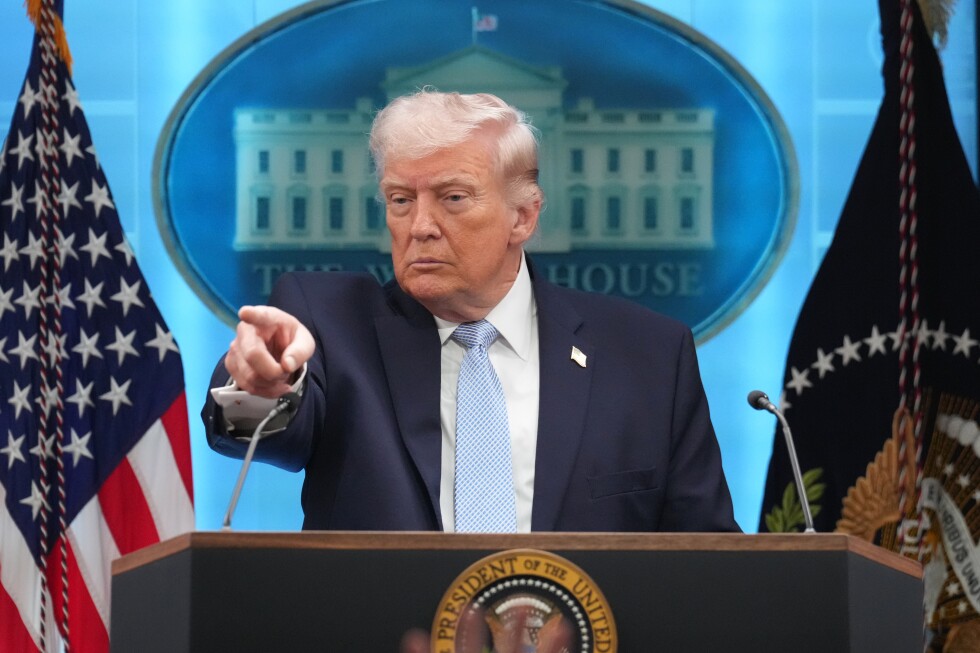
In his news conference on Monday, President Donald Trump issued a sweeping threat to destroy Iran’s power infrastructure and bridges, prompting concerns from legal experts that such actions could potentially constitute war crimes under international law.
Trump’s threats came as tensions escalated over shipping disruptions in the Strait of Hormuz, a critical maritime chokepoint through which approximately 20% of the world’s oil typically flows. The shipping halt has sent global oil prices soaring and contributed to stock market volatility.
The President set a Tuesday night deadline for Iran to reopen the strait, warning that failure to comply would result in widespread destruction of Iranian infrastructure. “We don’t care about precision, we don’t care about impact on civilians, we’re just going to take out all of Iranian power generating capacity,” according to Rachel VanLandingham, a Southwestern Law School professor and former U.S. Air Force judge advocate general, characterizing Trump’s approach.
When questioned about potential war crimes, Trump responded that he was “not at all” concerned, further stating that every power plant will be “burning, exploding and never to be used again,” though he added, “I hope I don’t have to do it.”
A spokesman for U.N. Secretary-General Antonio Guterres warned that targeting civilian infrastructure is prohibited under international law. “Even if specific civilian infrastructure were to qualify as a military objective,” Stephane Dujarric stated, an attack would still be forbidden if it risks “excessive incidental civilian harm.”
The conflict has intensified over the past month, with Trump escalating his rhetoric to include threats against Kharg Island, a critical hub for Iran’s oil industry, as well as desalination plants that provide drinking water. In a March 30 social media post, Trump warned of obliterating “all of their Electric Generating Plants, Oil Wells and Kharg Island (and possibly all desalinization plants!), which we have purposefully not yet ‘touched.'”
Michael Schmitt, professor emeritus at the U.S. Naval War College and international law professor at Britain’s University of Reading, described Trump’s statements as “clearly a threat of unlawful action.” While acknowledging that power facilities serving both civilian and military purposes can be legitimate targets under armed conflict laws, Schmitt emphasized that strikes must not “cause disproportionate harm to the civilian population, and you’ve done everything to minimize that harm.”
Military commanders should consider alternatives before destroying entire power plants, such as targeting substations or transmission lines feeding electricity to military bases, Schmitt noted. “If you look at the operation and you’ve got a valid military objective, but it’s going to cause harm to civilians and you go, ‘Whoa, that’s a lot,’ then you should stop.”
Political reactions have fallen along partisan lines. Republican Senator Joni Ernst of Iowa defended the President, saying Trump was “absolutely not” threatening a war crime, arguing that the infrastructure also serves military purposes and that “he’s using that leverage.” Meanwhile, Democratic Senator Chris Van Hollen of Maryland called the proposed actions a “textbook war crime.”
White House spokeswoman Anna Kelly deflected criticism by focusing on Iran’s record, stating, “The Iranian regime has committed egregious human rights abuses against its own citizens for 47 years, just murdered tens of thousands of protestors in January, and has indiscriminately targeted civilians across the region.”
Katherine Thompson, a senior fellow at the libertarian CATO Institute, suggested that any accountability would likely come through Congress rather than international courts. “This is the persnickety, inconvenient truth about international law: It only works if sovereign nations are willing to cede their sovereignty to a foreign body for accountability,” she explained.
Beyond legal considerations, military experts warn that strikes causing civilian harm could prove counterproductive for U.S. interests. VanLandingham cautioned that such actions risk alienating ordinary Iranians and providing propaganda opportunities for the Iranian regime.
“There’s a lot of violence that can still be justified as lawful, but lawful can still be awful,” VanLandingham said. “How far did that get us in Iraq? How far did that get us in Afghanistan? How far did that get us in Vietnam?”
As the Tuesday deadline approaches, global markets remain on edge, watching closely for any signs of military action or diplomatic resolution to the standoff over one of the world’s most strategic waterways.
Fact Checker
Verify the accuracy of this article using The Disinformation Commission analysis and real-time sources.

9 Comments
Destroying critical civilian infrastructure could indeed constitute a war crime. Targeting power plants and bridges that impact daily life seems disproportionate and raises serious legal concerns.
Agreed, Trump’s rhetoric seems reckless and could further escalate tensions with Iran. I hope the administration reconsiders such drastic measures that could harm innocent civilians.
Blocking key shipping routes like the Strait of Hormuz is a major disruption, but responding with mass destruction of infrastructure seems an extreme overreaction. There must be more measured diplomatic solutions.
Absolutely, escalating to potentially unlawful military actions is extremely concerning. The US should work within international law to address these issues responsibly.
As an energy industry observer, I’m worried about the volatility and potential for conflict in the region. Threats to infrastructure could severely impact global oil and gas supplies, with disastrous economic consequences.
You raise a good point. Any disruption to critical energy infrastructure would have widespread ramifications far beyond just the two countries involved. Cooler heads need to prevail here.
This is a very concerning situation. While Iran’s actions are problematic, the US response must remain within the bounds of international law to avoid further escalation and potential war crimes. Diplomacy should be the priority.
I agree. The rhetoric from the White House is extremely worrying and could lead to a disastrous conflict if not handled carefully. Cooler heads must prevail on all sides.
Destroying power plants and bridges seems like an excessive and illegal response, even if Iran is being provocative. I hope the US explores all diplomatic options before resorting to such extreme measures.