


Listen to the article
President Trump Banks on AI Sector to Drive Economic Growth
President Donald Trump is increasingly positioning the tech sector and artificial intelligence as cornerstones of his economic strategy, a shift highlighted during this week’s high-profile visit by Saudi Arabia’s Crown Prince Mohammed bin Salman to Washington.
The Saudi crown prince has pledged to invest $1 trillion with U.S. companies, largely focused on leveraging Saudi Arabia’s vast oil and natural gas reserves to transform the kingdom into a global AI data hub. This represents a significant increase from the $600 billion commitment made during Trump’s visit to Saudi Arabia in May.
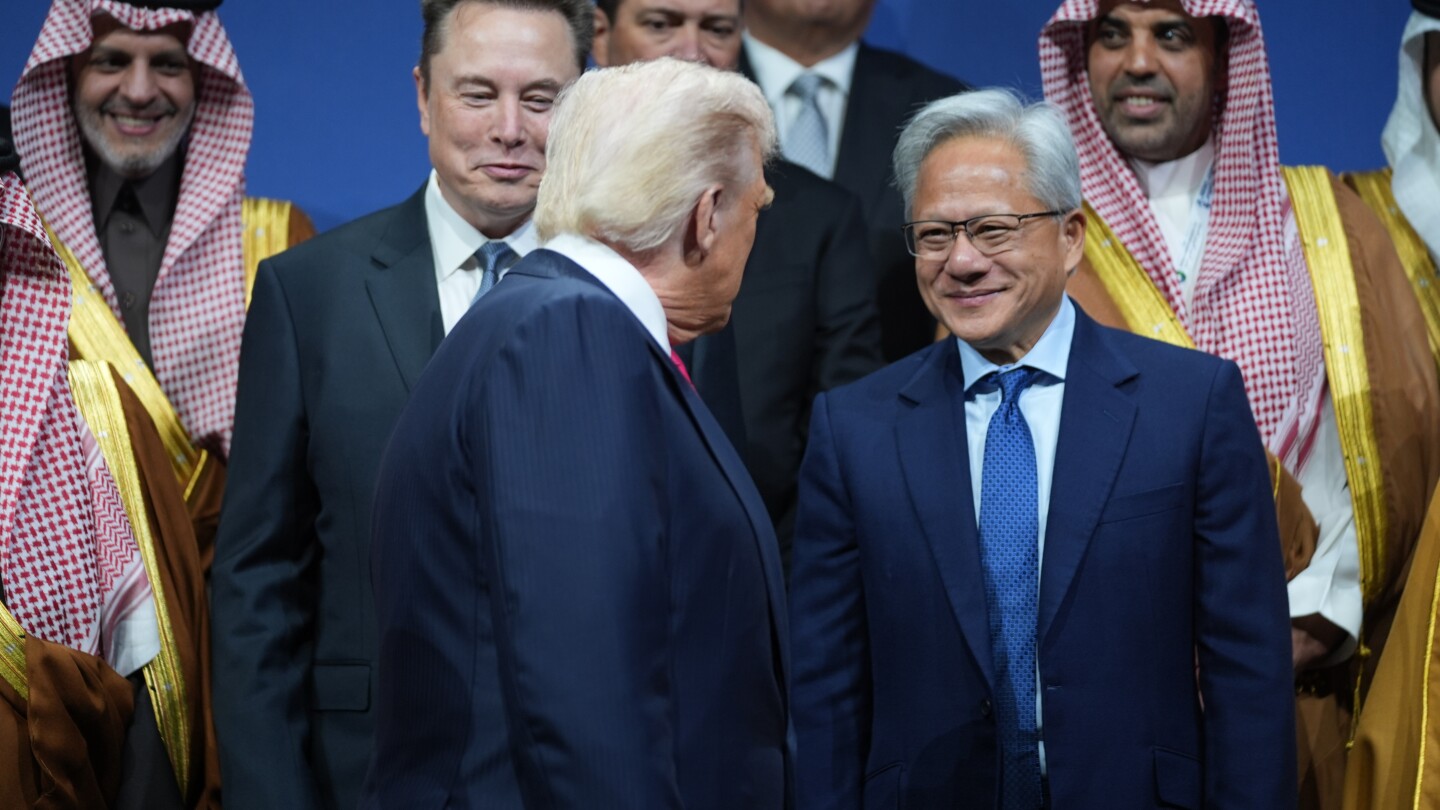
“We will work closely with friends and partners like those in this room to build the largest, most powerful, most innovative AI ecosystem in the world,” Trump declared at the U.S.-Saudi Investment Forum held at the Kennedy Center on Wednesday. Tech luminaries including Nvidia co-founder Jensen Huang and billionaire entrepreneur Elon Musk were prominently seated in the front row.
The president has been quick to take credit for new investments and stock market gains this year, both heavily influenced by the ongoing AI boom. However, this narrative comes with complications. While Trump frequently highlights how his tariff policies generate new investments, much of the incoming foreign capital is actually flowing toward data centers for AI computing infrastructure and the power facilities needed to operate them.
Market sentiment around AI experienced turbulence just a day before the forum, as leading stock indices fell Tuesday amid growing concerns that AI companies might be fueling a broader financial bubble. This volatility underscores potential political risks for Trump if the AI buildout further drives up utility prices for American consumers or if promised job creation fails to materialize.
The consultancy Oxford Economics released an analysis Tuesday noting that AI investments have helped offset “extreme uncertainty” in the U.S. economy this year—uncertainty they partly attribute to Trump’s tariff increases that have contributed to inflation and potentially slowed hiring. The firm cautioned that AI companies are increasingly relying on debt to fund sector growth, which could signal “a more vulnerable phase” for the boom in 2025.
During the forum, Trump revealed he’s already pushing for even greater Saudi investment, saying he lobbied Prince Mohammed backstage before their Kennedy Center appearance: “While we were taking the picture, I said, ‘Could you make it $1.5 trillion?’ So he’s got something to think about.”
When Blackstone Group CEO Stephen Schwarzman was asked about the summit’s most significant growth stories, the billionaire investor pointed to “AI and, you know, power.”
“Those are the two things that we spend a lot of time on,” Schwarzman explained. “At Blackstone, my company, we’re the largest developer, the largest owner, of data centers in the world. And this is a really explosive area.”
Tareq Amin, CEO of Humain, noted that his Saudi-backed AI company launched during Trump’s May visit to Saudi Arabia. The company identified an opportunity to build data centers and AI infrastructure by combining Saudi Arabia’s energy resources with U.S. technology.
“Yes, it is an ambitious, crazy thing,” Amin acknowledged with confidence.
Musk, whose xAI company developed the Grok chatbot, made characteristically bold predictions about AI’s societal impact, suggesting that AI and robots would eventually make work optional for humans, render money “irrelevant,” and eliminate poverty entirely. “AI and humanoid robots will actually eliminate poverty,” Musk claimed. “They will make everyone wealthy.”
Nvidia’s Huang offered a more measured assessment, noting: “Everybody’s jobs will be different. I think that that’s for sure.” His comments came shortly before the $4.5 trillion chip company announced its quarterly earnings Wednesday, which showed impressive growth with net income rising 65% from the previous year.
In a moment that highlighted American technological dominance, Trump asked Huang during the event whether any other country could compete with Nvidia’s cutting-edge Blackwell chip that powers much of today’s AI development.
“Not yet, sir,” Huang responded from the front row, underscoring the current U.S. advantage in the global AI race that Trump is increasingly tying to his economic agenda.
Fact Checker
Verify the accuracy of this article using The Disinformation Commission analysis and real-time sources.

8 Comments
The Trump administration’s emphasis on AI and tech innovation as drivers of economic growth makes sense, given the sector’s rapid advancements. However, ensuring broad-based benefits and not just gains for a few tech titans will be crucial.
Agreed. Careful policy and regulation will be needed to harness the power of AI while mitigating risks and distributing the rewards equitably.
The Saudi crown prince’s $1 trillion investment pledge highlights the global race to dominate the AI industry. It will be interesting to see how this plays out and what the geopolitical implications might be.
Absolutely. The intersection of energy, technology, and geopolitics is a complex and high-stakes arena. Responsible leadership and international cooperation will be critical.
The Trump administration’s focus on AI aligns with broader global trends, but the details of implementation and the distribution of benefits will be crucial. Oversight and public input will be essential.
While AI presents tremendous economic opportunities, we must also be mindful of the potential risks and ethical considerations. Ensuring AI development serves the public good should be a top priority.
Interesting to see the increased focus on AI and data infrastructure in the US-Saudi economic partnership. Leveraging Saudi energy resources to build a global AI hub could be a significant play, if executed well.
I’m curious to see how the AI ecosystem develops in Saudi Arabia and how it integrates with US tech leaders. The potential is there, but the geopolitical dynamics will be important to watch.