


Listen to the article
From the beginning of Trump’s first term, Emmanuel Macron believed he could effectively manage the American president. In private conversations with European leaders, Macron reportedly boasted of his ability to “handle” Trump through flattery and reasoning to keep him aligned with Western interests.
The strategy initially showed promise. Trump was treated to an elaborate red-carpet Bastille Day parade in Paris and publicly referred to the young French leader as a “great friend.” However, the relationship quickly evolved into a complex dynamic where cooperation and rivalry coexisted in equal measure.
Macron’s confrontational approach with Trump extends beyond mere personality clashes—it represents a broader geopolitical strategy. Each interaction serves Macron’s mission to demonstrate that Europe can assert itself as a global power. As Trump champions “America First,” Macron is working to define a “Europe First” vision: an alliance capable of standing firm against Washington, Moscow, or Beijing.
This vision has manifested in several recent diplomatic moves. While the U.S. plans to boycott the 2025 G-20 leaders’ summit in South Africa, Macron made a point of visiting Johannesburg, signaling his willingness to engage where Washington withdraws. Earlier this week, Ukrainian President Volodymyr Zelenskyy and Macron finalized a deal for Kyiv to purchase 100 French Rafale jets instead of American-made fighters, a decision that underscores France’s push for European defense autonomy.
The aircraft deal drew criticism from American officials, including former Rep. Mike Garcia, who characterized it as Zelenskyy “slapping the face of a nation that saved him” after receiving nearly $180 billion in American aid.
Macron further distanced himself from U.S. positions by recognizing a Palestinian state at the United Nations General Assembly despite American objections. Trump responded forcefully during his UN address, suggesting the move “honored Hamas” and would “encourage continued conflict.”
In June, Macron’s visit to Greenland sent another symbolic message to Trump, who has repeatedly expressed interest in purchasing the resource-rich island from Denmark, attracted by its oil, minerals, and strategic Arctic positioning.
“Macron has always seen himself in the European context as the leader of European defense efforts,” explained Liana Fix, senior fellow for Europe at the Council on Foreign Relations. Each of his moves asserts Europe’s autonomy and “at times seems designed to remind Trump that America no longer dictates every script.”
Despite their differences, Macron and Trump agree on one critical point: Europe must assume greater responsibility for its own defense. “Years ago, Macron proposed the idea that Europe should become more independent from the United States,” Fix noted. “Now, with the election of Donald Trump, the reaction of many Europeans was—perhaps Macron was right.”
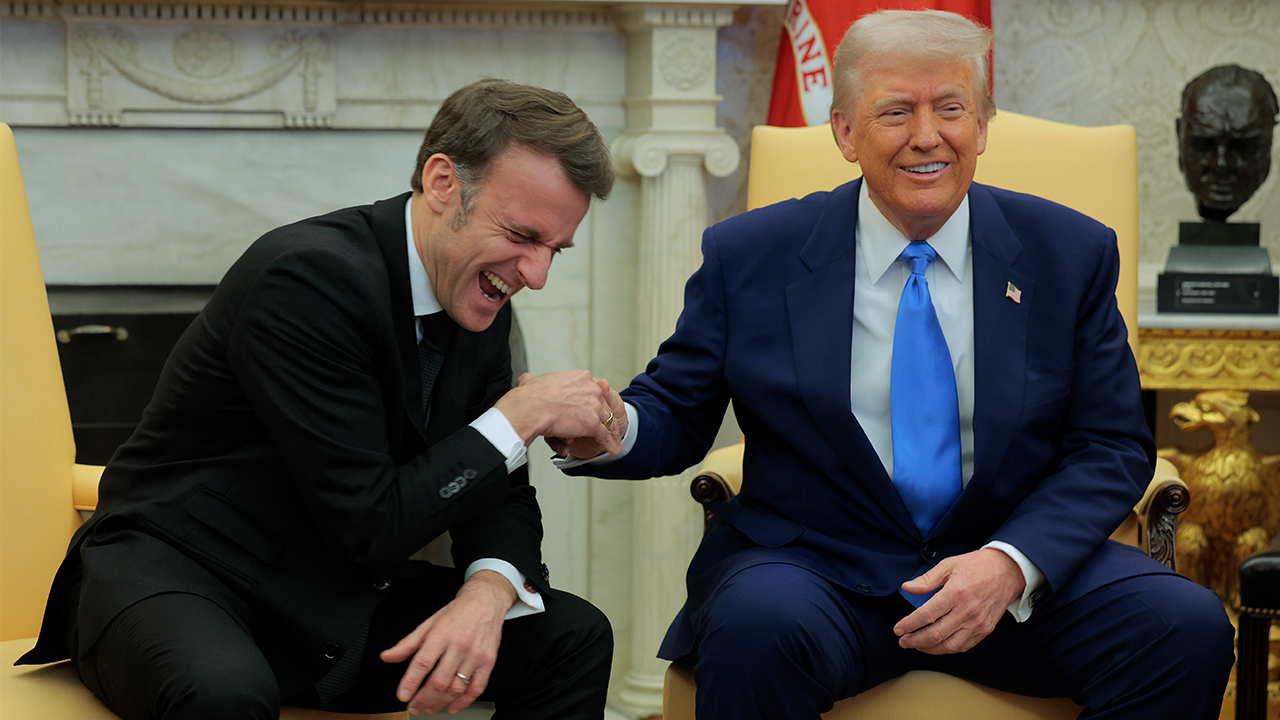
The relationship between the two leaders oscillates between camaraderie and confrontation. During a recent Fox News interview, Trump remarked, “I want to be able to get along with the world—not the French, though,” citing concerns about French tariffs. However, White House press secretary Karoline Leavitt maintained that “the relationship remains very strong” and that the two leaders speak “quite frequently.”
Their complex dynamic was on display during September’s UN General Assembly when Macron called Trump from the sidewalk to complain that the president’s motorcade was causing traffic congestion. France’s embassy in Washington playfully commented on social media: “It’s a good thing our presidents have each other on speed dial.”
With Germany distracted by domestic politics and Britain outside the European Union, Macron has seized the opportunity to position France as Europe’s voice of resolve, urging the continent to “think for itself” and invest in its own defense capabilities.
However, Macron’s vision faces practical limitations. Fix pointed out that Germany is projected to surpass France in defense spending, reaching 162 billion euros by 2029—a level France “simply doesn’t have the financial flexibility to match.”
Domestically, Macron’s authority is increasingly strained. His struggles to form a government and his party’s poor prospects in upcoming elections “inevitably weaken his hand abroad,” according to Fix.
Nevertheless, Macron remains one of the few European leaders willing to engage directly with Trump on the world stage. “It’s a difficult line for all European leaders,” Fix observed. “They have to charm Trump to fulfill Europe’s security needs, even though the Trump administration is hugely unpopular at home. They have to swallow some bitter pills.”
For Macron, navigating the delicate balance between charm and challenge has become central to his leadership—and the international stage on which he has chosen to define his presidency.
Fact Checker
Verify the accuracy of this article using The Disinformation Commission analysis and real-time sources.

14 Comments
This clash of ‘America First’ vs ‘Europe First’ visions highlights the growing tensions and potential for discord within the Western alliance. Maintaining unity and cohesion will be critical.
It will be crucial for Macron and other European leaders to strike the right balance between asserting European interests and preserving the transatlantic partnership.
Interesting to see the clash of national priorities between Trump’s ‘America First’ and Macron’s ‘Europe First’ vision. It highlights the growing tensions and competition for global influence between the U.S. and its European allies.
This power struggle could have significant implications for the future of Western leadership and international cooperation. It will be important to see how they navigate these competing interests.
The article raises valid points about Macron’s strategy to position Europe as a counterweight to U.S. influence. As a major power, Europe does need to assert its own interests on the global stage.
However, maintaining a united Western alliance against shared challenges like China’s rise will also be crucial. Finding the right balance between national priorities and collective interests will be a delicate challenge.
The article provides a thought-provoking analysis of the shifting power dynamics between the U.S. and Europe under Trump and Macron. It’s a complex issue without easy answers.
I hope that cooler heads can prevail, and that the transatlantic allies can find ways to work together constructively despite their differences.
Macron’s confrontational approach with Trump seems to reflect a broader shift in European attitudes. The days of Europe being content to follow America’s lead may be coming to an end.
It will be interesting to see how this dynamic evolves and impacts key geopolitical issues going forward, from trade to security to climate change.
The article provides a nuanced look at the complex relationship between the U.S. and Europe under the Trump and Macron administrations. This rivalry for global influence is an important trend to follow.
While competition between allies is natural, it’s crucial that they find ways to cooperate on shared priorities and present a united front against common challenges.
While I understand Macron’s desire to elevate Europe’s global role, I’m concerned that this confrontational approach with Trump could undermine Western unity at a time of increasing geopolitical uncertainty.
Finding ways to reconcile national priorities with collective interests should be the goal, rather than an ‘us vs them’ mentality between the U.S. and Europe.