


Listen to the article
Trump Adds Partisan Plaques to White House “Presidential Walk of Fame”
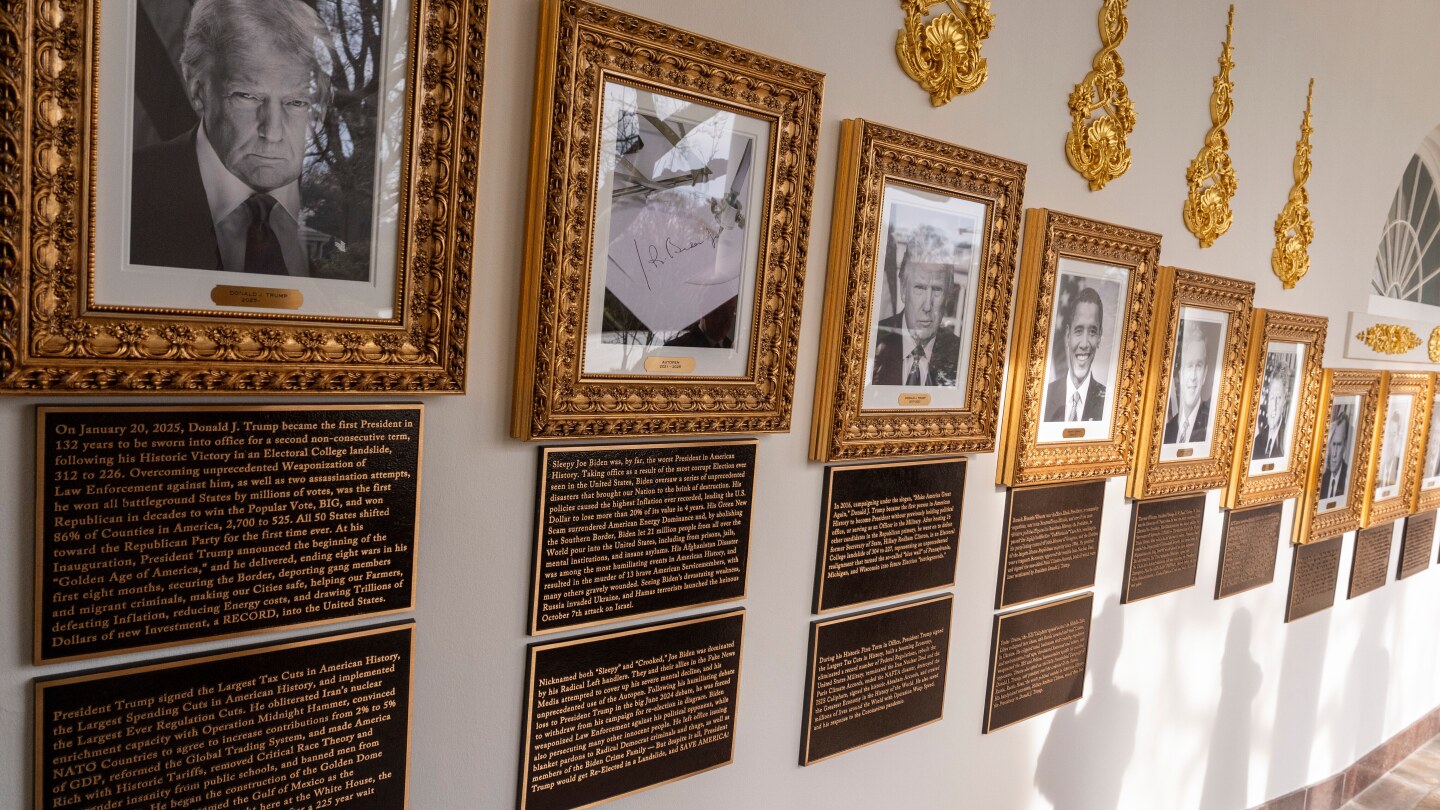
Months after President Donald Trump transformed a West Wing walkway into what he calls the Presidential Walk of Fame, he has installed a series of controversial and subjective plaques beneath the portraits, further personalizing the White House aesthetic while promoting his own interpretation of presidential history.
The new display, located along the colonnade connecting the West Wing to the White House residence, features gilded portraits of all former presidents alongside descriptions that bear Trump’s distinctive rhetorical style and partisan viewpoint.
An introductory plaque informs visitors that the exhibit was “conceived, built, and dedicated by President Donald J. Trump as a tribute to past Presidents, good, bad, and somewhere in the middle.” The text also declares that “the Presidential Walk of Fame will long live as a testament and tribute to the Greatness of America,” suggesting Trump intends the installation to remain after his presidency ends.
The plaque beneath President Joe Biden’s portrait repeats false claims about the 2020 election, stating Biden took office “as a result of the most corrupt election ever.” In reality, Biden defeated Trump in both the popular vote and Electoral College. The text also describes Biden as “by far, the worst president in American history.”
Former President Barack Obama, the nation’s first Black president, is labeled “one of the most divisive political figures in American history,” while the plaque for Republican President George W. Bush acknowledges his creation of the Department of Homeland Security but criticizes his decision to “start wars in Afghanistan and Iraq, both of which should not have happened.”
White House Press Secretary Karoline Leavitt defended the plaques, describing them as “eloquently written descriptions of each president” and noting that “many were written directly by the President himself.” When contacted, Biden had no comment on his plaque, and representatives for Obama and other former presidents did not immediately respond.
The placement of the exhibit is strategically significant. Located between the White House residence and the president’s usual entrance to the Oval Office, the walkway allows Trump to escort guests—including foreign dignitaries—past the display, presenting his personal narrative of presidential history.
This installation continues Trump’s broader efforts to reshape the White House according to his preferences. In September, he first established the Walk of Fame featuring the gilded portraits, notably excluding a traditional portrait of Biden and instead using an autopen, reflecting Trump’s frequent mockery of Biden’s age and questioning of his competence.
The Presidential Walk of Fame represents just one aspect of Trump’s larger campaign to leave his mark on the historic residence. Other projects include his redecoration of the Oval Office and the controversial razing of the East Wing to prepare for a massive ballroom addition.
Historians and presidential scholars have long noted that while each president customarily makes some changes to the White House during their tenure, Trump’s alterations—particularly those that promote partisan political messages—represent a significant departure from tradition. The White House has historically been viewed as a symbol of the presidency as an institution rather than as a platform for individual presidential commentary on predecessors.
The addition of these subjective plaques raises questions about the precedent being set for future administrations and whether subsequent presidents might continue or reverse Trump’s personalization of the historic residence’s public spaces.
Fact Checker
Verify the accuracy of this article using The Disinformation Commission analysis and real-time sources.

12 Comments
While I understand Trump’s desire to put his own mark on presidential history, the partisan nature of the plaques is troubling. The Presidential Walk of Fame should strive to be a nonpartisan tribute to the office, not a political statement.
Well said. The White House should avoid using such exhibits to advance a particular political agenda, no matter who is in power.
Regardless of one’s political views, altering historical records with partisan rhetoric sets a concerning precedent. The Presidential Walk of Fame should strive for impartiality and educational value.
Well said. Maintaining the integrity of presidential history should be the top priority, not advancing a political agenda.
Fascinating, if controversial, move by President Trump. While the partisan plaques seem inappropriate, I’m curious to learn more about his perspective on presidential history and legacy.
I agree, the partisan framing is concerning. Objective historical analysis would be a better approach for such an exhibit.
The Presidential Walk of Fame is an intriguing idea, but Trump’s partisan spin on it raises concerns about the proper role of the White House in shaping presidential history. A more balanced, educational approach would be preferable.
I agree. Maintaining objectivity and historical accuracy should be the top priority for such an exhibit in the people’s house.
While I appreciate Trump’s attempt to honor past presidents, the partisan nature of the plaques undermines the purpose of such an exhibit. I hope future administrations can restore a more objective and educational approach.
Exactly. Preserving the history and legacy of the presidency should transcend political divisions.
The Presidential Walk of Fame is an interesting concept, though Trump’s partisan spin on it raises questions about its purpose and legacy. I hope future administrations will maintain it in a more balanced way.
Agreed, this exhibit should aim for nonpartisanship and focus on the office of the presidency, not individual presidents’ political leanings.