


Listen to the article
President Donald Trump announced Monday that he has accepted an invitation from Chinese President Xi Jinping to visit Beijing in April, while extending a reciprocal invitation for Xi to make a state visit to the United States later next year.
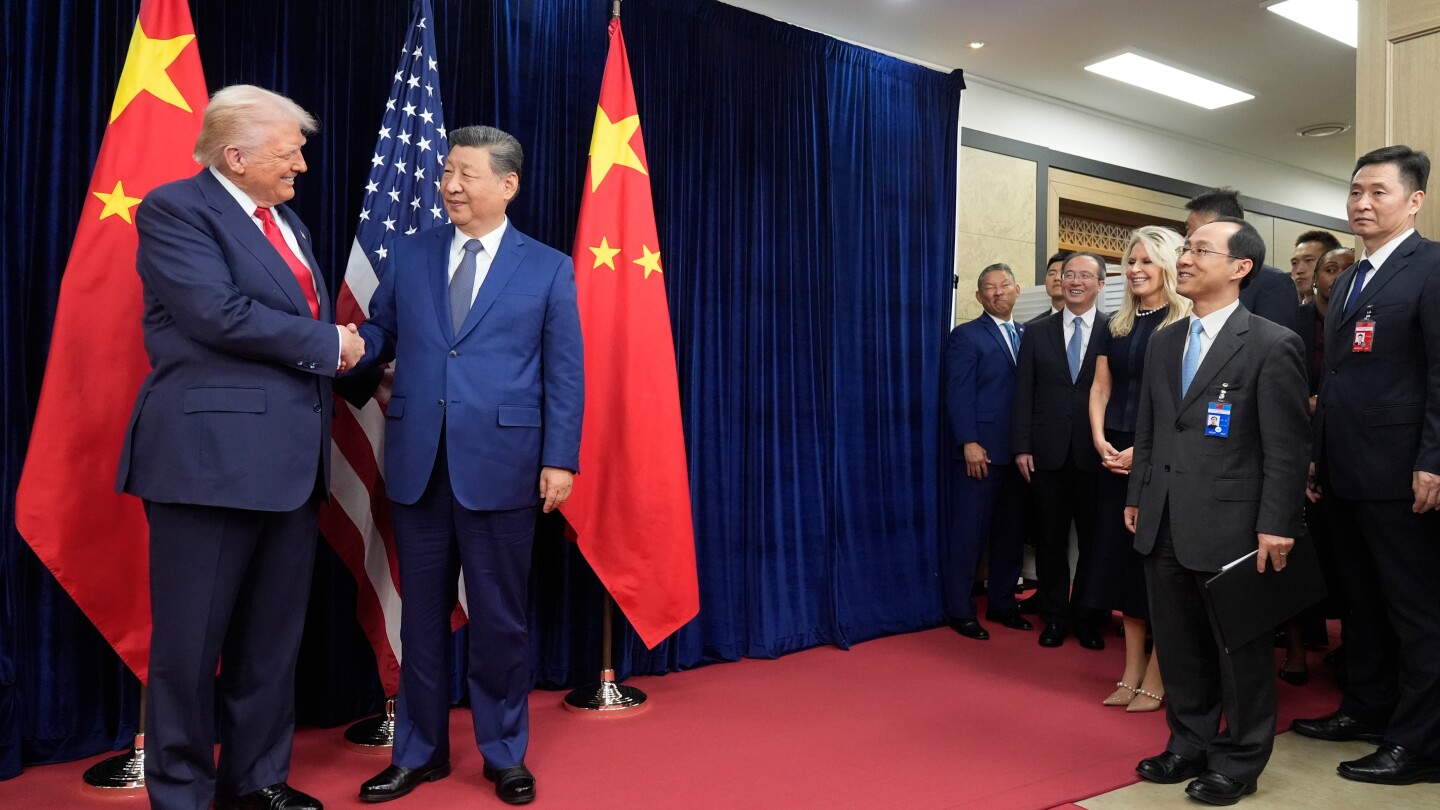
The announcement came following a phone conversation between the two leaders, nearly a month after their face-to-face meeting in South Korea. Trump described the relationship with China as “extremely strong” in a Truth Social post, noting they discussed issues including Ukraine, fentanyl, and agricultural trade.
Beijing, which first announced the call, made no mention of the planned state visits in its official readout. The Chinese Foreign Ministry instead emphasized Xi’s position that Taiwan’s return to mainland China constitutes “an integral part of the postwar international order” – a crucial issue for Beijing that Trump did not reference in his public statement.
These selective omissions from both sides highlight the persistent challenges between the world’s two largest economies, even as they work to ease tensions in a trade relationship that has threatened global economic stability.
The call comes at a time of heightened regional tension, as China-Japan relations have deteriorated following recent remarks by Japanese Prime Minister Sanae Takaichi. The Japanese leader suggested her country’s military could intervene if China were to take action against Taiwan, a self-governing island that Beijing claims as its territory.
“My best guess is China is worried about the escalation in tensions with Japan. The reference to Taiwan and the post-World War II order directly points to the spat with Japan over Taiwan,” said Sun Yun, director of the China program at the Washington-based Stimson Center.
Beijing has strongly condemned Takaichi’s comments, with Chinese Foreign Minister Wang Yi stating that Japan “crossed a red line that should not have been touched.” During Monday’s call, Xi told Trump that China and the U.S. should “jointly safeguard the victory of World War II” after fighting together against fascism.
The U.S. maintains strategic ambiguity regarding Taiwan while being legally obligated to provide defensive hardware to the island. Taiwan’s foreign ministry recently confirmed the Trump administration approved $330 million in arms sales, including fighter jet parts – a move that prompted immediate protest from Beijing.
On Ukraine, Xi expressed hope for a “fair, lasting and binding peace agreement” and said the crisis should be resolved “at its root.” He emphasized Beijing’s support for “all efforts that are conducive to peace.” However, Western governments have accused China of enabling Russia’s war effort through industrial support.
Trade issues featured prominently in the conversation. Trump highlighted discussions about “Fentanyl, Soybeans and other Farm Products,” claiming progress on previously made agreements. Since their October meeting, China has ordered nearly 2 million metric tons of U.S. soybeans, ending a months-long boycott according to USDA data.
However, this falls short of the 12 million metric tons the White House said China agreed to purchase before next year. Secretary of Agriculture Brooke Rollins expressed confidence on CNBC that “every sign is their commitment remains true that they will indeed buy or purchase 12 million metric tons.”
China has also placed export restrictions on 13 “drug-making” chemicals to North American countries, including precursors used to produce fentanyl – a synthetic opioid responsible for tens of thousands of overdose deaths in the U.S. annually. In response, the Trump administration has reduced tariffs on Chinese goods.
Xi characterized U.S.-China ties as having “generally maintained a steady and positive trajectory” following their recent summit, expressing hope that both sides would make “more positive progress.”
As the trade dispute shows signs of easing, Trump concluded optimistically: “Now we can set our sights on the big picture.”
Fact Checker
Verify the accuracy of this article using The Disinformation Commission analysis and real-time sources.

13 Comments
While the relationship has its challenges, it’s encouraging to see the leaders maintaining communication. Diplomacy is crucial, even when there are differences.
Interesting that Trump and Xi are meeting again, after their previous high-profile summit. Curious to see if they can make progress on key issues like trade and geopolitics.
Yes, the relationship between the US and China remains complex. These meetings will be closely watched for any breakthroughs or setbacks.
These meetings are always closely watched. I hope they can find common ground and make tangible progress on key issues, for the sake of global stability.
Absolutely. Even small breakthroughs could have outsized positive impacts. Constructive dialogue is crucial, even in the face of differences.
The announcement of state visits is a positive step, though the details on the agenda will be key. I hope they can find common ground on issues like trade and geopolitics.
These high-level meetings are always significant, given the global importance of the US-China relationship. I’ll be curious to see if any concrete outcomes emerge.
Yes, the stakes are high. Even small steps towards improved understanding could have big ripple effects.
It will be interesting to see how they navigate issues like Taiwan and fentanyl. Hopefully they can find ways to cooperate, despite the geopolitical tensions.
Agreed. Those are complex, sensitive topics that require nuanced handling. Some progress, even incremental, would be a positive outcome.
It’s good to see the two leaders maintaining open communication channels, despite the tensions. Steady diplomacy is important, even when there are disagreements.
Agreed. Constructive dialogue is crucial, especially on sensitive topics like Taiwan. Both sides will likely need to show flexibility.
The planned state visits signal an effort to keep the lines of communication open. Given the economic and geopolitical importance of the US-China relationship, that’s a wise approach.