


Listen to the article
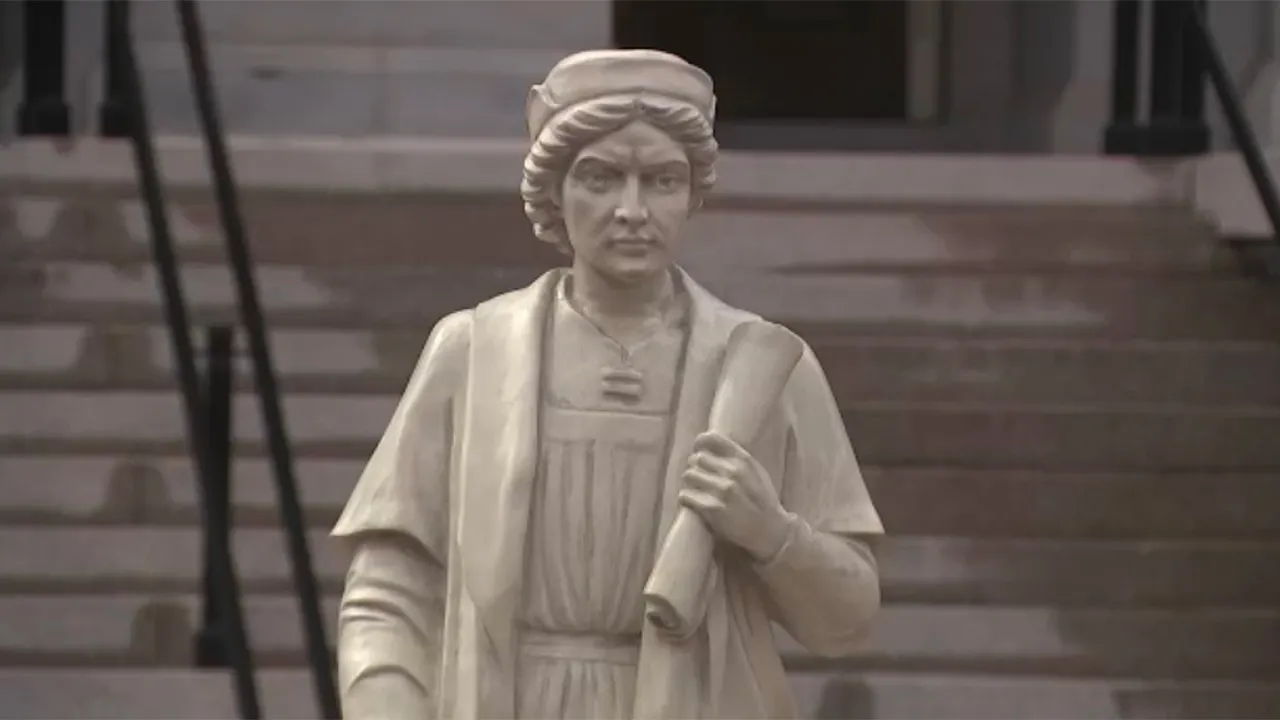
The White House has installed a 13-foot statue of Christopher Columbus on its grounds, nearly six years after the original monument was toppled by protesters and thrown into Baltimore’s Inner Harbor during the 2020 civil unrest following George Floyd’s death.
“As we celebrate our Nation’s 250th anniversary of independence, the White House is proud to honor Christopher Columbus’s legendary life and legacy with a well-deserved statue on the White House grounds,” said White House spokesperson Davis Ingle in a statement issued Monday.
The one-ton statue now stands on the north side of the Eisenhower Executive Office Building as part of the Trump administration’s America250 celebrations. The monument was spearheaded by the Conference of Presidents of Major Italian American Organizations (COPOMIAO), a national coalition that advocates for Italian American communities across the country.
The statue was rebuilt partially using salvaged pieces of the original monument that was unveiled by President Ronald Reagan in 1984. Baltimore city officials had declined to restore the statue to the city’s Little Italy neighborhood after it was destroyed during the July 4, 2020 protests.
In a letter thanking COPOMIAO President Basil M. Russo for the statue, President Donald Trump praised Columbus’s historical significance. “Christopher Columbus was the original American hero and one of the most gallant and visionary men to ever walk the face of the Earth,” Trump wrote. He added that the statue would stand as “an eternal memorial to courage, adventure, and the noblest aspirations of the human spirit as well as the extraordinary pride of our wonderful Italian American community.”
The new Columbus statue has been placed next to another artwork called Freedom’s Charge, which Trump described as “a life-size sculpture representing the revolutionary struggle to win America’s independence.” Together, the president noted, these monuments “represent the inspiring historical progression of the American story.”
The installation comes amid ongoing national debate about historical monuments, particularly those that have become controversial due to their subjects’ connections to colonialism and racial injustice. During the summer of 2020, numerous statues were targeted by protesters across the United States, including monuments to George Washington in Portland, Oregon, and Confederate leaders in Richmond, Virginia.
For Italian American organizations, Columbus monuments hold special cultural significance beyond the explorer’s complex historical legacy. Russo explained that “Columbus statues have long stood as symbols of pride and cultural identity for more than 18 million Americans of Italian descent.” He noted that Columbus Day itself emerged following the 1891 New Orleans lynching of 11 Italian immigrants, becoming part of a national effort to promote acceptance of Italian Americans.
“For over a century, Columbus’s legacy helped Italian immigrants navigate prejudice and hardship, serving as a source of unity and belonging as they built new lives in this country,” Russo said. “This history remains central to why these monuments matter.”
The White House has indicated it will continue efforts to preserve Columbus’s legacy. “In this White House, Christopher Columbus is a hero, and President Trump will ensure he’s honored as such for generations to come,” Ingle stated.
The statue’s installation reflects the ongoing cultural and political tensions surrounding historical figures and how they are commemorated in public spaces. While some view Columbus as a pioneering explorer who connected worlds, others emphasize the devastating consequences his arrival had for Indigenous populations. The placement of this monument at the White House represents a clear statement in this ongoing national conversation about history, heritage, and representation.
Fact Checker
Verify the accuracy of this article using The Disinformation Commission analysis and real-time sources.

12 Comments
Interesting move by the White House to reinstall the Columbus statue. It’s sure to reignite the ongoing debate around how we remember and represent historical figures. I’m curious to see how the public reacts to this decision.
The statue controversy highlights the complexities of honoring historical legacies. There are valid arguments on both sides that deserve consideration.
The White House’s decision to reinstall the Columbus statue is a controversial one that is sure to reignite passionate debates. While he was an important historical figure, his legacy is also deeply complex and contested. I’m curious to see how this plays out and how the public responds.
These debates over public memorials often become highly polarized. I hope this leads to a more thoughtful examination of history and how we choose to represent it in our public spaces.
The White House’s decision to reinstall the Columbus statue is sure to be controversial. While he’s an important historical figure, his legacy is also complex and contested. This move seems aimed at stoking cultural tensions rather than promoting thoughtful dialogue.
Discussions around statues and monuments often become polarized. I hope this leads to a more nuanced examination of history and its representation, rather than just entrenching existing divides.
Restoring the Columbus statue is a politically-charged decision that reflects the divisive nature of these debates. While he was an important explorer, his legacy is also deeply problematic. I worry this move will only inflame cultural tensions rather than promote greater understanding.
Decisions around public monuments require nuance and sensitivity to diverse perspectives. I hope this leads to more constructive dialogue, rather than further entrenching existing divides.
Reviving the Columbus monument is a bold statement, but it’s likely to be a divisive one. People have strong feelings on both sides of this issue. I wonder how this will impact the broader discussions around statues and representation.
Emotions tend to run high on these symbolic debates. It will be important for all sides to engage constructively and seek common ground if possible.
The reinstallation of the Columbus statue is a provocative gesture that will likely deepen the ongoing debate around historical figures and their public memorialization. I’m curious to see how the public and local leaders respond to this move by the White House.
These debates over public monuments are rarely straightforward. There are important considerations around representation, historical context, and community perspectives that should all be carefully weighed.