


Listen to the article
Democrats Surge in Off-Year Elections as Economic Concerns Reshape Political Landscape
In the wake of Donald Trump’s return to the White House, 2025’s off-year elections defied expectations of a quiet political season, instead delivering a series of dramatic developments that could reshape the 2026 midterm landscape.
Far from the political lull many anticipated following last year’s exhausting presidential race, Democrats found unexpected momentum while Republicans struggled to capitalize on their 2024 victories. The results suggest a rapidly shifting political environment just months into Trump’s second term.
Democrats began overperforming in special elections just eight days into Trump’s presidency when Mike Zimmer flipped a Republican state Senate seat in Iowa—a district Trump had carried by 21 points only months earlier. This victory triggered a wave of Democratic success in special elections throughout the year.
“Since the president was inaugurated back in January, there’s been 45 elections on the ballot. Democrats have overperformed in all of them to the tune of about 16 percentage points on average,” Democratic National Committee chair Ken Martin told Fox News Digital ahead of November’s elections.
The affordability crisis emerged as the dominant issue driving voter behavior. While economic concerns had boosted Trump and Republicans in 2024, helping them reclaim the White House and Senate majority, these same concerns worked against them a year later as inflation persisted.
“Voters are remarkably consistent in their priorities: the economy, the economy, the economy,” noted Wayne Lesperance, president of New England College. “When you win an election, voters expect you are going to do something to address those concerns and the reality is that the questions of affordability remain unchanged in their importance to the everyday voter.”
This economic discontent translated into sweeping Democratic victories in gubernatorial races in New Jersey and Virginia, along with significant wins in battleground states Georgia and Pennsylvania, plus solidly blue New York City and California.
In Virginia, Democrats overcame a potential scandal when attorney general nominee Jay Jones’ controversial text messages from 2022 came to light. Jones had compared then-Virginia House Speaker Todd Gilbert to Adolf Hitler and Pol Pot, suggesting he would shoot the GOP lawmaker in the head. While Republicans tried leveraging the incident against Democratic gubernatorial candidate Abigail Spanberger, the strategy ultimately failed. Spanberger defeated Republican Winsome Earle-Sears by 15 points, while Jones himself won by 6 points.
The year also saw an unprecedented redistricting battle as President Trump urged Republican-controlled states to redraw congressional maps to protect the GOP’s slim House majority ahead of the 2026 midterms. Trump specifically targeted Texas, saying in July: “Texas will be the biggest one. And that’ll be five.”
The redistricting push triggered immediate Democratic resistance. Texas Democratic lawmakers broke quorum for two weeks, fleeing the state to delay passage of the redistricting bill. Meanwhile, California voters passed Proposition 50, allowing the Democratic-dominated legislature to temporarily take control of congressional map drawing from the state’s nonpartisan commission—a move expected to create five more Democratic-leaning districts.
The redistricting battle spread to multiple states, with Missouri, North Carolina and Ohio drawing new maps while Indiana, Florida and Kansas considered similar moves. Democrats in Illinois, Maryland and Virginia have also begun redistricting efforts.
A federal court dealt Republicans a significant setback when two judges ruled Texas couldn’t use its newly drawn maps in 2026. Republicans plan to appeal to the Supreme Court. In Utah, a district judge rejected a Republican-drawn map, instead approving one creating a Democratic-leaning district.
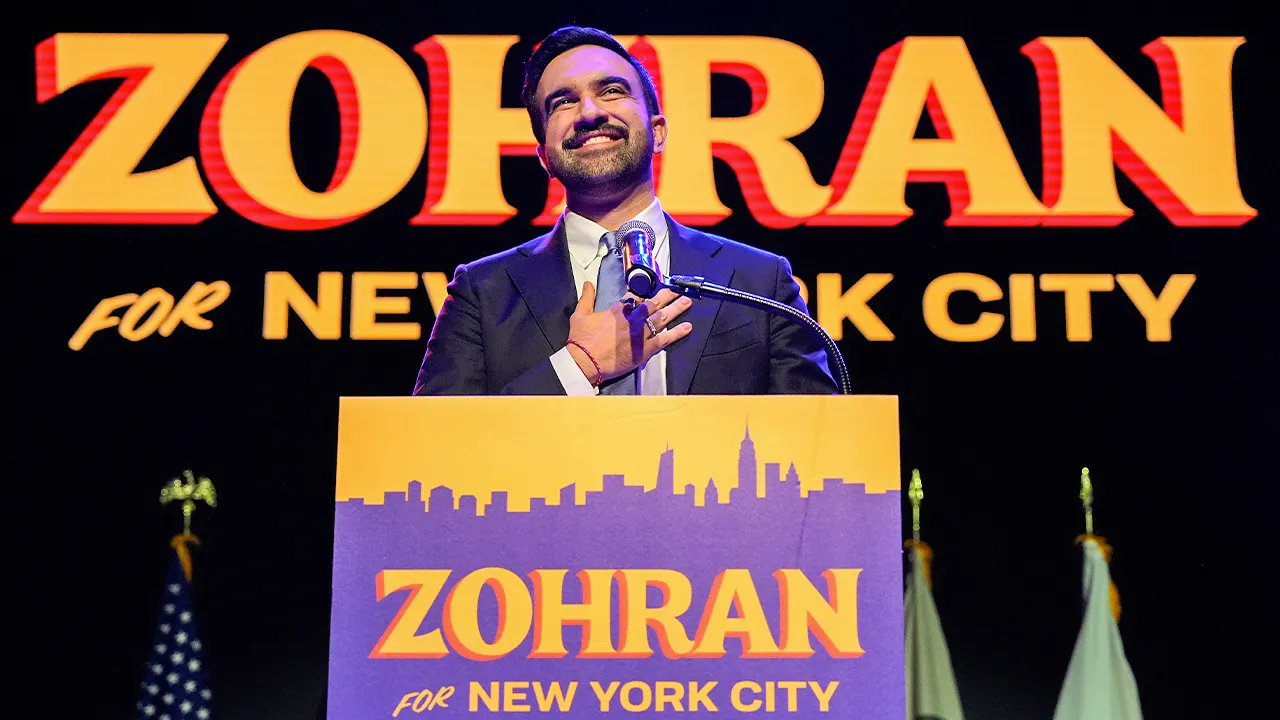
Perhaps the most surprising political earthquake came from New York City, where 34-year-old socialist state lawmaker Zohran Mamdani secured the Democratic nomination for mayor over frontrunner Andrew Cuomo and nine other candidates in June, before winning the general election by 9 points in November.
Republicans initially attempted to use Mamdani’s victory to paint all Democrats as far-left radicals. The National Republican Congressional Committee claimed “the new face of the Democrat Party just dropped, and it’s straight out of a socialist nightmare.” However, this strategy was undercut when Trump warmly welcomed Mamdani to the White House in late November.
As the political landscape continues to evolve, Democrats maintain that Republicans’ attempts to create boogeymen are merely a distraction from their inability to address voters’ economic concerns—a strategy that appears to be working as Democrats prepare for the crucial 2026 midterms with unexpected momentum.
Fact Checker
Verify the accuracy of this article using The Disinformation Commission analysis and real-time sources.

11 Comments
The Democrats’ overperformance in special elections is certainly noteworthy. I wonder what specific factors are contributing to their gains, especially in areas that Trump carried previously. Worth keeping an eye on as the campaign season heats up.
The Democrats’ apparent overperformance is an interesting data point, though I’d caution against drawing too many conclusions this early. Special elections don’t always translate to broader trends. Still, worth keeping an eye on as the campaign cycle progresses.
The article raises some thought-provoking questions about the evolving political landscape. I’ll be curious to see how the parties position themselves to address the economic concerns that seem to be resonating with voters. Flexibility and responsiveness could be key.
Absolutely. Adapting to shifting voter priorities will be crucial for both parties as they chart their paths forward. Careful analysis of the underlying trends will be essential.
Rapid political shifts can create uncertainty, but also opportunity. The article suggests a fluid environment where the traditional playbook may not apply. I’m curious to see how the parties adapt their strategies in response.
Agreed. Flexibility and an ability to read the electorate will likely be crucial for both sides as they position themselves for the 2026 races.
The article highlights some intriguing political dynamics at play. I’m curious to hear more analysis on the specific issues and concerns driving voter sentiment in these special elections. Understanding that could provide valuable insights.
Agreed. A deeper dive into the key factors shaping the electorate’s priorities would help shed light on the broader implications for the 2026 campaign season.
While it’s still early, the Democrats’ momentum is certainly eye-catching. I’ll be interested to see if this translates into broader gains in the 2026 midterms, or if it proves to be more of a temporary shift.
Fascinating developments in the 2025 campaign. I’m curious to see how the political landscape continues to shift, especially with the Democrats’ recent momentum. Curious to hear more on the potential drivers behind these trends.
The economic concerns mentioned seem to be playing a key role. It will be interesting to see how the parties address these issues leading up to the 2026 midterms.