


Listen to the article
Tennessee Judge Blocks National Guard Deployment in Memphis, Grants Appeal Window
A Tennessee judge has temporarily blocked the use of the National Guard in Memphis as part of a federal crime-fighting initiative, while giving state officials five days to appeal the decision.
Davidson County Chancellor Patricia Head Moskal ruled Monday in favor of Democratic state and local officials who argued that Republican Governor Bill Lee overstepped his authority by deploying Guard troops without proper legal justification or local request.
The lawsuit contended that under Tennessee law, the governor cannot deploy the National Guard to address civil unrest except in cases of rebellion or invasion, and even then, such action would require approval from state lawmakers. Plaintiffs further argued that deployment for scenarios like a “breakdown of law and order” requires a formal request from local government officials.
In her ruling, Judge Moskal determined the plaintiffs demonstrated “they are suffering or will suffer irreparable harm” without an injunction and have a strong likelihood of success in their claims that the deployment violates Tennessee’s military code. However, she paused her order for at least five days to allow the state to seek an appeal.
“The injunction does not take effect immediately, and the state has a chance to seek leave to appeal,” Shelby County Mayor Lee Harris, one of the plaintiffs, wrote on social media platform X. “However, this is a positive step toward ensuring the rule of law applies to everyone, including everyday Tennesseans and even the Governor.”
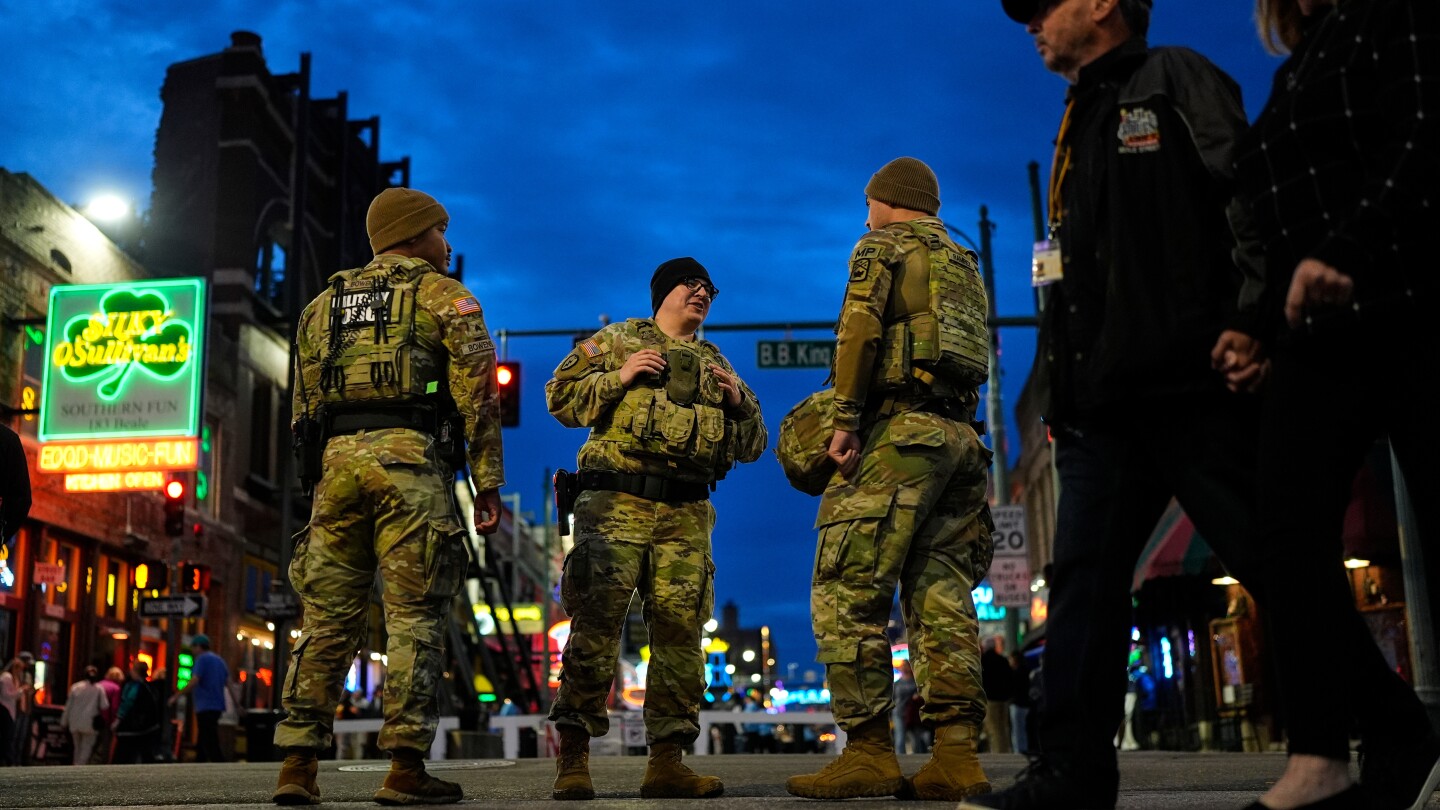
Since October 10, National Guard troops have maintained a visible presence in Memphis neighborhoods and commercial districts, including near the downtown Pyramid. Wearing camouflage and protective vests marked “military police,” the armed personnel have been patrolling the city, though officials have emphasized they possess no arrest authority.
The Guard deployment is part of the broader “Memphis Safe Task Force” established by President Donald Trump in September, which includes personnel from multiple federal, state, and local law enforcement agencies. According to officials, the task force has conducted more than 2,500 arrests since its inception, targeting offenses ranging from drug and weapons violations to immigration infractions and homicides.
Memphis has long struggled with elevated rates of violent crime, including assaults, carjackings, and homicides. While recent statistics show improvement in several categories, including murders, violence remains a significant concern for residents and officials alike.
Memphis Mayor Paul Young, a Democrat who is not involved in the lawsuit, has stated he never formally requested National Guard assistance. After Trump’s announcement and Governor Lee’s agreement to the deployment, Young indicated he wanted the task force to focus specifically on targeting violent offenders. Approximately 150 Guard members have participated in the operation.
Governor Lee has defended his decision, with his office stating, “As the commander-in-chief, Gov. Lee has the authority to authorize the Title 32 strategic mission to Memphis.” His spokesperson, Elizabeth Lane Johnson, expressed confidence that “the court will uphold the Governor’s constitutional authority.”
The legal battle highlights tensions between state and local control over law enforcement resources, particularly in cities facing persistent crime challenges. It also underscores divisions between Democratic local officials and the Republican-controlled state government regarding appropriate crime-fighting strategies.
Skye Perryman, president and CEO of Democracy Forward, whose legal team represents the plaintiffs, called the ruling “a powerful affirmation that no one—not a president, not a governor—is above the law.”
As the case moves toward potential appeal, Memphis residents continue to witness the unusual presence of military personnel on their streets, part of a controversial approach to urban crime reduction that has raised significant legal and constitutional questions about the proper role of military forces in civilian policing.
Fact Checker
Verify the accuracy of this article using The Disinformation Commission analysis and real-time sources.

16 Comments
The tension between state and local control over the National Guard is a significant issue that this case is grappling with. It will be interesting to see how it is ultimately resolved.
This ruling seems to indicate the judge believes the governor overstepped their authority. The appeal will be crucial in determining the final outcome.
This is an interesting legal case regarding the governor’s authority to deploy the National Guard. It will be important to see how the appeal process plays out and whether the judge’s ruling is upheld.
The judge’s decision to temporarily block the National Guard deployment seems reasonable given the concerns raised about the governor overstepping their legal authority.
This case highlights the ongoing debate over the appropriate use of the National Guard for domestic law enforcement purposes. The legal arguments will be worth following closely.
The judge’s decision to block the deployment, even temporarily, suggests they are skeptical of the governor’s actions. The appeal will be an important test.
This case touches on the delicate balance of power between state and local governments when it comes to the use of the National Guard. The legal arguments will be worth following.
The judge’s decision to grant a temporary injunction suggests they see merit in the plaintiffs’ claims. The appeal process will be crucial in determining the final outcome.
It’s good to see the court taking a close look at the legality of the National Guard deployment here. Maintaining the proper balance of power between state and local authorities is crucial.
This case highlights the complexities involved when it comes to the use of the National Guard for law enforcement purposes. The legal arguments will be worth following.
The legal arguments around when the National Guard can be deployed and the roles of state versus local government will be important to follow here. This case could set an important precedent.
I’m curious to see if the governor is able to successfully appeal the judge’s ruling or if the plaintiffs’ claims ultimately hold up.
The legal complexities around the deployment of the National Guard for civilian law enforcement are on full display in this case. The outcome could set an important precedent.
This ruling indicates the judge believes the plaintiffs have a strong case against the governor’s actions. It will be interesting to see how the appeal plays out.
This ruling puts the spotlight on the limits of a governor’s authority to deploy the National Guard, especially when local officials object. The appeal process will be an important test.
The judge’s decision to grant a temporary injunction suggests they believe the plaintiffs have a strong case. The final outcome could have broader implications.