


Listen to the article
Virginia Voters to Decide on Crucial Redistricting Referendum with National Implications
Virginians head to the polls Tuesday to vote on a congressional redistricting referendum that could significantly alter the balance of power in the U.S. House of Representatives during this year’s midterm elections.
If passed, the ballot measure would temporarily shift redistricting power from Virginia’s current nonpartisan commission to the Democrat-controlled state legislature through the 2030 election. Political analysts project this could result in a 10-1 advantage for Democrats in Virginia’s congressional delegation, a substantial increase from their current 6-5 edge.
The referendum represents the latest battleground in an escalating nationwide redistricting struggle between Democrats and Republicans. With Democrats potentially gaining four additional House seats in Virginia, the outcome could prove decisive in determining which party controls Congress after the midterms.
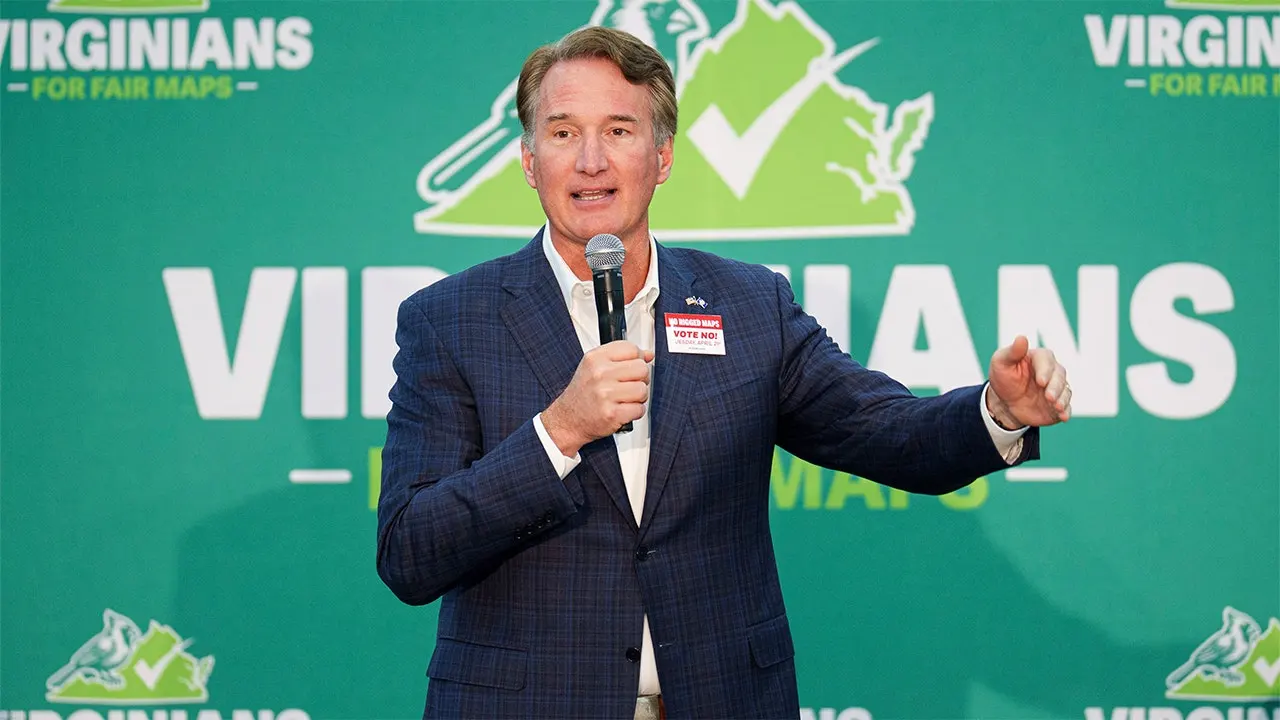
“It’s the most partisan map in America,” former Republican Governor Glenn Youngkin told supporters during his final campaign stop in Leesburg, a northern Virginia town on the outskirts of Washington, D.C.’s suburbs. Youngkin and former Virginia Attorney General Jason Miyares have been leading Republican opposition to the ballot initiative, crisscrossing the state to rally voters against what they characterize as an “unconstitutional power grab.”
Miyares was particularly blunt in his assessment, telling a crowd that the Democrats’ proposed map is one that “you draw when you’re drunk with power.” Speaking with Fox News Digital, he charged that “what they are doing is immoral” and accused Democrats of attempting to disenfranchise millions of Virginians through gerrymandering.
The opposition campaign has also received support from high-profile national Republicans. President Donald Trump took to the airwaves on a popular Virginia-based conservative talk show and later collaborated with House Speaker Mike Johnson to urge voters to defeat the referendum. Trump warned that “if they get these additional seats, they’re going to be making changes at the federal level.”
Democrats counter that the redistricting effort represents a necessary response to similar Republican-led initiatives in other states. They argue their proposal offers a temporary solution to balance partisan gerrymandering already implemented by Republicans at Trump’s urging.
“By voting yes, you have the chance to do something important — not just for the Commonwealth, but for our entire country,” former President Barack Obama stated in a video released before the final day of early voting. “By voting yes, you can push back against the Republicans trying to give themselves an unfair advantage in the midterms.”
Critics have noted the apparent contradiction between Obama’s support for the Virginia measure and his previous statements opposing political gerrymandering. Republican groups have weaponized these past comments in their campaign materials, highlighting Obama once saying: “Because of things like political gerrymandering, our parties have moved further and further apart, and it’s harder and harder to find common ground.”
Democratic Governor Abigail Spanberger has become a primary target of Republican attacks on the referendum. Youngkin and other Republican leaders have accused her of a “bait and switch,” claiming she initially expressed no interest in redistricting before making it a priority upon taking office.
Spanberger has defended her position, saying in an advertisement that the referendum “is directly in response to what other states decide to do and a president who says he’s quote entitled to more Republican seats before this year’s midterms. Our approach is different. It’s temporary. It preserves Virginia’s fair redistricting process into the future.”
The financial disparity between campaigns has been substantial. Pro-referendum groups have outraised and outspent their opposition by approximately three-to-one, with Virginians for Fair Elections significantly outpacing Virginians for Fair Maps in fundraising. Much of this funding has come from nonprofit public policy organizations that are not required to disclose their donors.
Despite this financial advantage, recent polling suggests support for the ballot initiative is only slightly ahead of opposition amid a surge in early voting, which concluded Saturday.
The Virginia referendum reflects a broader national pattern of redistricting battles. California voters passed Proposition 50 last November, temporarily bypassing the state’s nonpartisan redistricting commission to give the Democratic-dominated legislature control over congressional maps. This is expected to yield five more Democratic-leaning districts, directly countering Republican redistricting efforts in Texas.
Republican-controlled states including Missouri, Ohio, and North Carolina have drawn new maps as part of Trump’s redistricting initiative. However, Republicans have faced setbacks in Utah, where a district judge rejected a GOP-drawn map, and in Indiana, where the state Senate defied Trump by rejecting a redistricting bill.
Florida is poised to become the next redistricting battleground, with Republican Governor Ron DeSantis and the GOP-dominated legislature planning to pursue an additional three to five right-leaning seats during an upcoming special legislative session.
As these partisan redistricting wars continue, the Supreme Court looms large over the process. An upcoming ruling in Louisiana v. Callais could potentially overturn key provisions of the Voting Rights Act, potentially leading to the redrawing of numerous majority-minority districts across the country—a change that would likely favor Republicans.
Fact Checker
Verify the accuracy of this article using The Disinformation Commission analysis and real-time sources.

16 Comments
The partisan nature of this redistricting proposal is concerning. While I understand the political motivations, I hope Virginia’s leaders can find a way to depoliticize the process and put the interests of voters first.
I share your hope. Redistricting should be about ensuring fair and equal representation, not about giving one party an advantage. It’s a complex issue, but the democratic process must be protected.
Redistricting is a complex issue with significant implications. While I understand the Republican concerns about a potential Democratic advantage, I would encourage all sides to focus on upholding democratic principles and protecting the integrity of the electoral process.
Well said. Partisan politics should not override the fundamental right of citizens to have a fair say in how they are represented. I hope cooler heads prevail.
Redistricting is a complex and often politically charged issue. While I understand the concerns raised by Republicans, I would encourage all parties to prioritize fairness, transparency, and the will of the voters over partisan interests.
I agree completely. Redistricting should be a nonpartisan process that ensures fair and equal representation. It’s a crucial issue that deserves careful consideration by all Virginians.
This appears to be a high-stakes battle over the future political landscape in Virginia and potentially the nation. I’ll be curious to see how Virginians weigh the arguments and make their decision at the ballot box.
You raise a good point. Redistricting can have far-reaching consequences, and voters will need to carefully evaluate the pros and cons before casting their ballots.
Redistricting is a complex and often contentious issue. While I understand the Republican concerns, I would urge all parties to prioritize fairness, transparency, and the will of the voters over political expediency.
Agreed. Redistricting should be a nonpartisan process that ensures equal representation. I hope Virginia can find a balanced approach that instills confidence in the democratic process.
This is a concerning development. Redistricting should be a fair, nonpartisan process that reflects the will of the voters, not a power grab by either party. I hope Virginia voters carefully consider the implications before making their decision.
I agree, the partisan nature of this proposal is troubling. Virginians deserve an independent redistricting process that prioritizes fairness and representation over political advantage.
This is a high-stakes issue with national implications. I encourage all Virginians to carefully research the arguments on both sides and make their voices heard at the ballot box. The integrity of our electoral system is at stake.
Well said. Voting is a fundamental right, and citizens should have confidence that their votes will be fairly represented. I hope Virginians can find a solution that prioritizes democratic principles over partisan interests.
This is a crucial decision for Virginia with far-reaching consequences. I encourage all voters to carefully weigh the arguments and make their voices heard. The integrity of our electoral system is at stake.
Well said. Redistricting is a critical issue that deserves thoughtful consideration from all stakeholders. I hope Virginians can find a solution that upholds democratic principles and reflects the will of the people.