


Listen to the article
Indiana’s Controversial Redistricting Plan Faces Critical Senate Test
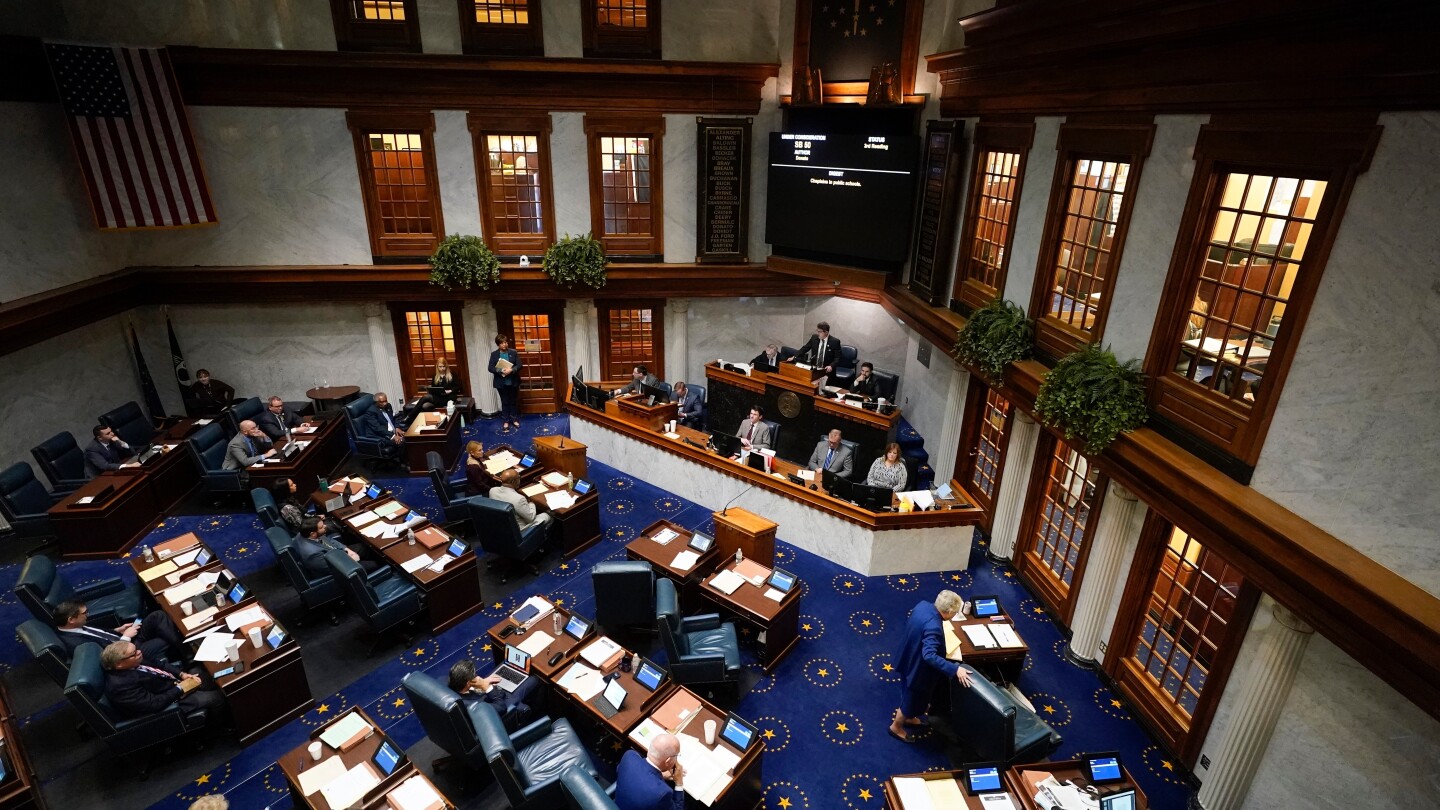
A contentious proposal to redraw Indiana’s congressional districts faces its first public test in the state Senate on Monday, following months of pressure from former President Donald Trump. The outcome remains uncertain as Republican lawmakers appear divided on the mid-decade redistricting effort that could significantly alter the state’s political landscape.
The bill, designed to favor Republican candidates in upcoming elections, passed the GOP-controlled state House on Friday after being introduced just one week earlier. The proposed map would dramatically reshape Indiana’s political boundaries, splitting Indianapolis into four separate districts merged with Republican-leaning areas, and combining the Democratic strongholds of East Chicago and Gary with rural northern Indiana counties.
If approved, the plan would effectively eliminate the districts currently represented by the state’s two Democratic congressional members: Rep. André Carson of Indianapolis, the state’s only Black member of Congress, and Rep. Frank Mrvan from the northwest region near Chicago. Republicans already hold seven of Indiana’s nine congressional seats.
The redistricting effort comes at a time when Democrats hope to flip control of the U.S. House in the 2026 midterm elections, which historically tend to favor the party not holding the presidency. This political calculation appears to be driving the unusual mid-decade redistricting push.
While redistricting typically occurs once every ten years following the census, Trump has actively encouraged Republican-controlled states to redraw districts to maximize GOP advantages. Several states have already responded to this pressure, including Texas, Missouri, Ohio, and North Carolina. Democratic-led states like California and Virginia have countered with their own redistricting efforts.
The Indiana Senate’s stance on the proposal remains unclear. The chamber’s leader, Republican Rodric Bray, previously indicated there weren’t enough votes to support redistricting, but intense pressure tactics may have shifted some positions. Monday’s committee hearing could provide the first indication of how many senators will publicly oppose the measure.
The White House has significantly escalated pressure on Indiana lawmakers. Vice President JD Vance has visited Indianapolis twice since August, and legislative leaders met with Trump in the Oval Office earlier this year. After Bray announced the Senate would reject the governor’s call for a special session on redistricting, Trump repeatedly criticized him and other state senators on social media, promising to endorse primary challengers to any lawmaker opposing the plan.
In a disturbing turn, about a dozen state lawmakers have been subjected to threats and “swatting” incidents in recent weeks, where hoax emergency calls prompt law enforcement responses to targets’ homes. These incidents have raised concerns about intimidation tactics being used to influence the legislative process.
For final passage, proponents need at least 25 “yes” votes in the 50-person Senate chamber. This would trigger a tiebreaking vote from Republican Lt. Gov. Micah Beckwith, who supports redistricting. If the Senate rejects the new map, proponents would face significant challenges in making another attempt, as the filing deadline for congressional candidates in Indiana is early February, with primary elections following in May.
The Senate is scheduled to meet Monday at 12:30 p.m., with the elections committee gathering at 1:30 p.m. The committee hearing and subsequent floor vote will be closely watched as a test of Trump’s influence over the Republican party in a staunchly conservative state, and as a potential inflection point in the broader national battle over congressional redistricting ahead of crucial midterm elections.
Fact Checker
Verify the accuracy of this article using The Disinformation Commission analysis and real-time sources.

8 Comments
The proposed map seems quite controversial, splitting Indianapolis and combining Democratic strongholds with rural areas. This raises concerns about fair representation and the potential for gerrymandering. I hope the Senate will carefully consider the impact on all Hoosiers.
I share your concerns about the potential for gerrymandering. Redistricting should be a fair and transparent process that prioritizes the interests of all constituents, not just partisan advantages.
This is a complex issue with high stakes for Indiana’s political landscape. I’m curious to see how the public hearings and debates unfold, and whether the final map will be viewed as a fair and balanced outcome.
You raise a good point. Public engagement and transparency will be crucial in this process to ensure that the redistricting plan reflects the interests of all Hoosiers, not just partisan agendas.
Redistricting is always a contentious issue, with both parties trying to gain an advantage. It will be interesting to see how this plays out in the Indiana Senate and whether the proposed map changes the political landscape as expected.
You’re right, redistricting is a delicate process that can have significant political implications. I’m curious to see if the Republican-backed plan will face pushback or if it will ultimately pass.
Redistricting is always a politically charged issue, and this case in Indiana seems particularly contentious. I hope the Senate will make decisions based on objective criteria and a commitment to fair representation, rather than partisan interests.
It’s concerning to see a proposal that could effectively eliminate the districts of Indiana’s two Democratic congressional members. This raises questions about the fairness and integrity of the redistricting process. I hope the Senate will carefully weigh the implications for democratic representation.