


Listen to the article
Obama Presidential Center Faces Backlash Over ID Requirements and Public Costs Ahead of Opening
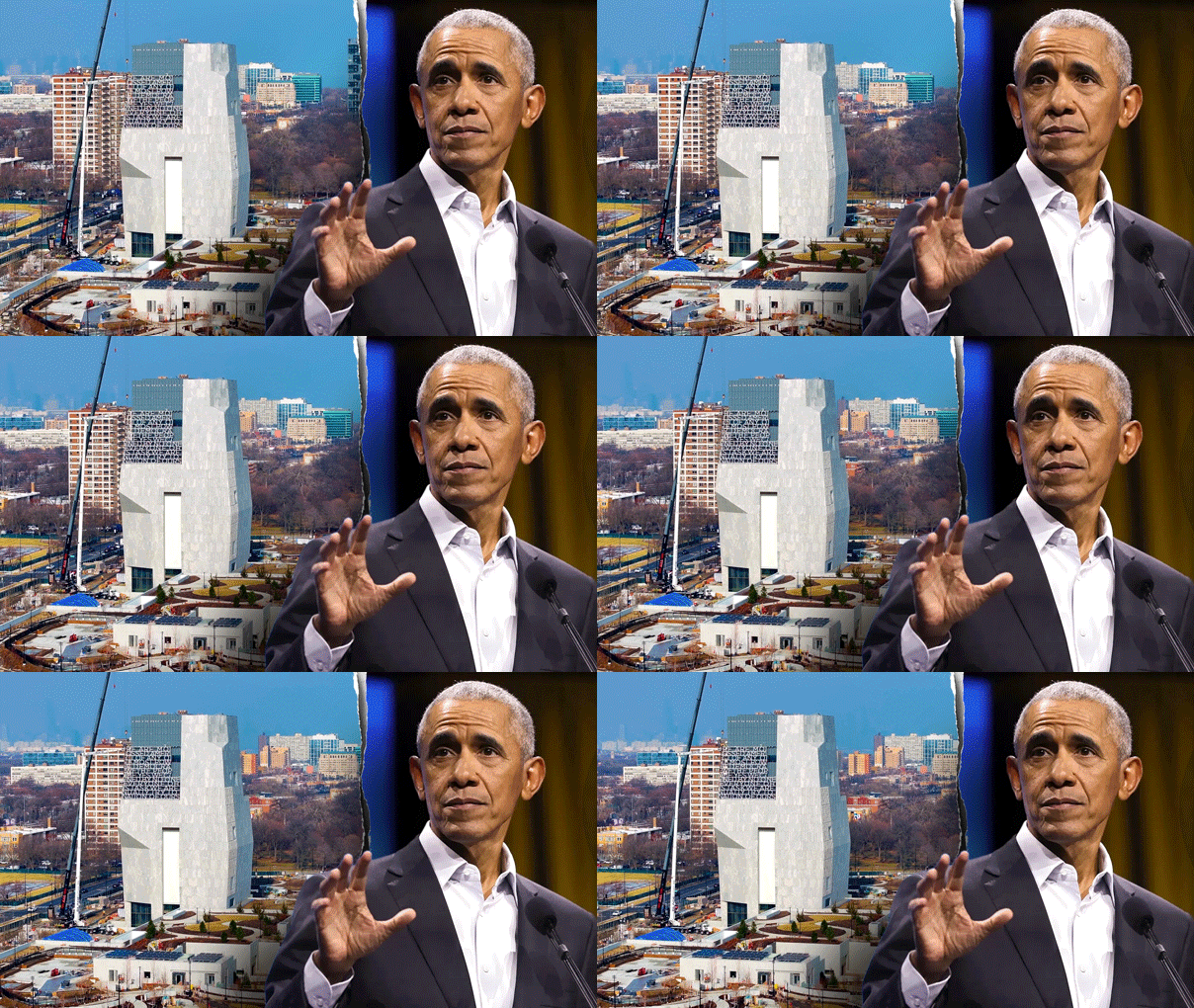
The Obama Presidential Center in Chicago has become the subject of growing criticism as it prepares to open its doors, with controversies ranging from admission policies to questions about its financial burden on taxpayers.
Conservative commentators have seized on the center’s requirement that Illinois residents show valid identification to receive free admission on certain days. Many critics have highlighted what they see as hypocrisy, drawing parallels to Democratic opposition to voter ID laws.
“They’re making you show ID… to visit the Obama Library… in Chicago. You can’t make this stuff up!” wrote one social media user. Another pointed out: “The Obama Presidential Library is making people show an ID for proof of Illinois residency to get in for free. So residents have to prove who they are for this, but not to vote?”
According to the center’s website, Illinois residents “must be able to provide proof of residency” and should be “prepared to show proof of residency at the Museum with a valid photo ID, Illinois driver’s license, state ID, or city-issued ID.” Critics have also raised concerns about reports that some early ticket promotions were limited to U.S. citizens or lawful permanent residents.
The ID requirement controversy adds to a series of criticisms that have dogged the $850 million project throughout its development. Earlier this year, the Obama Foundation faced backlash after seeking 75 to 100 unpaid volunteers, called “ambassadors,” to help operate the center. This request came even as federal filings showed CEO Valerie Jarrett earning approximately $740,000 annually, with overall compensation at the foundation increasing significantly in recent years.
Perhaps the most persistent criticism centers on the project’s financial impact on Illinois and Chicago taxpayers. Former President Barack Obama initially described the center as a “gift” to Chicago that would be privately funded. While the 19.3-acre campus construction is indeed being financed through private donations, the surrounding infrastructure necessary to support the site—including road redesigns, utility relocations, and drainage systems—is being paid for with public funds.
Early estimates placed these infrastructure costs at roughly $350 million, split between the city and state. More recent figures indicate Illinois has committed approximately $229 million, while Chicago has allocated more than $200 million in related improvements. Critics point to a lack of transparency regarding the total taxpayer expense, with Illinois Republican Party Chair Kathy Salvi saying taxpayers are being left “on the hook for hundreds of millions of dollars.”
“No single agency appears to oversee the full scope” of the infrastructure work, making it difficult for watchdogs to determine the true public cost of the project.
The controversy extends to the physical footprint of the center, which occupies nearly 20 acres of historic Jackson Park land transferred under a long-term agreement. The development has required significant roadway changes, including the removal of a major thoroughfare, and extensive utility overhauls to accommodate the campus.
Despite these criticisms, foundation officials defend the project, emphasizing that the center itself is funded by $850 million in private investment and will serve as an economic catalyst for Chicago’s South Side by generating jobs, community programs, and public amenities.
The center is moving forward with its opening plans. Tickets will go on sale April 21 for “Founding Members,” with general public sales beginning May 6. Visitors can reserve timed-entry tickets for dates between June 19 and November 30. Adult admission is set at $30, with children ages 3 to 11 paying $23. Illinois residents will receive discounted rates with proof of residency and can visit for free on Tuesdays.
The museum will feature four levels of exhibits, including a replica Oval Office and the Sky Room. Much of the surrounding campus—including gardens, walking trails, a playground, a Chicago Public Library branch, and dozens of newly commissioned artworks—will be free and open to the public.
Fact Checker
Verify the accuracy of this article using The Disinformation Commission analysis and real-time sources.

8 Comments
The ID requirement for free entry raises some tricky questions. I can see the rationale, but the voter ID comparisons give me pause. Curious to hear more perspectives on striking the right balance here.
Interesting that the Obama Presidential Center is requiring ID for free admission. Seems like a fair policy to ensure the benefits are going to Illinois residents. Though the comparisons to voter ID laws are understandable, the contexts are quite different.
I can see both sides on this issue. On one hand, requiring ID for free entry seems like a reasonable way to target the benefits to local residents. But the parallels to voter ID laws are hard to ignore. Curious to see how this plays out.
An interesting debate with valid points on both sides. As a Chicago resident, I’m glad to see efforts to make the Obama Center accessible, but the voter ID comparisons give me pause. Curious to see how this plays out.
The ID requirement for free entry seems reasonable, but the voter ID parallels raise valid concerns. It’s a complex issue without easy answers. Hopefully there’s a way to balance access and accountability.
As a Chicago resident, I’m glad to see efforts to make the Obama Center accessible to the local community. The ID requirement seems sensible, though I agree the voter ID parallels raise valid questions. An interesting debate with valid points on both sides.
This is a complex issue without easy answers. I can appreciate the desire to target local benefits, but the voter ID parallels are hard to ignore. Hopefully there’s a way to make the Obama Center accessible while addressing accountability concerns.
This is a complex issue without easy answers. I can appreciate the desire to direct resources to the local community, but the voter ID comparisons are concerning. Hopefully there’s a way to balance access and accountability.