


Listen to the article
ABA Representative Absent from Federalist Society Panel on Law School Accreditation
The American Bar Association (ABA) faced criticism Thursday when an expected panelist from its council on law school accreditation failed to appear at a Federalist Society event discussing what conservative critics called the ABA’s “monopoly” on law school accreditation.
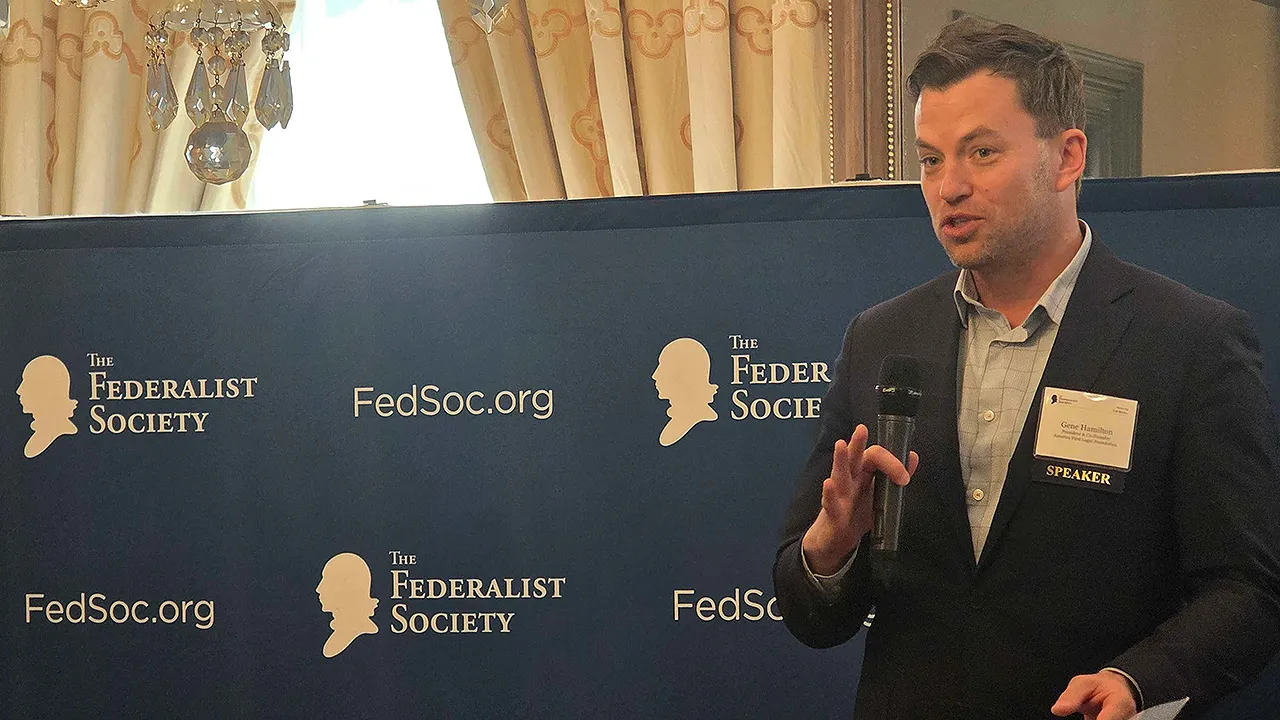
The event, held across the street from the ABA’s spring antitrust conference in Washington, D.C., featured a panel of legal experts who questioned the organization’s role as what they described as an increasingly politicized gatekeeper for the legal profession.
America First Legal President Gene Hamilton, who moderated the discussion, suggested the ABA’s absence was telling. “If I was a betting man, my suspicion is that the ABA’s status quo and their position and their involvement in the process is indefensible from the perspective of somebody who tries to present themselves as being an unbiased, uninterested party,” Hamilton said.
The ABA disputes this characterization, claiming former Colorado Supreme Court Justice Melissa Hart, Chair-elect of the ABA’s Section of Legal Education and Bar Admissions, was unaware she had been listed as a panelist. An ABA representative stated the invitation sent on March 13 was “last-minute” and no one was available to attend, though the Federalist Society maintains their invitation had been confirmed approximately a week after it was sent.
Panelists at the event shared what they described as firsthand experiences with ABA politicization. Brent Webster, First Assistant Attorney General of Texas, recounted how the State Bar of Texas sought to strip him and Attorney General Ken Paxton of their law licenses over litigation Texas filed following the 2020 election.
“That fight, which ended with the Texas Supreme Court vindicating him, helped expose to Texas officials how deeply bar institutions had been ‘radicalized’ and contributed to the state’s decision to loosen the ABA’s hold over law-school approval,” Webster explained.
David Dewhirst, Solicitor General for Florida, cited St. Thomas University’s law school in Miami as another example, claiming the institution faced prolonged uncertainty from the ABA over whether its Catholic identity could coexist with ABA nondiscrimination standards, particularly regarding sexual orientation and gender identity.
The panel discussion comes amid growing tensions between the ABA and the conservative legal community. The Trump administration had previously accused the ABA of acting as a politicized gatekeeper, with executive agencies restricting members from attending ABA events. Trump’s Attorney General Pam Bondi later revoked the ABA’s special access to the judicial vetting process, following concerns about bias in its rating system for federal judicial nominees.
During the event, Hamilton unveiled research from America First Legal claiming the ABA’s Standing Committee on Amicus Curiae Briefs has shown clear political leanings over the past decade. According to the report, 80% of the committee’s arguments leaned left politically, 20% were neutral, and none aligned with conservative positions. The research also noted that in all six cases involving former President Trump where the ABA filed amicus briefs, the organization opposed the president or his allies.
“The ABA requires that amicus briefs be authorized by its board of governors and must be consistent with existing ABA policy or involve matters of ‘special significance to lawyers or the legal profession,'” America First Legal stated in a press release. “Briefs on birthright citizenship, transgender healthcare for minors and the Texas heartbeat law fall well outside that mandate.”
Critics at the event argued that the ABA has evolved from a neutral professional body into an ideological gatekeeper with significant power to shape who receives training, licensing, and recognition in the legal profession.
The dispute highlights broader tensions in the legal community about the appropriate role of professional organizations and whether they should maintain strict neutrality or advocate for particular social and political positions.
Fact Checker
Verify the accuracy of this article using The Disinformation Commission analysis and real-time sources.

8 Comments
As someone with an interest in the mining and energy sectors, I don’t have a direct stake in this law school accreditation issue. However, I do believe it’s important for any regulatory authority to maintain impartiality and transparency. The ABA’s absence from this panel raises some red flags in that regard.
The ABA’s absence from this panel is certainly curious. I wonder if they felt they couldn’t adequately defend their position or if they were simply trying to avoid the scrutiny. Either way, it’s troubling if a regulatory body is seen as overly politicized or biased.
Interesting that the ABA was absent from this panel discussion about their role in law school accreditation. Sounds like there are some concerns about potential bias and politicization. I’m curious to learn more about the perspectives of the legal experts who participated.
Yes, the ABA’s absence is certainly notable. It suggests they may have a hard time defending their position and role as an unbiased accreditor.
This is an important topic that deserves careful examination. I’m glad to see the Federalist Society taking it on, even though the ABA chose not to participate. Maintaining the integrity and independence of the legal profession is crucial for the rule of law and a well-functioning society.
Absolutely. The ABA’s role as an accreditor is a significant responsibility, and they should be willing to engage in open and honest dialogue about it.
This issue of law school accreditation and the ABA’s regulatory powers is an important one. I appreciate that the Federalist Society is shining a light on it and providing a platform for diverse views to be aired. Transparency and accountability are crucial for any regulatory body.
Agreed. As an aspiring lawyer, I’m particularly interested in this topic and how it may impact the future of legal education and the profession.