


Listen to the article
It’s the longest walk in Georgia politics — the 600 steps from the mayor’s office in Atlanta’s towering City Hall to the governor’s office in the gold-domed state Capitol. No Atlanta mayor has ever made this journey to the state’s top office, but Democrat Keisha Lance Bottoms is determined to break this historical barrier.
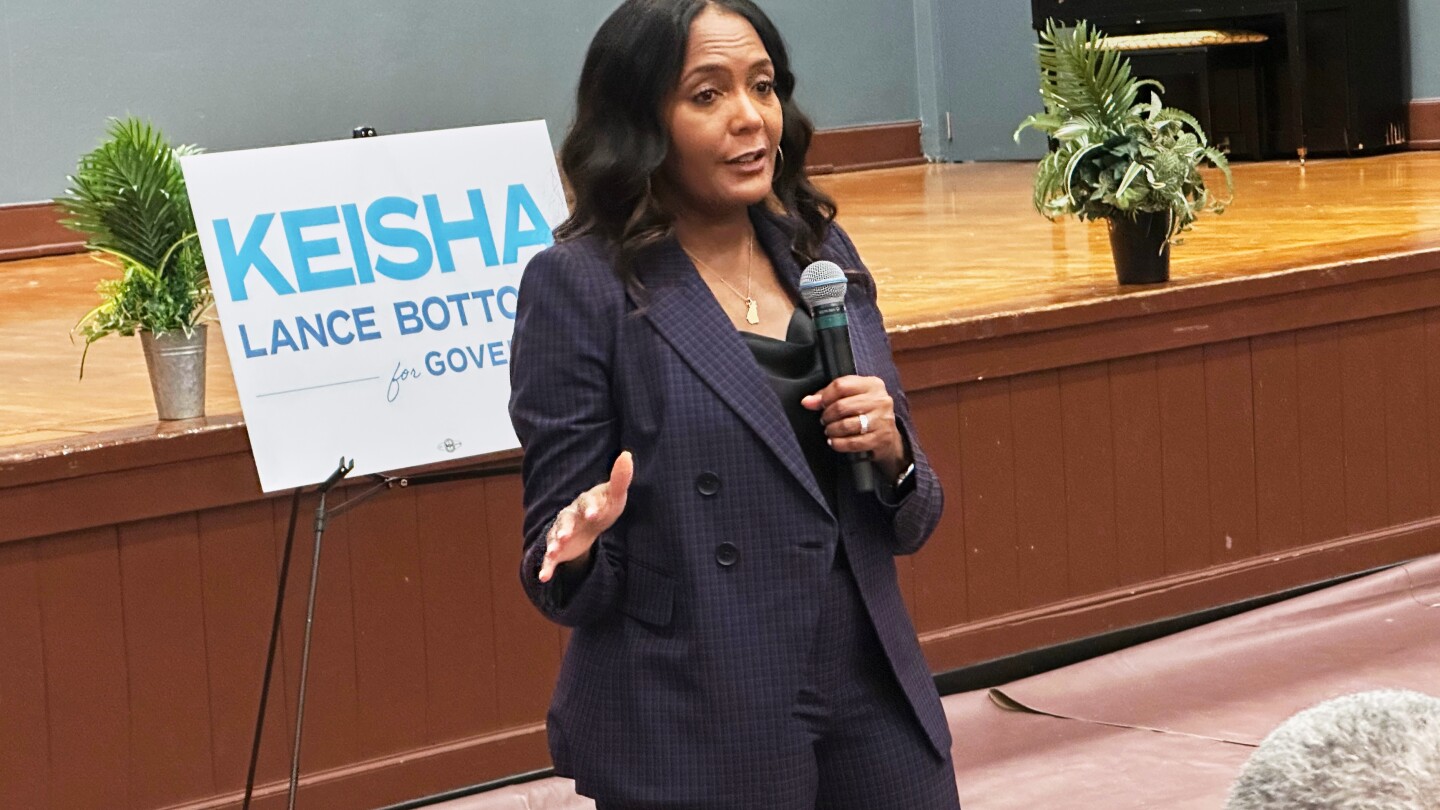
“I’m going to be the first because I am working to earn people’s votes across the state,” Bottoms declared after a campaign appearance in Columbus last week. “Just because it hasn’t happened doesn’t mean that it can’t happen.”
Before she can make history, Bottoms must navigate a crowded Democratic primary field in May featuring six other candidates. Should she emerge victorious, Republicans are already preparing attacks centered on her management of crime, civil unrest, and the COVID-19 pandemic during her tenure as Atlanta’s mayor — particularly her surprising decision not to seek reelection.
“She is the easiest to run against,” said Republican strategist Brian Robinson, who dismisses Bottoms as “unelectable.”
The stakes are high for Georgia Democrats, who despite recent Public Service Commission victories, haven’t won a gubernatorial race since 1998. The party briefly celebrated Joe Biden’s 2020 presidential victory in the state, only to watch Republican Governor Brian Kemp handily defeat Democrat Stacey Abrams in their 2022 rematch, despite Abrams’ significant fundraising advantage. The 2024 presidential election further dampened Democratic hopes when Donald Trump substantially boosted Republican turnout to reclaim Georgia.
For Bottoms’ supporters, the primary presents a process of elimination in a field that highlights many of the divisions Democrats face nationally. Former state Senator Jason Esteves has insider support but lacks statewide name recognition. Former labor commissioner Michael Thurmond brings extensive experience but, at 72, has historically struggled with fundraising. Ex-Republican lieutenant governor Geoff Duncan’s party switch has generated curiosity, but may not satisfy lifelong Democrats. State Representatives Ruwa Romman and Derrick Jackson face their own uphill battles to gain traction among the party faithful.
Bottoms begins with several advantages. She enjoys the highest name recognition among Democratic contenders and brings executive experience from her time as mayor. Her national profile was enhanced when President Biden considered her as a potential vice presidential nominee before she joined his administration, establishing valuable fundraising connections beyond Georgia. Additionally, as the only Black woman in the Democratic field, Bottoms represents a demographic that forms the backbone of the party in Georgia. In 2022, Democrats nominated five Black women for statewide offices.
At a Columbus campaign event, state employee Sheana Browning cited Bottoms’ promise of pay raises along with her “previous mayoral status and the fact that she’s a Black woman” as compelling reasons for support. About 70% of the roughly 125 attendees were Black women, reflecting Bottoms’ core constituency.
Some Democrats, however, speculate that Bottoms’ early support may be superficial. Her association with President Biden could alienate voters disenchanted with his administration. Additionally, no Black woman has ever been elected governor of any state, presenting another historical barrier.
For her part, Bottoms is working to reintroduce herself to voters across Georgia. She frequently references her personal story — how her father, a 1960s soul singer, went to prison for dealing cocaine, and how her mother enrolled in cosmetology school at night to support the family. She also emphasizes her mayoral accomplishments, including building city reserves to $180 million, avoiding property tax increases, raising salaries for police and firefighters, and creating or preserving 7,000 affordable housing units.
“That sounds pretty successful to me,” Bottoms told reporters in Columbus.
Her campaign platform focuses heavily on affordability issues, with proposals to exempt teachers from state income taxes and address the housing crisis, including “cracking down” on corporate investors who control tens of thousands of single-family rental homes across Georgia.
However, Bottoms’ mayoral record, particularly from the tumultuous summer of 2020, presents significant vulnerabilities. The high point of her political career may have been her emotional May 30, 2020 speech condemning violence during Black Lives Matter protests, when she famously pleaded, “We are better than this! We are better than this as a city, we are better than this as a country! Go home! Go home!”
But weeks later came a devastating low point when 8-year-old Secoriea Turner was shot and killed near a Wendy’s that protesters had burned after police fatally shot Rayshard Brooks. Police officers staged a “blue flu” sickout after prosecutors charged two officers in Brooks’ death, and Bottoms was criticized for giving a City Council member more time to negotiate with protesters rather than ordering immediate police intervention.
“She took the side of the mob over the Atlanta police over and over again,” Robinson, the Republican strategist, claims.
In May 2021, Bottoms became the first Atlanta mayor since World War II not to seek a second term. She later served as Biden’s senior adviser for public engagement before joining his reelection campaign.
This decision has become a point of attack from primary opponents like Esteves, who told WXIA-TV that Bottoms “abandoned the city at a time of crisis.” Bottoms rejects this characterization, insisting her political position remained strong and that she would have won reelection. “I ran through the tape,” Bottoms said in May. “We ended the term delivering.”
As the race intensifies, Bottoms continues to emphasize her experience as her greatest asset.
“Who I am is a battle-tested leader,” she said. “I know what it’s like to go into battle. I know what it’s like to go up against Donald Trump. I know what it’s like not to back down against Donald Trump.”
Fact Checker
Verify the accuracy of this article using The Disinformation Commission analysis and real-time sources.

24 Comments
Interesting update on Keisha Lance Bottoms aims to be first Atlanta mayor to become Georgia governor. Curious how the grades will trend next quarter.
Uranium names keep pushing higher—supply still tight into 2026.
Silver leverage is strong here; beta cuts both ways though.
Silver leverage is strong here; beta cuts both ways though.
Good point. Watching costs and grades closely.
Good point. Watching costs and grades closely.
Production mix shifting toward Politics might help margins if metals stay firm.
Interesting update on Keisha Lance Bottoms aims to be first Atlanta mayor to become Georgia governor. Curious how the grades will trend next quarter.
Good point. Watching costs and grades closely.
Nice to see insider buying—usually a good signal in this space.
Good point. Watching costs and grades closely.
Nice to see insider buying—usually a good signal in this space.
The cost guidance is better than expected. If they deliver, the stock could rerate.
If AISC keeps dropping, this becomes investable for me.
Good point. Watching costs and grades closely.
The cost guidance is better than expected. If they deliver, the stock could rerate.
Good point. Watching costs and grades closely.
Good point. Watching costs and grades closely.
The cost guidance is better than expected. If they deliver, the stock could rerate.
Good point. Watching costs and grades closely.
Silver leverage is strong here; beta cuts both ways though.
Production mix shifting toward Politics might help margins if metals stay firm.
If AISC keeps dropping, this becomes investable for me.
Good point. Watching costs and grades closely.