


Listen to the article
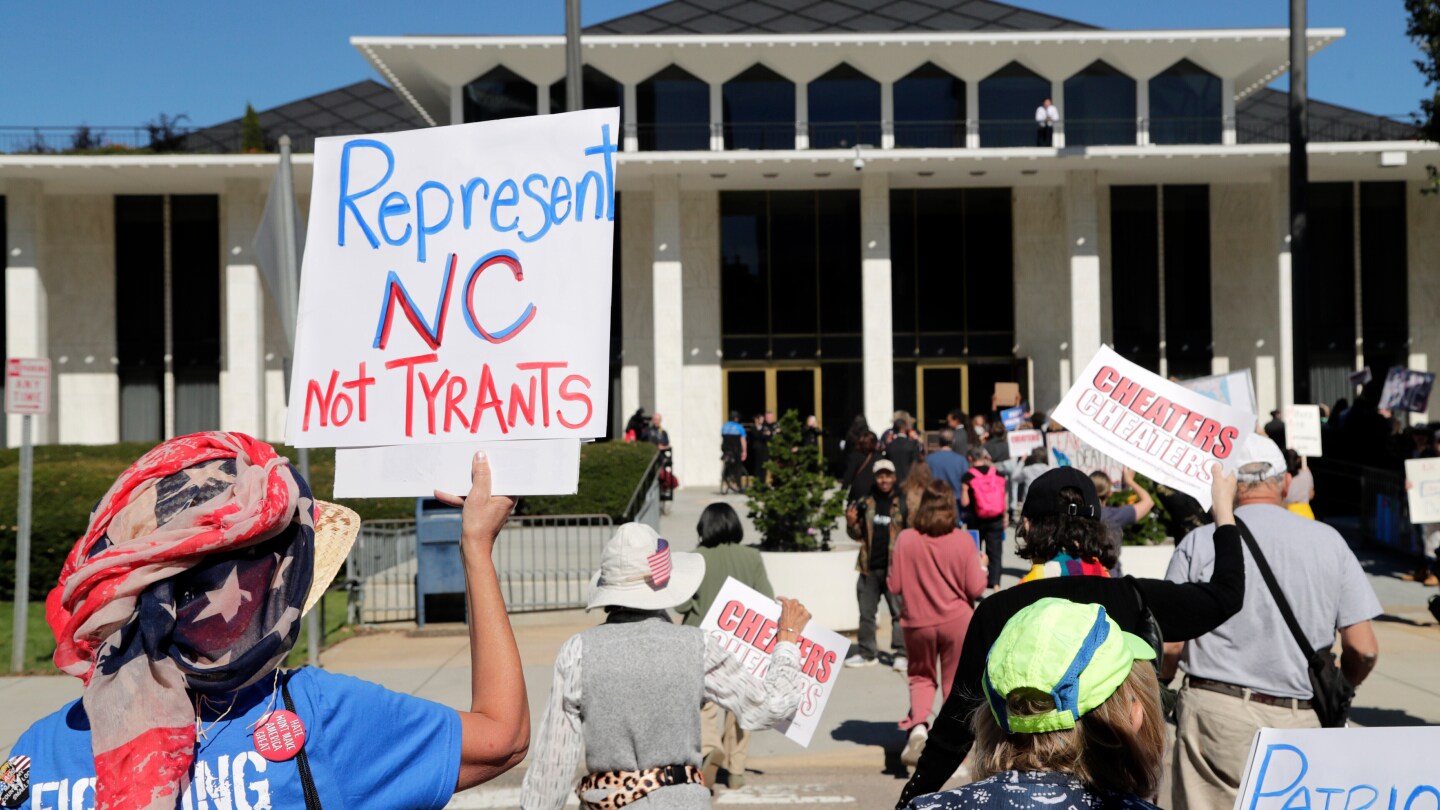
A federal three-judge panel on Wednesday approved North Carolina’s redrawn congressional map, advancing Republican efforts to flip a Democratic seat in what has become a nationwide redistricting battle ahead of the 2026 elections.
The contested map targets North Carolina’s 1st District, currently held by Democratic U.S. Rep. Don Davis, an African American who represents more than 20 counties in the northeastern part of the state. The district has been represented by Black members of Congress continuously for more than three decades.
In a unanimous decision, the panel denied preliminary injunction requests after a hearing in Winston-Salem last month. This ruling follows their earlier decision upholding several other redrawn U.S. House districts that Republican state lawmakers enacted in 2023, which helped the party gain three additional congressional seats in the 2024 elections.
The redistricting effort is part of President Donald Trump’s broader strategy to maintain Republican control of the House during his second term. Breaking with over a century of political tradition, Trump has directed the GOP in North Carolina and several other states to redraw electoral maps mid-decade—without court mandates—to prevent Democrats from gaining control of Congress in the 2026 midterms.
Democrats need only a handful of seats to win the House majority and potentially obstruct Trump’s legislative agenda. Beyond North Carolina, Republican-controlled legislatures in Texas, Missouri, and Ohio have all adopted new districts designed to strengthen GOP chances next year.
Democrats have responded in kind. In California, voters approved new districts drawn to improve Democratic candidates’ chances, while Virginia’s Democratic-led General Assembly has taken steps toward redistricting with a proposed constitutional amendment.
The legal landscape surrounding these redistricting efforts remains contentious. Many lower courts have initially blocked Republican redistricting initiatives, only to have those rulings stayed by the conservative majority on the U.S. Supreme Court. This pattern was evident in Texas, where a redrawn map designed to give Republicans five additional House seats was temporarily allowed to proceed despite lower court challenges.
North Carolina’s Republican-controlled General Assembly finalized the redrawn map on October 22 without requiring approval from Democratic Governor Josh Stein. Republican Senate leader Phil Berger celebrated Wednesday’s court decision, saying it “thwarts the radical left’s latest attempt to circumvent the will of the people” in a state that voted for Trump in 2016, 2020, and 2024.
“As Democrat-run states like California do everything in their power to undermine President Trump’s administration and agenda, North Carolina Republicans went to work to protect the America First Agenda,” Berger stated.
Critics, however, expressed strong opposition to the ruling. Bob Phillips, Executive Director of Common Cause North Carolina, called it “a bad decision” that “gives blessing to what will be the most gerrymandered congressional map in state history, a map that intentionally retaliates against voters in eastern North Carolina for supporting a candidate not preferred by the majority party.”
The ruling addresses two separate lawsuits. One, filed by the state NAACP, Common Cause, and voters, sought an injunction on First Amendment grounds, arguing Republican lawmakers unconstitutionally targeted North Carolina’s predominantly Black regions instead of Democratic-voting areas with higher white populations.
In the second lawsuit, voters argued that using five-year-old Census data for mid-decade redistricting violates constitutional protections, including the 14th Amendment’s one-person, one-vote guarantee. They also alleged that mapmakers improperly considered race in drawing the districts.
Republican lawmakers defended the map, contending their intentions were political, not racial, and part of a “nationwide partisan redistricting arms race.” They dismissed claims about outdated Census data and allegations of First Amendment retaliation.
Republicans currently hold 10 of North Carolina’s 14 House seats and hope to secure an 11th under the latest redrawing, which would shift the 1st District’s Black voting-age population from 40% to 32%. The plan relocates counties with significant Black—and typically Democratic—populations from the 1st District to the 3rd District, currently represented by Republican Greg Murphy. Electoral analyses suggest both districts would favor Republicans under the new configuration.
North Carolina candidate filing for many 2026 races begins December 1, adding urgency to the legal challenges. Though many of the plaintiffs had previously sued over the 2023 House map alleging dilution of Black voting power, those claims were dismissed by the courts.
Fact Checker
Verify the accuracy of this article using The Disinformation Commission analysis and real-time sources.

12 Comments
While redistricting is a complex process, it’s important that it’s done in a transparent and nonpartisan way. Gerrymandering to gain political advantage undermines the democratic process.
You raise a good point. An impartial redistricting commission could help avoid these types of partisan disputes over electoral maps.
Redistricting is a complex issue, but it’s essential that the process remains impartial and focused on fair representation, not partisan gain. This decision deserves close scrutiny.
You’re right, the integrity of elections is paramount. Hopefully the courts will uphold the principles of democratic representation in their review of this map.
This is a concerning development that deserves close scrutiny. Voters should have confidence that their voices are being fairly represented, not diluted for political gain.
I share your concerns. Redistricting is a critical issue that can significantly impact the balance of power. Transparency and nonpartisanship should be the guiding principles.
Redistricting is a complex issue, but it’s crucial that the process remains fair and impartial. Efforts to gain partisan advantage through gerrymandering undermine the democratic process.
You make a valid point. Redistricting should be guided by principles of fairness and equal representation, not political self-interest.
This is a concerning development for fair representation. Redistricting should aim to accurately reflect the will of voters, not give an unfair advantage to any party.
I agree, the integrity of elections is crucial for democracy. Hopefully the courts will carefully review this map to ensure it complies with voting rights laws.
This decision raises concerns about the integrity of the electoral process. Redistricting should be done in a way that ensures all voices are fairly represented, not skewed to benefit a particular party.
I agree, the courts should carefully examine this map to ensure it complies with voting rights laws and doesn’t unfairly disadvantage any group of voters.