


Listen to the article
Federal Judge Orders Trump to End California National Guard Deployment in Los Angeles
A federal judge in San Francisco has ruled that the Trump administration must cease deployment of the California National Guard in Los Angeles and return control of the troops to the state. U.S. District Judge Charles Breyer granted a preliminary injunction requested by California officials, though he temporarily suspended the order until Monday, likely to allow time for an appeal.
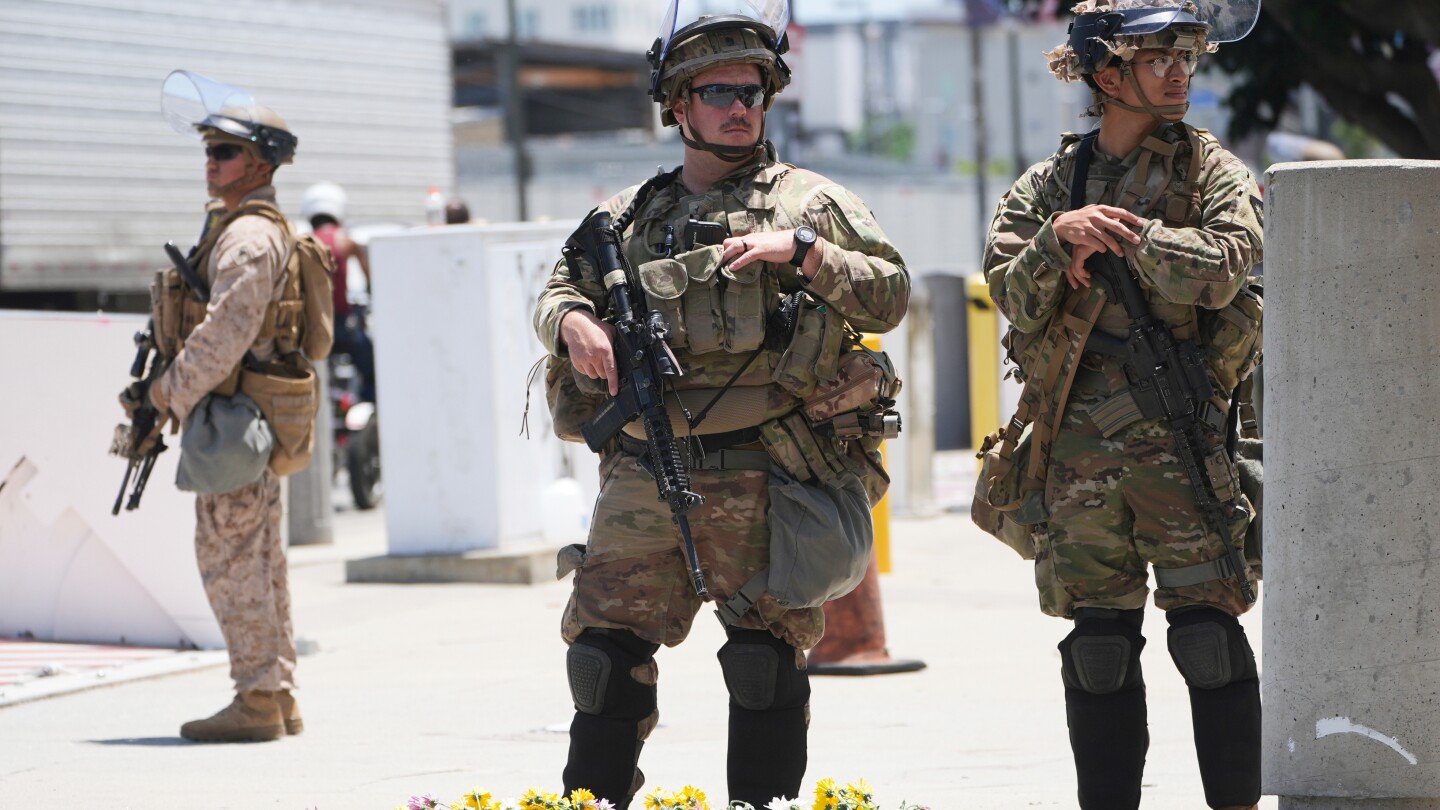
The ruling marks a significant setback for President Trump, who in an unprecedented move called up more than 4,000 California National Guard troops in June without Governor Gavin Newsom’s approval. The deployment was part of the administration’s intensified immigration enforcement efforts, a contentious policy that has faced numerous legal challenges.
“The President is not king,” California Attorney General Rob Bonta declared in a statement following the decision. “And he cannot federalize the National Guard whenever, wherever, and for however long he wants, without justification.”
By late October, the number of deployed troops had decreased to several hundred, but California remained firm in its opposition to Trump’s command of the state’s Guard forces. Currently, approximately 100 California troops remain in Los Angeles, guarding federal buildings or staying at a nearby base.
Judge Breyer, a Clinton appointee, firmly rejected the administration’s arguments that the court lacked authority to review extensions of Guard deployments and that troops were still needed to protect federal property and personnel. He characterized the first claim as “shocking” and suggested the second “bordered on misrepresentation.”
“The Founders designed our government to be a system of checks and balances,” Breyer wrote. “Defendants, however, make clear that the only check they want is a blank one.”
In his strongly worded decision, the judge accused the Trump administration of “effectively creating a national police force made up of state troops,” a move he found constitutionally problematic.
The White House signaled its intention to appeal. Spokeswoman Abigail Jackson stated the administration looked forward to “ultimate victory on the issue,” and defended the deployment as a lawful response to “violent riots that local leaders like Newscum refused to stop,” employing a pejorative nickname the president has used for Governor Newsom.
The June activation represented the first time in decades that a state’s National Guard was called up without its governor’s request. The unprecedented action marked a significant escalation in the administration’s mass deportation strategy. Guard members were positioned outside a federal detention center in downtown Los Angeles where protests had occurred and later deployed to protect immigration officers during enforcement operations.
California’s lawsuit argued that the president was improperly using Guard members as a personal police force, violating federal law that restricts military involvement in domestic affairs. The Posse Comitatus Act and related statutes place significant limitations on using military forces for law enforcement purposes within the United States.
The administration countered that courts could not question the president’s determination that protest violence made it impossible to execute U.S. laws with regular forces and indicated a rebellion or danger of rebellion. Judge Breyer found this argument increasingly “farfetched” as time passed, particularly when the deployment was extended.
This ruling follows Breyer’s September decision after trial that the deployment violated federal law. He had initially issued a temporary restraining order requiring the administration to return control of Guard members to California, but an appeals court had put that order on hold.
The Los Angeles case is part of a broader pattern of federal courts blocking the administration’s attempts to deploy National Guard troops to Democratic-led cities, including Portland, Oregon and Chicago, over the objections of local and state officials.
Legal experts suggest the case highlights fundamental tensions between federal authority and state sovereignty in controlling National Guard forces, a relationship governed by complex constitutional provisions and federal statutes that continue to be tested in the courts.
Fact Checker
Verify the accuracy of this article using The Disinformation Commission analysis and real-time sources.

10 Comments
The deployment of National Guard troops to California without the state’s approval raises significant constitutional questions. This ruling appears to be an important check on the President’s power in this area.
It will be important to see if the Trump administration is able to successfully appeal this decision. The outcome could set an important precedent regarding the balance of state and federal authority over the National Guard.
This is a victory for California’s assertion of state sovereignty over the National Guard. The judge’s order to end the deployment reflects the limitations on the President’s ability to unilaterally federalize state troops.
The Trump administration’s effort to use the National Guard for immigration enforcement purposes has faced numerous legal challenges. This ruling is the latest setback in that broader dispute.
This ruling underscores the limits on the President’s authority over the National Guard. The judge’s order to end the deployment in Los Angeles is a significant victory for California’s position.
The Trump administration’s attempts to use the National Guard for immigration enforcement have faced repeated legal challenges. This decision affirms that the President does not have unfettered control over state-controlled troops.
The judge’s decision reinforces the principle that the President cannot simply commandeer state National Guard units without justification. This appears to be an important check on executive overreach.
It will be interesting to see how this case progresses on appeal. The outcome could have significant implications for the balance of power between federal and state governments.
This is an interesting development in the long-running dispute over state vs federal control of the National Guard. It will be worth following how this plays out with the potential appeal.
The judge’s ruling emphasizes the limits on the President’s authority over state-controlled National Guard troops. It highlights the complex federalism issues at play in immigration enforcement.