


Listen to the article
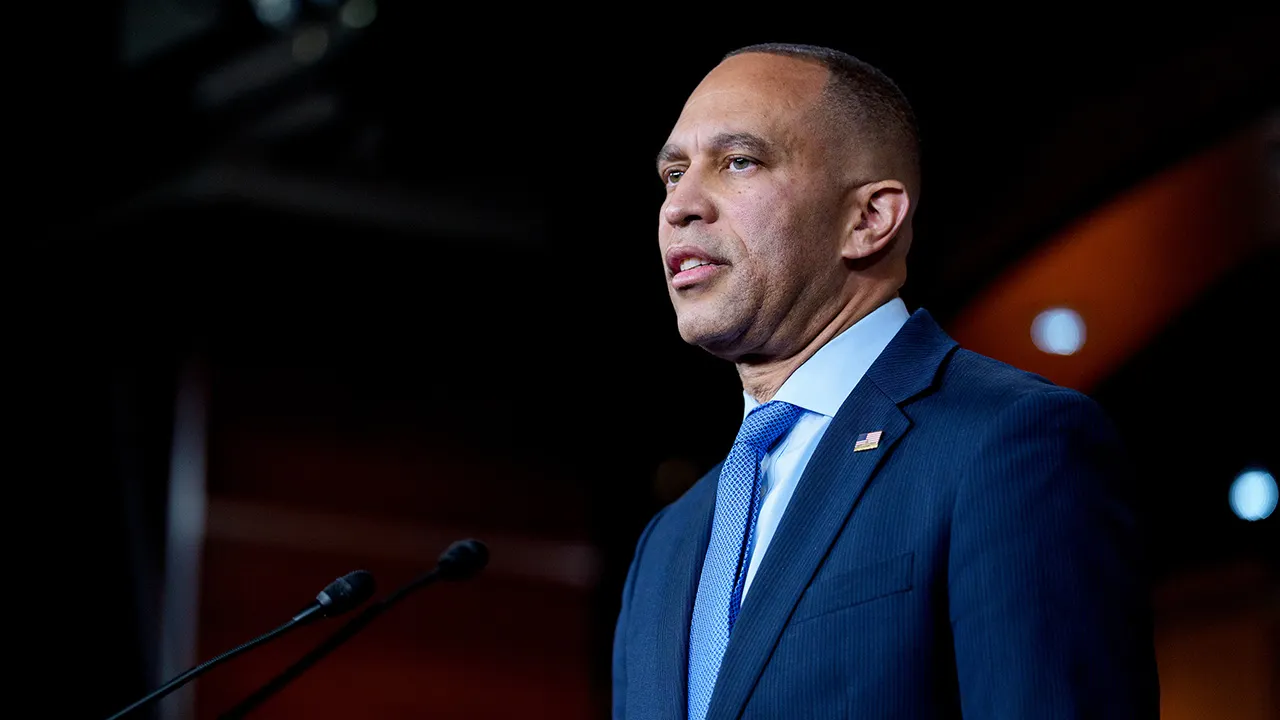
In a heated press conference Monday, House Minority Leader Hakeem Jeffries firmly defended his controversial rhetoric against Republicans, telling critics bluntly, “I don’t give a damn about your criticism.” The New York Democrat doubled down on his earlier pledge to unleash “maximum warfare” against GOP redistricting efforts ahead of November’s midterm elections.
Jeffries’ defiant stance comes at a politically charged moment, following what authorities described as a third apparent assassination attempt on former President Donald Trump during the White House Correspondents’ Association Dinner on Saturday. The incident has amplified concerns about heightened political tensions nationwide.
When pressed by reporters about his inflammatory language, Jeffries justified his word choice by referencing a New York Times report from 2025, which quoted an anonymous White House staffer using identical terminology when discussing Republican redistricting strategy.
“That phrase ‘maximum warfare everywhere, all the time’ came from the White House in the summer of 2025, when they started this redistricting battle, and now they’re big mad,” Jeffries said. “Why? Because Democrats have decided to finish it. Get lost.”
The Democratic leader emphasized that he has consistently denounced political violence in all forms, drawing a distinction between aggressive political strategy and calls for actual physical confrontation.
Jeffries reserved particularly harsh criticism for White House Press Secretary Karoline Leavitt, whom he labeled a “disgrace” and a “stone-cold liar” for her comments criticizing Democrats’ characterization of Trump as an existential threat to democracy.
“This so-called White House press secretary wants to lecture America and lecture us about civility. Get lost,” Jeffries said. “Clean up your own house before you have anything to say to us about the language that we use.”
Earlier that day, Leavitt had conducted her own press briefing, where she directly linked Democrats’ rhetoric to the security incidents involving the former president.
“This hateful, constant and violent rhetoric directed at President Trump, day after day after day for 11 years, has helped to legitimize this violence and bring us to this dark moment,” Leavitt said. She added that “mentally disturbed individuals across the country” might be influenced by such rhetoric to “do crazy things.”
The National Republican Congressional Committee (NRCC) quickly condemned Jeffries’ comments, with spokesman Mike Marinella issuing a statement accusing Democrats of “playing with fire and pretending they don’t smell the smoke.” Marinella suggested the rhetoric demonstrated Democrats’ willingness to “do anything to appease their far-left base.”
The backdrop to this verbal sparring is an increasingly contentious battle over congressional redistricting, with both parties engaged in aggressive gerrymandering efforts ahead of the November elections. Democrats recently scored a victory in Virginia, where voters approved a redistricting plan that targets four Republican-held seats.
In response, Florida’s Republican-controlled legislature is advancing a new congressional map that could potentially offset Democrats’ gains elsewhere. Jeffries dismissed the Florida proposal as a “DeSantis dummymander” that he described as “blatantly unconstitutional.”
“Florida is not going to make a meaningful difference as it relates to their efforts to rig the midterm elections. That effort has failed,” Jeffries declared.
The increasingly hostile rhetoric from both parties reflects the high stakes of the upcoming midterm elections, where control of Congress hangs in the balance. Political analysts note that redistricting battles could be decisive in determining which party holds power in the closely divided House of Representatives.
As security concerns around political figures remain heightened, questions about the impact of inflammatory language on an already polarized electorate will likely continue to dominate political discourse in the coming months.
Fact Checker
Verify the accuracy of this article using The Disinformation Commission analysis and real-time sources.

8 Comments
This is a complex issue without easy answers. I’m curious to see how the public responds to Jeffries’ defense of his ‘maximum warfare’ rhetoric. Surely the White House quote he referenced adds some context, but the language is still quite provocative.
As a concerned citizen, I’m troubled by the apparent assassination attempt on former President Trump. Heightened political tensions like this are deeply worrying, regardless of one’s partisan affiliation. I hope cooler heads can prevail and we can return to substantive policy debates.
While the language used by both parties may seem inflammatory, I believe it reflects the high stakes and deep divisions in the current political landscape. Voters will have to weigh the merits of the arguments being made on redistricting, rather than simply reacting to the strong words.
Jeffries may have a point about the White House’s past use of similar language, but that doesn’t make his comments any less inflammatory. Ratcheting up the rhetoric seems unlikely to lead to productive solutions on redistricting or other key issues facing the country.
The redistricting battle is clearly a high-stakes fight, but the use of combative language like ‘maximum warfare’ is concerning. I hope both parties can find a way to engage constructively on this issue, rather than resorting to inflammatory rhetoric that only serves to further divide the country.
The tensions around redistricting and the broader political climate are certainly concerning. I hope the parties can find a way to engage in substantive debate without resorting to such combative language. Voters deserve a measured, fact-based discussion of the issues.
It’s troubling to see political rhetoric escalate to the point of ‘maximum warfare.’ While I understand the high stakes involved, I hope both sides can take a step back and find a way to find common ground, or at least agree to disagree more civilly.
Interesting to see the heated rhetoric from both sides on this politically charged issue. I appreciate Jeffries defending his comments, even if they are controversial. Redistricting battles can get nasty, and it’s concerning to see political tensions escalating further.