


Listen to the article
Alberta Government Launches Taxpayer-Funded Campaign to Influence Referendum Vote
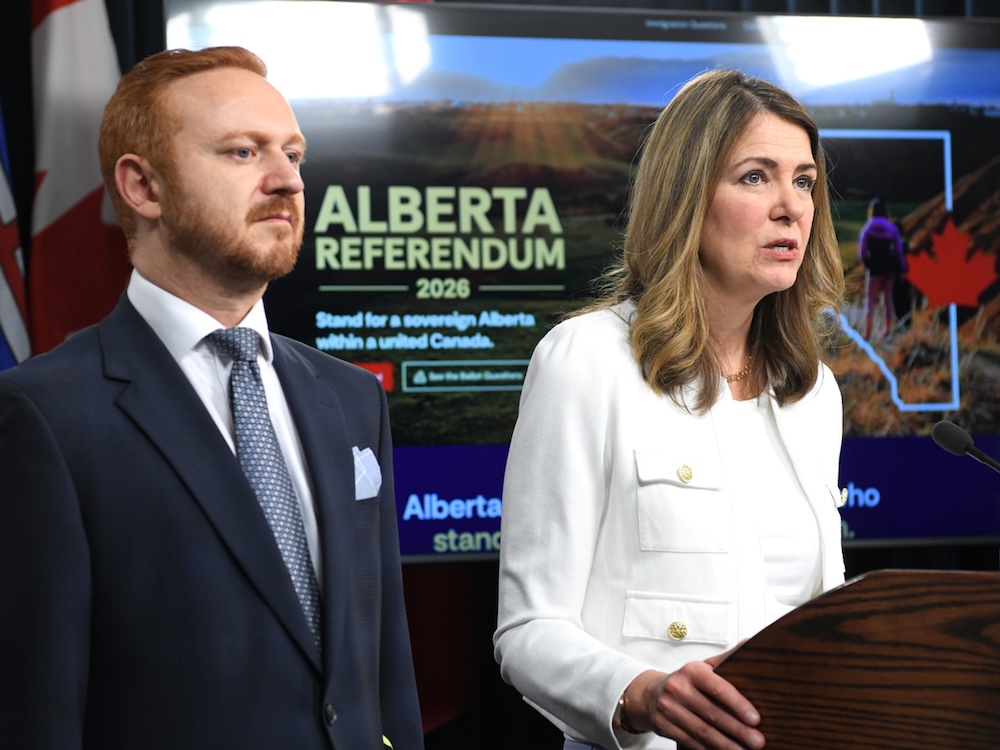
Premier Danielle Smith’s government has unveiled an extensive propaganda campaign using Alberta taxpayers’ money to persuade voters to support a series of constitutional and immigration ballot questions in the upcoming October vote.
The initiative, presented by the government as merely an informational website with “relevant information on these important issues,” clearly has broader ambitions. The site repeatedly urges voters to “Stand for a sovereign Alberta within a united Canada” and represents significant investment in what critics describe as a subversive effort to undermine Canada’s federal structure.
At a recent news conference, Smith and Justice Minister Mickey Amery introduced nine non-binding plebiscite questions scheduled for the October 19 ballot. Smith openly admitted the government’s intent to influence voters, stating, “We’re going to be out actively persuading the public that this is the direction we want to go.”
The premier claims these questions emerged from consultations conducted by the Alberta Next Panel last summer. However, observers note that these town halls appeared strategically designed to generate support for predetermined UCP priorities. Despite efforts to pack meetings with party supporters, Albertans showed limited enthusiasm for some key proposals, particularly an Alberta police force and provincial pension plan.
The UCP government nonetheless proceeded with nine questions focusing on immigration and constitutional change. The immigration questions have been criticized for scapegoating newcomers for problems many attribute to decades of neoliberal policies. The constitutional questions, meanwhile, seek permission to pursue changes with “other willing provinces” – demands unlikely to gain traction across Canada.
Political analyst Deirdre Mitchell MacLean pointed out the questionable premise of the initiative, noting that “the UCP doesn’t need ‘a mandate’ to work with other provinces to change the Constitution.” Critics suggest the questions violate the original intent of the province’s “citizen initiative” legislation, which was meant for grassroots proposals rather than government-driven agendas.
Media coverage of the announcement has varied in tone. The Globe and Mail described it as a “lobbying campaign,” while CBC and Postmedia outlets used more neutral terminology like “information campaign.”
Adding to the complexity is a separate petition campaign by open separatists seeking to add a question about Alberta’s immediate departure from Canada to the same ballot. Sources differ on whether this petition has collected the nearly 178,000 signatures required by the May 2 deadline, but observers note Smith and the UCP appear supportive of getting the question included.
The referendum process itself may generate controversy, as the UCP insists on using paper ballots with separate ballot boxes for each question at every polling station – a system likely to delay results significantly after the October vote.
Meanwhile, foreign interference concerns have emerged. CBC recently reported that three individuals in the Netherlands are behind a network of YouTube channels hiring actors to create content supporting Alberta separatism. This revelation raises questions about potential coordination between separatist groups, the UCP, and foreign entities interested in destabilizing Canada.
Smith’s admission about question selection revealed the strategic calculation behind the initiative: “We think we’ve done that initial culling of the questions to make sure that we found the ones that are likely to get majority support.” She added that if the desired mandate isn’t received, “then we’ll have to address what we do at that time” – suggesting alternative approaches remain available regardless of voter response.
With five months until the vote, observers expect the campaign of misinformation and disinformation on social media to intensify as October 19 approaches, raising further questions about democratic integrity and outside influence in Alberta’s political process.
Fact Checker
Verify the accuracy of this article using The Disinformation Commission analysis and real-time sources.

8 Comments
The Alberta government’s decision to use taxpayer money for this referendum campaign is sure to be a hot-button issue. I’ll be interested to see how the public and media respond to the perceived partisan nature of these materials.
Agreed. Maintaining the integrity of the democratic process should be the top priority, even if the government believes the referendum questions are important. Transparency and impartiality are key.
It’s interesting to see the Alberta government taking such a direct approach to influencing the upcoming referendum. I’m curious to learn more about the specific issues and rationale behind these ballot questions.
Yes, the details around the consultation process and question development will be important to evaluate. Maintaining impartiality is crucial when it comes to direct-to-voter campaigns on constitutional matters.
Allocating public funds for a referendum campaign seems like a controversial move, even if the intent is to provide ‘relevant information.’ I hope the government will ensure balanced and objective messaging throughout this process.
It’s concerning to see a provincial government using public resources to actively persuade voters on constitutional matters. While I understand the desire for provincial autonomy, this type of campaign raises red flags about potential bias and manipulation.
This seems like a concerning use of public funds to push a partisan political agenda. While I understand the desire for provincial autonomy, using taxpayer money for explicit campaigning raises ethical questions.
I agree, the line between informing the public and outright propaganda can be blurry here. Transparency and objectivity should be the top priorities when using public resources.