


Listen to the article
Sanders Faces Criticism for Hosting Chinese AI Officials Amid Global Tech Race
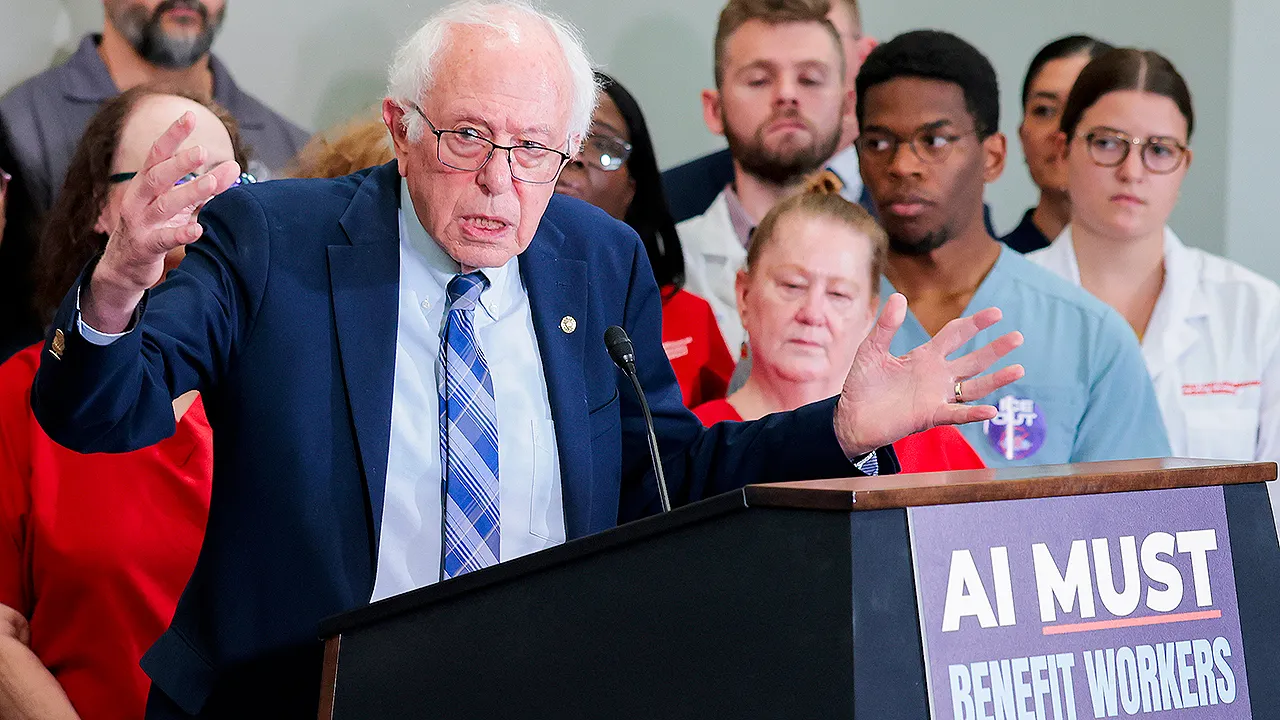
Senator Bernie Sanders is drawing sharp criticism for an upcoming panel discussion on Capitol Hill that includes officials linked to Chinese government-backed artificial intelligence initiatives, even as he advocates for policies that critics say would hamper America’s competitiveness in the global AI race.
The Vermont independent is scheduled to participate in Wednesday’s panel alongside Xue Lan, a professor at the Chinese Communist Party-funded Tsinghua University who chairs the Ministry of Science and Technology-backed New Generation Artificial Intelligence Governance Professional Committee. Also attending will be Zeng Yi, Dean of the Beijing Institute of AI Safety and Governance, who has ties to the same committee.
The event, which will focus on “AI existential risk and international cooperation,” according to Massachusetts Institute of Technology professor Max Tegmark, comes at a time of heightened tension between the United States and China over technological supremacy.
“What we shouldn’t do is partner with foreign adversaries like the Chinese Communist Party in these discussions,” said Michael Sobolik, a China policy expert at the Hudson Institute. While acknowledging that Sanders’ concerns about AI deserve consideration, Sobolik emphasized that collaboration with representatives of the Chinese government crosses a line.
Rep. Pat Harrigan (R-N.C.) pointed to Tsinghua University’s direct ties to the Chinese Communist Party, noting China’s recent aggressive actions in the AI sector. “China is aggressively locking down their most powerful AI assets and shutting American companies out,” Harrigan wrote on social media, referencing Beijing’s blocking of Meta’s $2 billion acquisition of Manus AI. “Bernie Sanders wants to hand them a seat at the table to help decide how America handles the same technology.”
The controversy arrives just months after Sanders and Representative Alexandria Ocasio-Cortez introduced the Artificial Intelligence Data Center Moratorium Act in March. The legislation would impose an immediate federal ban on constructing or upgrading AI data centers until Congress establishes a broader regulatory framework. Sanders’ office explicitly stated that the bill aims to “slow down the development of AI,” citing threats to jobs, privacy, democracy, and the environment.
Even fellow Democrats have criticized Sanders’ approach. Senator Mark Warner (D-Va.) called the proposed moratorium “idiocy” during a recent AI summit, warning it would give China a competitive advantage in the race to develop advanced artificial intelligence technologies.
Industry representatives have also voiced opposition. Cy McNeill, senior director of federal affairs at the Data Center Coalition, warned that freezing data center development would risk “rationing access to digital services” while impairing U.S. competitiveness. The Center for Data Innovation similarly criticized the bill for relying on “well-worn anxieties” without justifying such drastic measures.
The Chinese officials participating in Sanders’ panel have promoted governance models that would expand China’s role in establishing global AI rules – an approach that conflicts with America’s more market-driven strategy. Yi helped develop UNESCO’s Recommendation on the Ethics of AI and has advocated for mandatory safety and ethics frameworks with increased international cooperation. Lan has worked to establish a CCP-backed national AI safety body designed to connect technical experts with policymakers.
House Energy and Commerce Chairman Brett Guthrie contrasted these approaches in a February policy review: “China has chosen the path of top-down government control to drive its AI industry. While this strategy affords the CCP some advantages, the American model of bottom-up, free-market capitalism has long been the engine of innovation for the world, and it is more efficient in the long run.”
The global competition for AI dominance carries significant implications for national security, economic growth, and technological influence. As Senator Ted Cruz (R-Texas) has argued, “The way to beat China in the AI race is to outrace them in innovation, not saddle AI developers with European-style regulations.”
Sanders’ office did not respond to requests for comment before publication.
Fact Checker
Verify the accuracy of this article using The Disinformation Commission analysis and real-time sources.

10 Comments
While I appreciate Sen. Sanders’ intent to address critical AI safety risks, hosting Chinese officials linked to the CCP raises concerning questions. Maintaining American competitiveness in key technologies is crucial, even as we seek to cooperate globally on shared challenges.
The geopolitical tensions around AI and other cutting-edge technologies are understandable. However, I hope this meeting can find a constructive path forward on AI safety that serves the interests of all people, not just narrow political or economic agendas.
Navigating the complex dynamics between the US and China on technology issues is extremely delicate. I’m curious to see if this meeting can find common ground and advance cooperative solutions, despite the political baggage.
Agreed, this is a high-stakes balancing act. Fostering international cooperation on crucial challenges like AI safety is vital, but must be done thoughtfully to mitigate risks.
The US-China technology rivalry is a major geopolitical flashpoint. While I respect Sanders’ intent, hosting Chinese officials linked to the CCP on Capitol Hill is risky and could be seen as lending legitimacy to their agenda.
AI safety is a global imperative that demands collaborative solutions. However, the political sensitivities around US-China relations complicate this particular meeting. I hope the participants can find a way to advance productive dialogue without compromising principles.
AI safety is a global challenge that requires international collaboration. However, the political dynamics between the US and China add significant complicating factors. Transparent and ethical engagement is key, but the public perception risks here are substantial.
Balancing cooperation and competition in emerging technologies is an ongoing challenge for policymakers. This meeting highlights the difficult tradeoffs involved.
This is a sensitive issue with complex geopolitical implications. While cooperation on AI safety is critical, concerns about China’s human rights record and technological competition with the US are valid. The optics of this meeting are tricky and merit careful consideration.
I agree, the stakes around AI capabilities and influence are high. Reasonable people can disagree on the appropriate level of engagement with China on these issues.