


Listen to the article
US and China Reshape Airpower for Pacific Rivalry, Each Banking on Technology Supremacy
From new stealth bombers to AI-enabled drones, the United States and China are transforming their air forces in anticipation of a potential Pacific confrontation, with each nation betting its technological edge can dominate the skies.
The U.S. Air Force is moving forward with its next-generation F-47 fighter after briefly pausing the program earlier this year. In March, Boeing secured the contract for this sixth-generation manned fighter, designed to be the cornerstone of America’s future air superiority fleet. The first flight is scheduled for 2028.
Simultaneously, the B-21 Raider, intended to replace the aging B-2 stealth bomber, is undergoing extensive testing at Edwards Air Force Base. The Air Force plans to acquire at least 100 Raiders, specifically engineered to operate within heavily defended Chinese airspace.
Pentagon officials are also investing heavily in Collaborative Combat Aircraft (CCAs) – autonomous drones designed to accompany fighter jets as “loyal wingmen.” Companies like Anduril and General Atomics have already begun flight testing prototypes. Military planners envision scenarios where a single pilot could control multiple drones simultaneously, multiplying combat effectiveness.
“In terms of high-end military drones that are really important to this fight, the U.S. still has a pretty significant edge,” said Eric Heginbotham, a research scientist at MIT’s Center for International Studies. He cited the Air Force’s stealth reconnaissance platforms—the RQ-170 and RQ-180—as evidence of America’s continued leadership in advanced integration and stealth technology.
China’s Accelerated Development
China’s air force modernization has gained significant momentum as it focuses on three critical areas that have historically limited its capabilities: stealth technology, engine development, and carrier operations.
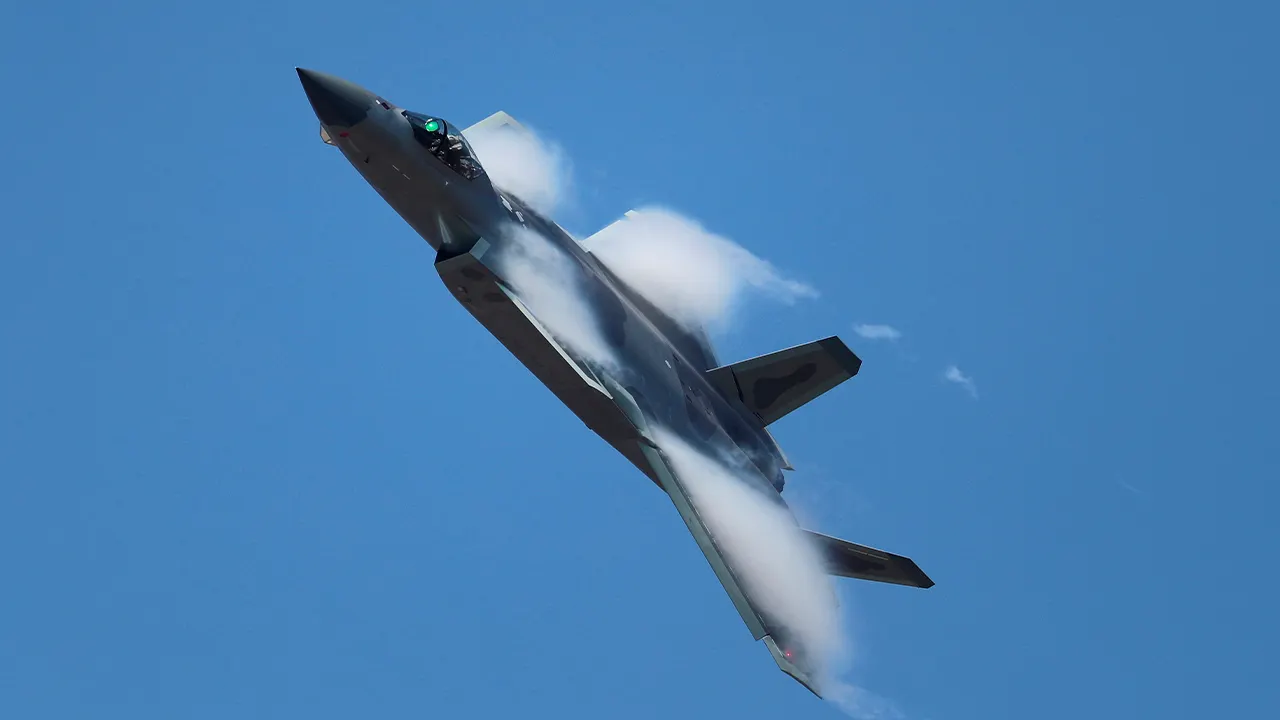
The Chengdu J-20, China’s premier stealth fighter, is currently being upgraded with the indigenous WS-15 engine, designed to rival American powerplants. However, Heginbotham notes that despite progress, “The J-20 really does not have a lot of the performance features that even the F-22 does, and we’ve had the F-22 for a long time.”
China reached another milestone this fall with the commissioning of its third aircraft carrier, the Fujian. This vessel represents a technological leap as the first Chinese carrier equipped with electromagnetic catapults similar to America’s Ford-class carriers, signaling Beijing’s ambition to operate stealth jets from sea and project power well beyond its coastline.
The combination of land-based J-20s, carrier-based J-35 fighters, and the Fujian carrier creates a layered airpower network supported by an extensive missile defense system.
Different Approaches to Air Dominance
The two military powers are pursuing distinct strategies to achieve the same goal: air superiority over the Pacific.
America’s approach relies on smaller numbers of highly advanced aircraft connected through sophisticated sensor networks and artificial intelligence. The objective is to strike first from long range while maintaining survivability in contested airspace.
China, conversely, is banking on volume—mass-producing fighters, missiles, and carrier operations to overwhelm American defenses and logistics networks.
“U.S. fighter aircraft—F-35s, F-15s, F-22s—are relatively short-legged, so they have to get close to Taiwan if they’re going to be part of the fight,” explained Mark Cancian, a retired Marine colonel and senior advisor at the Center for Strategic and International Studies. “They can’t fight from Guam, and they certainly can’t fight from further away. So if they’re going to fight, they have to be inside that Chinese defensive bubble.”
The Vulnerability Challenge
Both militaries face a critical challenge: surviving within China’s expanding defensive perimeter. Chinese missile capabilities are forcing U.S. aircraft to operate from greater distances, while American bombers and drones are specifically designed to penetrate these defenses.
Military analysts stress that survivability—not traditional dogfighting—will determine the outcome of future air competition. “We keep talking about aircraft as if it’s going to be like World War II—they go up, they fight each other. That’s not really our problem,” Heginbotham said. “Our problem is the air bases themselves and the fact that aircraft can be destroyed on the air base.”
Chinese military strategy specifically targets airfields as critical vulnerabilities. PLA campaign manuals prioritize runway strikes in the early phases of conflict to paralyze enemy air operations. Experts believe concentrated missile barrages could severely damage U.S. bases across Japan, Okinawa, and Guam within days.
“Unlike the United States, China is hardening its air bases. The U.S. is criminally negligent in its refusal to harden its air bases,” Heginbotham warned.
War-game simulations support these concerns. “At the initial stages of a conflict, China would have a distinct advantage,” Cancian said. “Now, over time, the U.S. would be able to reinforce its forces, and that would change.”
For decades, American air dominance was considered a given. In the Pacific theater today, that advantage can no longer be assumed as certain.
Fact Checker
Verify the accuracy of this article using The Disinformation Commission analysis and real-time sources.

7 Comments
Interesting update on Inside the U.S.-China Race for Air Dominance. Curious how the grades will trend next quarter.
Good point. Watching costs and grades closely.
If AISC keeps dropping, this becomes investable for me.
Good point. Watching costs and grades closely.
Interesting update on Inside the U.S.-China Race for Air Dominance. Curious how the grades will trend next quarter.
I like the balance sheet here—less leverage than peers.
Interesting update on Inside the U.S.-China Race for Air Dominance. Curious how the grades will trend next quarter.