


Listen to the article
The revolving door of enforcement traps Honolulu’s homeless in legal limbo, as citations surge with few results
In a Honolulu courtroom, Judge 7D called Yvonne Almond’s name for her latest charges – sitting on a public sidewalk and littering. But Almond was absent, like many others facing similar citations. The judge quickly dismissed her case for lack of evidence, a pattern that has repeated dozens of times for Almond this year alone.
Hours later, the 68-year-old woman could be found in Chinatown, sitting on a disposable blanket next to scattered belongings and a wheelchair. Wild-eyed with disheveled hair, she spoke incoherently, lighting a cigarette while sentences tumbled over each other.
This scene illustrates the reality of Honolulu’s intensified campaign against homelessness. Since August 2024, when Mayor Rick Blangiardi pledged to remove 1,000 people from the streets following a U.S. Supreme Court ruling that allowed cities to enforce anti-camping regulations, police have issued nearly 11,000 citations – a 60% increase from the previous year.
Yet the revolving door continues to spin. While citations have ballooned, the number of people being cited remained steady at approximately 3,200. Many individuals are simply receiving multiple tickets, sometimes several in a single day.
“It’s constant,” said Sharolyn Rodrigues, a former police officer who was cited 46 times in a year – nearly once weekly. Now 54, she spends her days in Thomas Square guarding shopping carts filled with belongings and caring for four small dogs.
When cited, Rodrigues simply moves down the street or around the block before eventually returning to the same area. “It’s all a waste of time,” she said.
Court records reveal a troubling pattern: more than a third of citations issued in the year following Blangiardi’s promise went to just 170 people, each receiving at least a dozen tickets. More than half of cases involved someone cited six or more times, and 83% of all citations were given to repeat offenders.
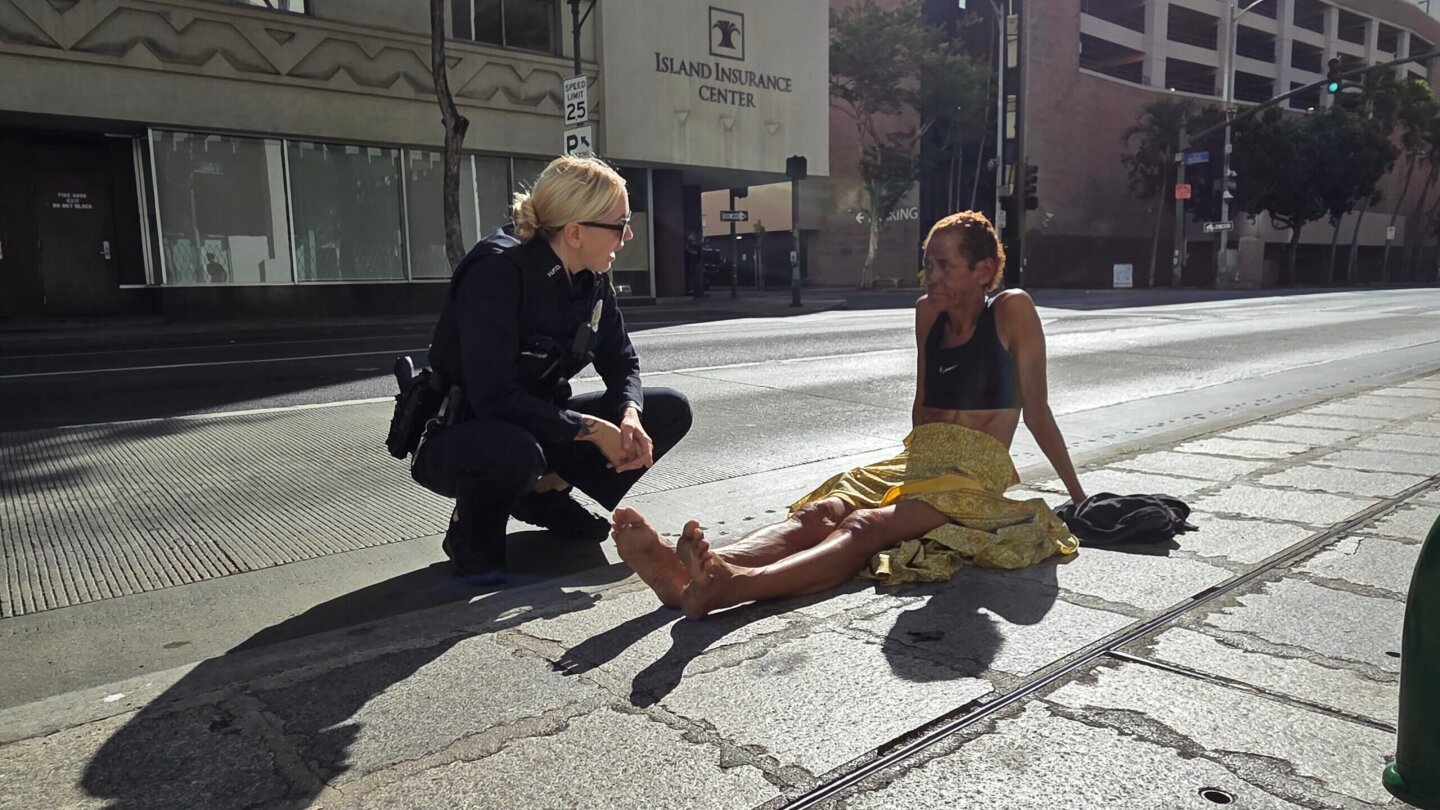
Honolulu Police Officer Molly Wilt encounters this reality daily in her Chinatown beat. On a typical shift, she issues multiple warnings to people violating the sit-lie ordinance, which prohibits sitting or lying on public sidewalks between 5 a.m. and 11 p.m.
“Imagine how Chinatown would be if we had nothing to move people to get up off the sidewalk,” Wilt said. “We’re not out to make anybody’s life harder…but if we didn’t enforce it, people would be lying on every corner.”
Yet enforcement rarely leads to meaningful outcomes. Of all citations issued in the year following the mayor’s pledge, at least three-quarters were either dismissed by judges or dropped by prosecutors – a rate unchanged from the previous year.
“That’s the part we’re stumbling over right now,” Blangiardi acknowledged regarding the high dismissal rate.
The public defender’s office sees the cycle clearly. “We see the same individuals over and over coming back through the system in the same exact situation with the same exact offenses,” said First Deputy Public Defender Hayley Cheng. “On its face, that’s indicative that we’re not or the system is not addressing the underlying issue, which is the fact that they are houseless.”
Homeless advocates point to deeper issues. Many living on the streets struggle with mental illness or substance abuse and repeatedly refuse services when offered. Citation after citation contains the notation “Refused shelter” or “Refused services.”
“People are kind of trapped in a system that doesn’t really guide them to maybe what they need,” said Connie Mitchell, executive director of the Institute for Human Services, Oahu’s largest homeless services provider. “But also they won’t accept what is really needed.”
The city has made efforts beyond enforcement, investing millions to add 1,000 new shelter beds and increase treatment slots. It also created an island-wide outreach team to respond to people in crisis and established the Homeless Outreach and Navigation for Unsheltered program (HONU), a popup offering short-term beds and services.
In the 13 months before October, HONU recorded 957 intakes. About half resulted in people moving to shelters or other facilities, while the remainder either left without a recorded destination or were ejected for rule violations.
Anton Krucky, director of the Department of Community Services, considers these numbers a success but acknowledges room for improvement. “The enforcement’s really not a homeless strategy,” Krucky said. “The real strategy that the mayor has for homeless is treatment and beds.”
Laura Thielen, executive director of Partners in Care, a coalition coordinating Oahu homeless services, believes the city should focus more on outreach and housing placement models that have succeeded elsewhere. She points to the Encampment Resolution approach used in Washington State, Denver and New Orleans, where outreach teams work with homeless individuals for months before moving them into housing.
“As a community member, I don’t want to see people living in our parks, but how we get to that solution can either be enforcement or enforcement balanced with true solutions,” Thielen said. “What we’re accomplishing with the sit-lie is we’re exchanging a long-term solution for a short-term solution.”
Meanwhile, on Oahu’s streets, the cycle continues. For at least seven of the ten most frequently cited homeless people last year, life remains unchanged. The individual cited most often – 286 times – is missing.
Fact Checker
Verify the accuracy of this article using The Disinformation Commission analysis and real-time sources.

20 Comments
Interesting update on Honolulu’s campaign against homelessness is a revolving door of citations and court dismissals. Curious how the grades will trend next quarter.
I like the balance sheet here—less leverage than peers.
Exploration results look promising, but permitting will be the key risk.
Good point. Watching costs and grades closely.
Silver leverage is strong here; beta cuts both ways though.
Good point. Watching costs and grades closely.
Good point. Watching costs and grades closely.
Silver leverage is strong here; beta cuts both ways though.
The cost guidance is better than expected. If they deliver, the stock could rerate.
Uranium names keep pushing higher—supply still tight into 2026.
Good point. Watching costs and grades closely.
Good point. Watching costs and grades closely.
Nice to see insider buying—usually a good signal in this space.
Good point. Watching costs and grades closely.
Silver leverage is strong here; beta cuts both ways though.
Good point. Watching costs and grades closely.
Good point. Watching costs and grades closely.
Uranium names keep pushing higher—supply still tight into 2026.
Good point. Watching costs and grades closely.
The cost guidance is better than expected. If they deliver, the stock could rerate.