


Listen to the article
From Pandemic Distrust to Conservative Advocacy: The Rise of Christian Women Influencers
Years before becoming a homeschool advocate in rural Arkansas, Taylor Moran was a liberal Dallas mother who supported Bernie Sanders. Her transformation began during the COVID-19 pandemic when she became disillusioned with government responses.
“It was a lot of rules, a lot of hysteria, a lot of things that didn’t make sense,” Moran told Religion News Service.
Following what she described as an “overnight spiritual experience” in early 2021, Moran embraced Christianity and relocated her family to Arkansas. Her social media content, while not explicitly political, reflects her evolving beliefs about natural foods, outdoor education, and traditional gender roles.
Moran represents a growing trend of American mothers who, in the aftermath of the pandemic, began questioning institutions they once trusted. This vacuum created an opportunity for conservative Christian women influencers who blend religious messaging with polished aesthetics and personal storytelling to build credibility on issues ranging from food safety to transgender rights.
Political commentator Allie Beth Stuckey, wellness advocate Alex Clark, and anti-transgender activist Riley Gaines Barker exemplify this movement. By addressing maternal concerns about children’s health, education, and development, they’ve created an entry point for conservative political engagement that many frame as part of a larger spiritual battle.
“Post-COVID, a lot of people felt isolated. And post all of the events of 2020, a lot of Christian women felt like, oh my goodness, I’m alone,” explained Stuckey, whose “Relatable” podcast has amassed a substantial following since 2018. “People really feared saying what they believed to be true, because they didn’t want to be canceled or condemned.”
For many women, COVID-19 vaccine requirements marked a turning point. Alex Clark, a 32-year-old wellness influencer based in Scottsdale, Arizona, recalled her growing skepticism: “They’re telling us that we all need to be vaccinated with the COVID vaccine. If we don’t… you may or may not be able to participate in public life, essentially. That was deeply unsettling and disturbing to me.”
Sociologist Katie Gaddini, author of “Esther’s Army: The Christian Women Who Power the American Right,” notes that 2020 created a perfect storm of conservative disillusionment through pandemic skepticism, opposition to Black Lives Matter protests, and disbelief over Trump’s election loss. “That shift has elevated the trust and the importance that is given to these forms of Christian conservative media figures,” she explained.
Clark, once self-described as an “ultimate Chicken Nugget princess,” now reaches over half a million Instagram followers with content covering everything from regenerative farming to male headship in marriage. Her Turning Point USA-affiliated podcast “Culture Apothecary” champions the Make America Healthy Again movement associated with Robert F. Kennedy Jr.
“If the government is lying to you about the food pyramid… you think that they don’t lie to you about other things?” Clark told RNS, illustrating how health concerns can serve as an entry point to broader conservative ideology.
Personal experiences bolster these influencers’ credibility. Former collegiate swimmer Riley Gaines Barker’s activism stems directly from competing against transgender athlete Lia Thomas in 2022. Clark connects her advocacy to her father’s death at 57, which she attributes partly to his consumption of ultra-processed foods.
These influencers maintain a delicate balance—asserting leadership without embracing feminism and promoting traditional gender roles without identifying as “trad wives.” They prioritize femininity over feminism, showcasing their roles as wives and mothers while maintaining professional careers.
“I think we’re beginning to see a shift away a little bit from the whole girl boss culture,” said Gaines Barker, who hosts “Gaines for Girls” on Fox Corporation’s OutKick platform.
Sara Petersen, author of “Momfluenced,” observes that traditional markers of femininity grant these influencers a “morality that we sort of assume is sacrosanct,” enhancing their persuasive power.
Despite conservatives’ current political influence, these influencers portray themselves as embattled defenders in a culture war. They frame challenges to their values as not merely cultural but spiritual battles, with Clark describing conventional farming as “deeply demonic” and Gaines Barker characterizing her anti-transgender activism as part of a “spiritual awakening.”
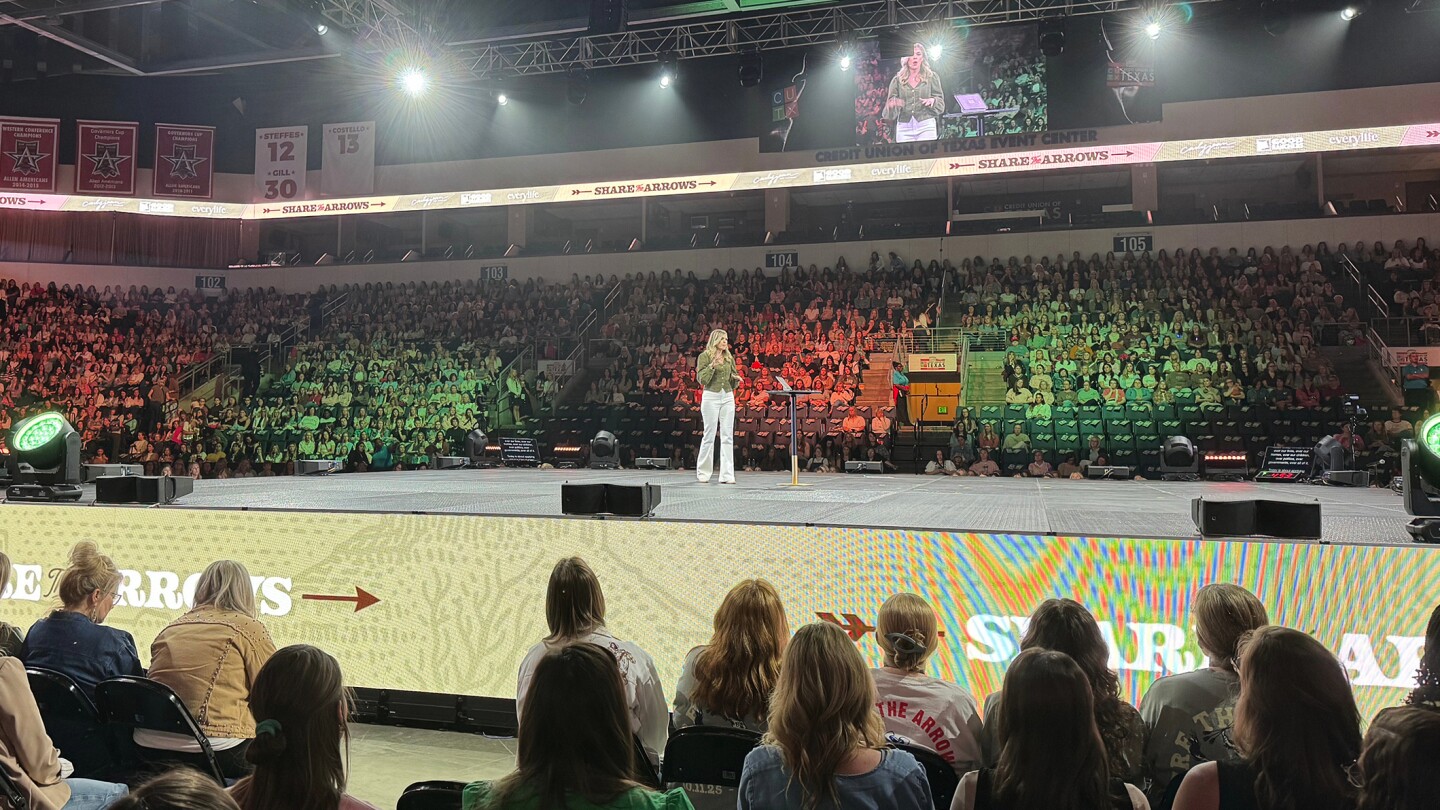
“This is a fight to which every single Christian is called,” Stuckey told 6,700 attendees at her recent conference. “This is a spiritual battle that is waged in our homes and in our neighborhoods, at school, at your job.”
Their advocacy has yielded tangible policy outcomes. Georgia and West Virginia have passed bills named for Gaines Barker restricting transgender participation in women’s sports, and at least 27 states have enacted similar legislation. Clark has testified in favor of banning certain ultra-processed foods in Arizona schools.
As their influence grows, some advocates have adopted increasingly polarizing rhetoric. Gaines Barker refuses to use transgender individuals’ chosen names and pronouns in the name of “telling someone the truth,” while Clark characterizes hormonal birth control as “poison” and links processed foods to government dependency.
Critics like Petersen worry that dehumanizing rhetoric can justify harmful policies or even violence. “Their rhetoric does help support a lot of legislation and policies that are straightforwardly violent,” she said.
However, those within the movement view their growing boldness as evidence of success. Payton McNabb, a young conservative activist who claims she was injured playing volleyball against a transgender competitor, celebrates that viewpoints once considered controversial are becoming more acceptable.
“I definitely do think it’s a culture war, and I think that we’re starting to get the upper hand finally,” McNabb told RNS. “I’m very thankful to be a part of that shift.”
Fact Checker
Verify the accuracy of this article using The Disinformation Commission analysis and real-time sources.

18 Comments
The article highlights an intriguing shift in the political landscape, where personal experiences and faith-based messaging are gaining traction. It will be important to closely monitor how these ‘momfluencers’ continue to shape the discourse, especially on issues like gender and healthcare.
You make a valid point. The ability of these influencers to leverage their personal stories and religious beliefs to impact political debates is certainly noteworthy and warrants further investigation.
The article sheds light on an intriguing trend where personal experiences and faith-based messaging are gaining traction in the political sphere. It will be important to closely monitor how these ‘momfluencers’ continue to shape debates on issues like healthcare, education, and social values.
You make a valid point. The ability of these influencers to leverage their personal stories and religious beliefs to impact political discussions is certainly noteworthy and deserves further examination.
Fascinating to see how the pandemic has influenced the political views of some mothers. It highlights how personal experiences can shape one’s beliefs, even on complex issues. I’m curious to learn more about the intersection of religion, parenting, and political advocacy.
You raise a good point. The pandemic seems to have been a significant catalyst for some people’s shift in political views and affiliations. It will be interesting to see how this trend evolves.
This is a complex and nuanced issue without easy answers. The rise of Christian ‘momfluencers’ reflects broader societal trends and the power of personal narratives in shaping political discourse. It will be interesting to see how this dynamic evolves and the long-term impacts on American politics.
Agreed, this is a multi-faceted issue that deserves careful examination. The interplay of faith, family, and politics is an important area of study, as it reveals much about the changing landscape of American society and values.
This is a thought-provoking article that sheds light on the growing influence of Christian ‘momfluencers’ in American politics. The intersection of faith, family, and political advocacy is a complex and evolving dynamic that deserves close attention.
Agreed. The ability of these influencers to blend personal narratives, wellness, and conservative values is an intriguing development that will likely continue to shape political discourse in the coming years.
The article provides a fascinating glimpse into the shifting political landscape, where personal experiences and faith-based messaging are gaining traction. It will be important to follow how these ‘momfluencers’ continue to impact debates on issues like healthcare, education, and social values.
You raise an important point. The ability of these influencers to leverage their personal stories and religious beliefs to shape political discussions is quite remarkable and will likely have far-reaching implications.
This trend of Christian ‘momfluencers’ gaining influence on the American right is certainly noteworthy. Their personal narratives and blend of religion, wellness, and politics appear to be resonating with many. I wonder how their messaging and impact will continue to evolve.
Agreed. The ability of these influencers to leverage their personal stories and online platforms to shape political discourse is quite remarkable. It will be important to follow how this dynamic plays out.
This is a nuanced and complex issue that deserves thoughtful analysis. The rise of Christian ‘momfluencers’ and their ability to blend personal narratives, faith, and political advocacy is a fascinating development that warrants close observation.
Agreed. The interplay of faith, family, and politics is a critical area of study, as it reveals much about the evolving landscape of American society and the shifting dynamics of political discourse.
The article highlights an intriguing intersection of faith, parenting, and politics. It’s thought-provoking to see how individual experiences during the pandemic have led some mothers to re-evaluate their beliefs and political affiliations. This shift bears close watching.
You make a good point. The pandemic seems to have been a significant disruptive force that has reshaped the worldviews of some parents, leading them to seek out new sources of information and community. The implications of this trend warrant further analysis.