


Listen to the article
When President Abraham Lincoln established Thanksgiving as a national holiday in 1863, he unknowingly began the decline of what was once America’s most prominent patriotic November celebration: Evacuation Day.
Commemorated on November 25, Evacuation Day marked the final withdrawal of British forces from New York City in 1783, effectively ending the Revolutionary War on American soil. The celebration, which for decades outshined both Thanksgiving and Independence Day in cultural significance, has largely faded from national consciousness.
Following the Declaration of Independence in 1776, New York City remained a British stronghold throughout the Revolutionary War. The city served as the crown’s military and political center in North America, with captured Continental soldiers held aboard prison ships in New York Harbor.
The signing of the Treaty of Paris in 1783 forced British troops to abandon their last American foothold. On November 25 of that year, approximately 6,000 British soldiers began their journey back across the Atlantic to King George III, marking the final chapter of British colonial rule in the newly formed United States.
The day wasn’t without drama. As British forces departed, they attempted one final act of defiance by greasing flagpoles that still flew the Union Jack, including a prominent one at Bennett Park near Manhattan’s northern tip. Undeterred, Revolutionary War veteran Sergeant John van Arsdale fashioned makeshift cleats that allowed him to scale the slippery pole and replace the British flag with the Stars and Stripes. From this elevated position—the highest point on Manhattan Island—the American flag could be seen across much of the city, symbolizing the complete reclamation of New York.
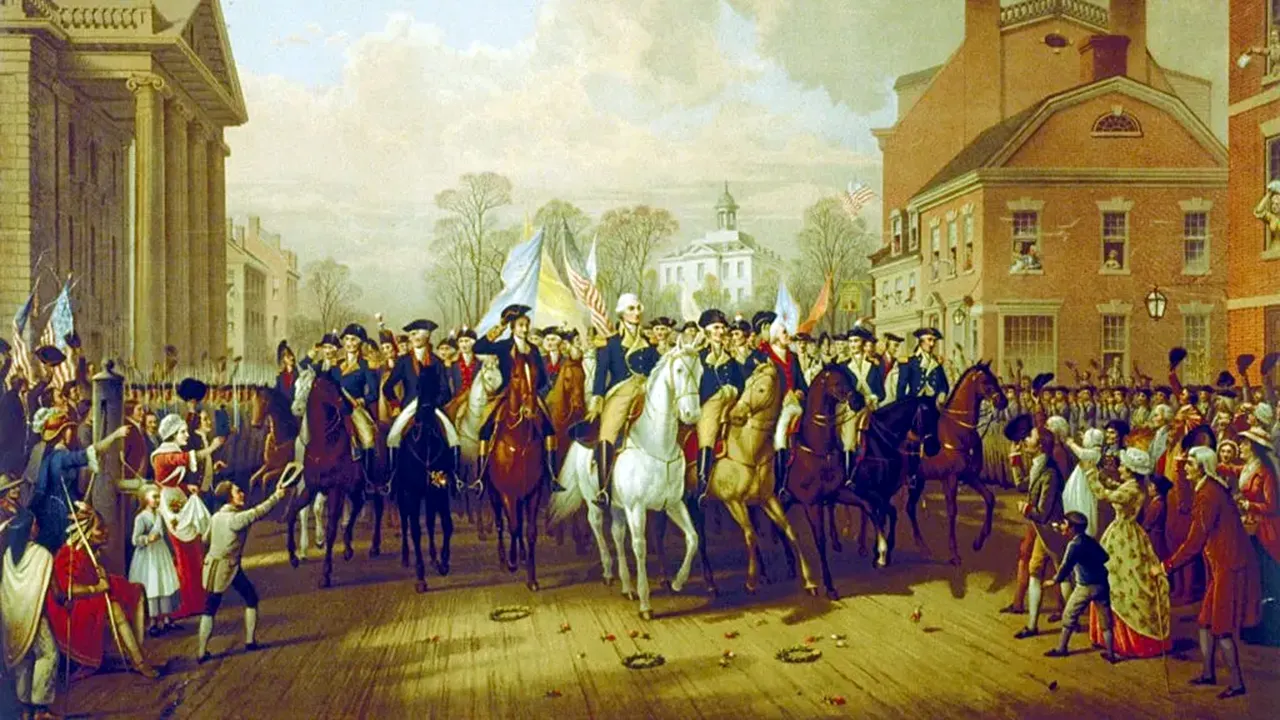
Later that day, General George Washington and New York Governor George Clinton, who had negotiated the evacuation terms with England’s Canadian Governor Sir Guy Carleton, led a triumphant military procession down Broadway. Throngs of jubilant citizens lined the route as American forces formally reclaimed the city.
The procession concluded at Fraunces Tavern near Wall Street, where Clinton hosted Washington for dinner and a “Farewell Toast.” The tavern’s owner, Samuel Fraunces, had provided both food and intelligence to the Continental Army during the war. Just over a week later, Washington would return to the tavern to deliver his emotional farewell address to his officers before retiring from military service.
“With a heart full of love and gratitude, I now take leave of you. I most devoutly wish that your latter days may be as prosperous and happy, as your former ones have been glorious and honorable,” Washington told his assembled officers.
For nearly a century after the Revolution, Evacuation Day remained a major civic holiday, particularly in New York. Schools closed for the day, commemorative flag-raisings were held, and celebrants recreated van Arsdale’s climb up the flagpole at Bennett Park. Formal dinners at prestigious venues like the Plaza Hotel and Delmonico’s Steakhouse were annual traditions, with the New York Public Library still preserving a Delmonico’s menu from the Evacuation Day centennial celebration in 1883 featuring fish, pheasant, and turkey.
The city also hosted an official Evacuation Day parade until the early 1910s, reminiscent of today’s Macy’s Thanksgiving Parade in scale and importance.
Several factors contributed to Evacuation Day’s decline. As diplomatic relations with the United Kingdom warmed in the early 20th century and the two nations became crucial allies during both World Wars, celebrating British defeat became less politically appropriate. Simultaneously, Thanksgiving’s transformation into a standardized national holiday—codified by Congress in the 1940s as the fourth Thursday in November—gradually overshadowed the patriotic celebration.
Despite its diminished prominence, commemorations of Evacuation Day haven’t completely disappeared. In recent years, the Lower Manhattan Historical Association has organized processions from Fraunces Tavern to Evacuation Day Plaza—now home to Wall Street’s famous “Charging Bull” statue. Ceremonial flag-raisings still take place at Bowling Green, the oldest public park in the city and once a regular gathering place in British Colonial New York.
Perhaps most enduring are the thirteen toasts raised at the original Evacuation Day celebration, representing the thirteen United States. These toasts, recorded by Washington’s aide for posterity, are still recited by the Sons of the American Revolution at annual dinners. They include tributes to the United States, King Louis XVI of France, and “the vindicators of the rights of mankind in every quarter of the globe.”
The thirteenth and final toast offered a warning to any nation that might threaten American sovereignty: “May the remembrance of this day be a lesson to princes.”
Fact Checker
Verify the accuracy of this article using The Disinformation Commission analysis and real-time sources.

8 Comments
Fascinating history! I didn’t know about Evacuation Day and how it rivaled Independence Day before Thanksgiving became a national holiday. It’s intriguing how cultural celebrations can rise and fall over time.
I agree, it’s remarkable how this patriotic commemoration faded from prominence. I wonder what factors led to its decline relative to Thanksgiving and the Fourth of July.
It’s curious how Evacuation Day lost its prominence compared to Thanksgiving and Independence Day over time. I wonder if there are any efforts to revive interest in this important historical event and holiday.
This is the first I’ve heard of Evacuation Day, but it sounds like it was a really significant event in the early days of the United States. I appreciate learning about these kinds of overlooked historical holidays and celebrations.
The details about the British forces withdrawing from New York City in 1783 are really interesting. It must have been quite a momentous occasion for the newly formed United States to finally see the last of the colonial occupiers.
Absolutely, the end of British rule in America after the Revolutionary War was a hugely significant milestone. No wonder Evacuation Day was celebrated so enthusiastically for so long.
The article provides a great overview of the history behind Evacuation Day and how it used to be a major patriotic celebration. I’m always fascinated to learn about lesser-known historical events and how they evolved.
Same here. It’s a good reminder that there are many important historical milestones that have faded from popular consciousness over time. Preserving and commemorating them is valuable.