


Listen to the article
Democratic Leaders Force USC to Cancel Gubernatorial Debate Over Diversity Concerns
The University of Southern California (USC) canceled its planned gubernatorial debate after facing intense pressure from top California Democratic lawmakers who objected to the all-white candidate lineup that resulted from the university’s selection criteria.
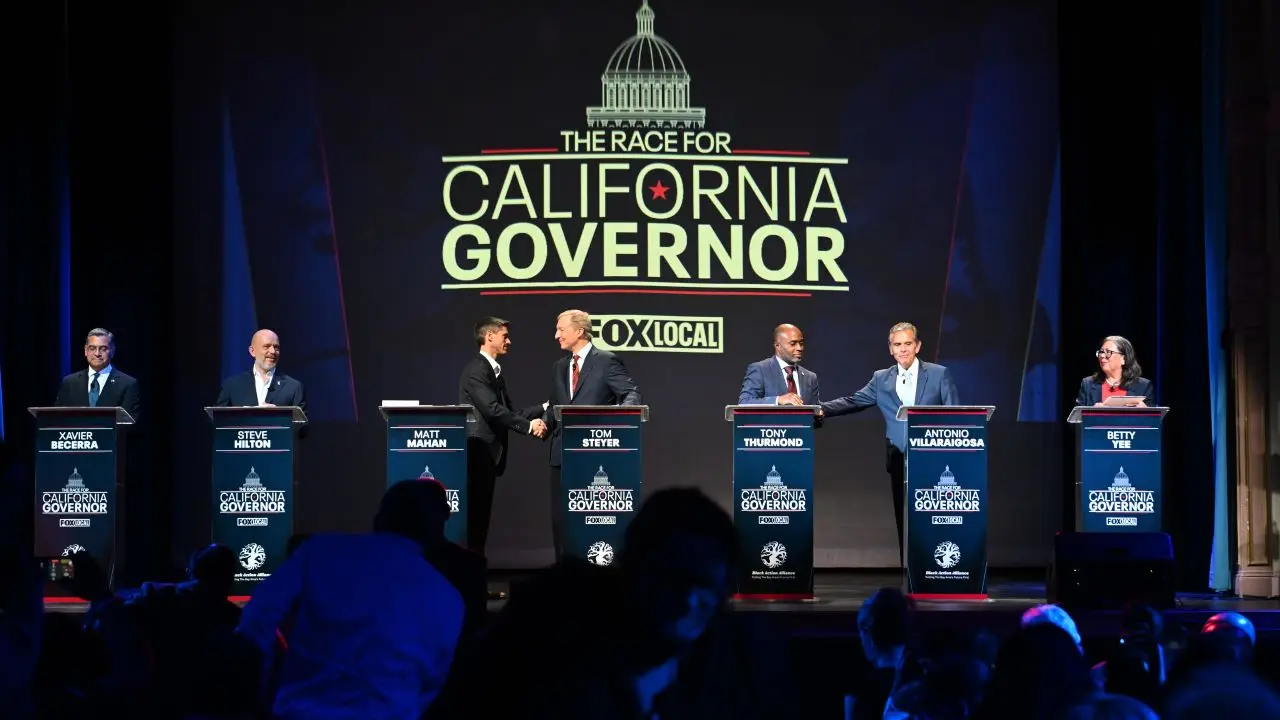
The controversy erupted when USC’s “data-driven” candidate viability framework produced a debate roster consisting of Republicans Chad Bianco and Steve Hilton, alongside Democrats Tom Steyer, Matt Mahan, Katie Porter, and Eric Swalwell – all of whom are white. The same criteria excluded four minority Democratic candidates: former Health and Human Services Secretary Xavier Becerra, former Los Angeles Mayor Antonio Villaraigosa, former State Controller Betty Yee, and State Superintendent Tony Thurman.
According to USC, the excluded candidates fell short on polling and fundraising metrics used in the selection process developed by a university professor. The decision sparked immediate backlash from those left out, with some claiming the system was inherently racist.
Becerra, who served in President Biden’s cabinet, drew a stark historical comparison, likening the situation to when his father would encounter signs reading “No Dogs, Negroes or Mexicans Allowed.”
The pressure campaign escalated when California Senate President pro Tempore Monique Limon and Assembly Speaker Robert Rivas, along with other Democratic legislators, sent a letter to USC President Beong-Soo Kim. The lawmakers called the selection framework “biased” and labeled the excluded candidates’ complaints as “valid.”
“If USC does not do the right thing, we call on California voters to boycott this debate. If the university will not give voters a fair shot at evaluating everyone running for governor, voters should find other ways to learn about the candidates,” the letter stated. It carried letterhead featuring logos of approximately half a dozen Democratic Party caucuses in California.
The lawmakers’ letter also raised concerns about one selected candidate’s connections to USC’s donor community. When pressed for clarification, Speaker Rivas’s staff confirmed they were referring to Matt Mahan, a tech entrepreneur and former Mayor of San Jose.
With the debate scheduled for the following day, USC announced its cancellation, explaining that KABC, the Los Angeles television station set to broadcast the event, could not reach an agreement to expand the candidate pool.
Republican candidate Steve Hilton, one of the frontrunners in the race, provided insight into the behind-the-scenes pressure. “The top signatories to this letter, Robert Rivas, who is the Speaker of the Assembly, and Monique Limon, who’s the head of the Senate – that came very late on Monday,” Hilton explained. “They get this letter from the legislature, they think, ‘Oh, sh–t, we better do something. This is now a real threat. This isn’t just the candidates complaining. This is the legislature, which regulates and affects everything we do.'”
According to Hilton, USC approached ABC about expanding the debate to include the excluded candidates, but the network declined, leading to the event’s cancellation.
Despite the controversy, the race’s overall dynamics remain unchanged. A party-sponsored poll from Democratic State Chairman Rusty Hicks shows Republicans Hilton and Bianco leading the field at 16% and 14% respectively, with Democrats Porter, Swalwell, and Steyer tied at 10%. The excluded Democratic candidates, including Becerra, remain in the low single digits, with 24% of voters still undecided.
The debate cancellation highlights the increasing tension around representation and diversity in California politics, where demographics have shifted dramatically in recent decades. It also demonstrates the significant influence that legislative leadership can wield over institutions like USC, which must navigate both political and public relations considerations in the nation’s most populous state.
Fact Checker
Verify the accuracy of this article using The Disinformation Commission analysis and real-time sources.

12 Comments
This is a tricky situation with no easy answers. On one hand, diversity in political debates is crucial. But the university’s data-driven selection process also seems reasonable, even if the outcomes were controversial. I hope they can find a balanced solution that satisfies all sides.
Agreed. Compromise and open dialogue will be key here. Forcing a particular outcome through political pressure is not the right approach, in my view. I’m curious to see how this plays out.
This seems like a complex issue with valid concerns on both sides. On one hand, diversity in political debates is important. But the data-driven selection process also raises questions about its fairness and potential bias. I hope USC can find a way to resolve this productively.
Agreed. Hopefully they can revisit the criteria and find a way to include a broader range of perspectives while still maintaining some objective standards. It’s a delicate balance.
Interesting to see the debate controversy at USC. Diversity in representation is important, but it sounds like the selection process was flawed. I hope they can find a way to host a fair debate that includes a range of perspectives.
Yes, this is a tricky situation. Exclusion based on polling and fundraising metrics may disadvantage less-established candidates. A more inclusive process could lead to a richer debate.
As someone interested in mining and energy issues, I’m curious how this debate controversy might impact discussions around those topics. Hopefully the candidates can still find a way to engage on the full range of policy priorities, including critical resource development.
That’s a good point. Debates on mining, energy, and natural resources are so important. I hope the candidates still get a chance to share their views, even if the format has to change.
The pressure campaign by California Democrats against USC’s debate plans is concerning. While diversity is important, it seems the university was trying to apply objective metrics. Excluding candidates solely based on race or ethnicity sets a dangerous precedent, in my view.
I share your concerns. Resorting to political pressure to force a particular outcome, rather than working constructively, is worrying. This is a complex issue that deserves a thoughtful, principles-based solution.
As someone who follows mining and energy issues closely, I’m disappointed to see this debate controversy overshadowing discussions of those important topics. Regardless of the diversity concerns, I hope the candidates can still engage substantively on critical resource development and policy priorities.
That’s a really good point. Debates on mining, energy, and commodity markets are so vital, and I share your hope that the candidates can find a way to address those issues thoroughly despite the logistical challenges.