


Listen to the article
Federal Appeals Court Halts Restrictions on Immigration Agents in Chicago
A federal appeals court on Wednesday temporarily suspended an order that limited how federal immigration agents could use force in the Chicago area, calling the original injunction “overbroad” and “too prescriptive.”
The 7th U.S. Circuit Court of Appeals issued a stay of the preliminary injunction that had been granted earlier this month by U.S. District Judge Sara Ellis. However, the three-judge panel cautioned against “overreading” their decision and suggested an expedited appeal process could result in a “more tailored and appropriate” order.
The legal battle stems from a lawsuit filed by news outlets and protesters who alleged federal officers employed excessive force during a widespread immigration enforcement operation that has resulted in more than 3,000 arrests across Chicago and its suburbs since September. This crackdown represents one of the largest coordinated immigration enforcement actions in the nation’s third-largest metropolitan area in recent years.
In granting the stay, the appeals court indicated the government’s arguments were likely to prevail. “In no uncertain terms, the district court’s order enjoins an expansive range of defendants, including the President of the United States, the entire Department of Homeland Security and Justice, and anyone acting in concert with them,” the ruling stated.
The court further noted that Judge Ellis’ order was excessively detailed in specifying prohibited types of riot control weapons and devices in a manner that “resembles a federal regulation.”
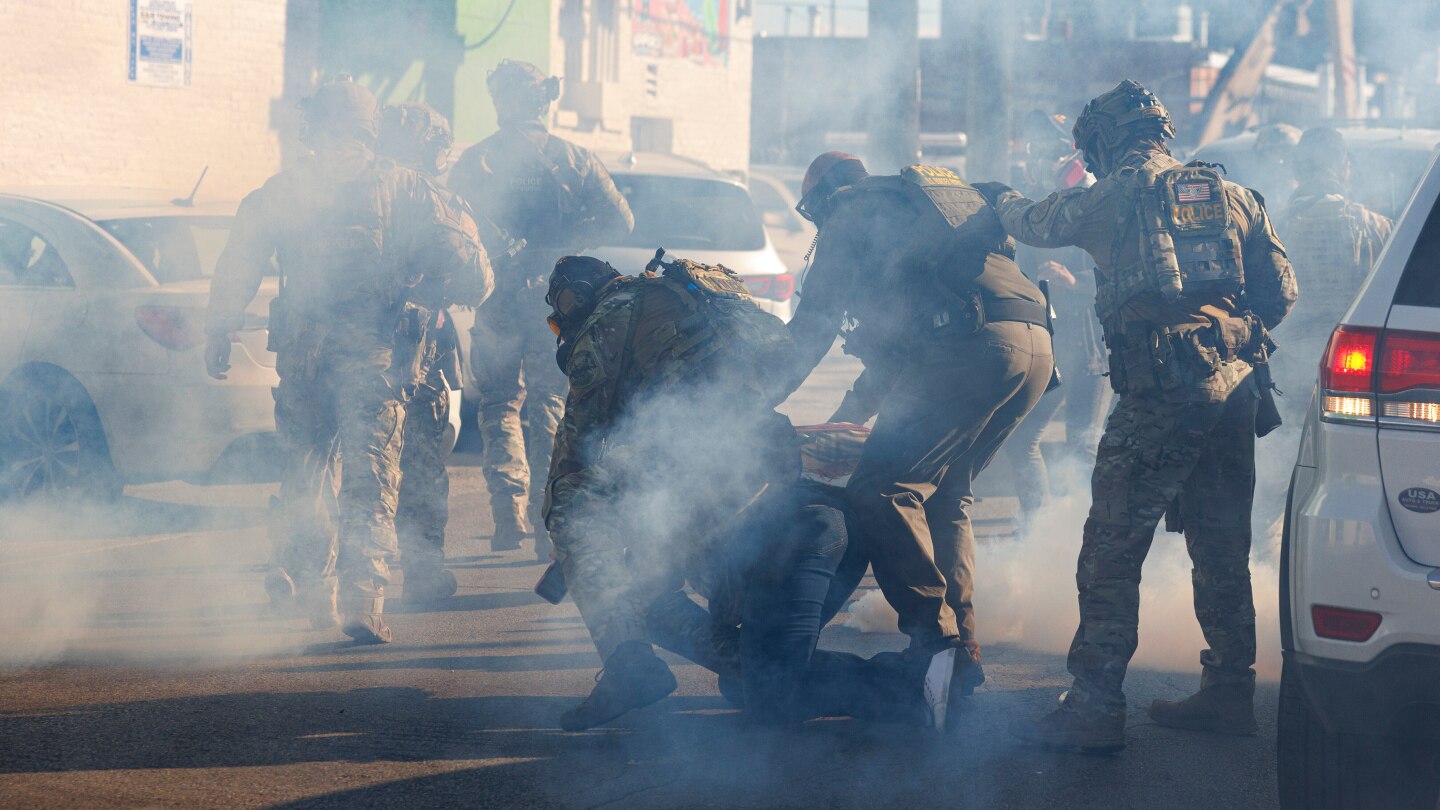
Ellis’ original order had placed significant restrictions on federal agents, prohibiting them from using physical force and chemical agents such as tear gas and pepper balls unless necessary to prevent “an immediate threat.” She determined these enforcement practices violated the constitutional rights of journalists and protesters monitoring or demonstrating against the operations.
During earlier court hearings, witnesses provided emotional testimony describing their experiences during enforcement actions. They recounted being exposed to tear gas, being shot in the head with pepper balls while praying, and having firearms pointed at them. Judge Ellis found the testimony from Trump administration witnesses, including Gregory Bovino, the Border Patrol commander who initially led the Chicago operation, “simply not credible.”
The Department of Homeland Security welcomed the appeals court decision. Assistant Secretary Tricia McLaughlin characterized the stay as “a win for the rule of law and for the safety of every law enforcement officer.” Attorneys representing the plaintiffs did not immediately respond to requests for comment.
Bovino, who normally heads a Border Patrol sector in El Centro, California, has consistently defended the agents’ use of force during the operations. He supervised approximately 230 agents from U.S. Customs and Border Protection in the Chicago area beginning in September before recently being reassigned to North Carolina. Federal border agents are expected to be deployed next to New Orleans, suggesting a continuation of the administration’s targeted immigration enforcement strategy in major urban centers.
The Chicago immigration operation has sparked multiple legal challenges beyond concerns about excessive force. Another lawsuit alleges inhumane conditions at a federal immigration detention center outside Chicago. That complaint prompted a federal judge and attorneys to personally inspect the longstanding U.S. Immigration and Customs Enforcement facility last week.
The ongoing legal battles highlight the tensions between aggressive immigration enforcement policies and civil liberties concerns, particularly as federal authorities continue large-scale operations in major metropolitan areas across the country. Immigration advocates argue these operations often lead to civil rights violations, while federal officials maintain they are necessary for enforcing immigration laws.
Fact Checker
Verify the accuracy of this article using The Disinformation Commission analysis and real-time sources.

22 Comments
If AISC keeps dropping, this becomes investable for me.
Good point. Watching costs and grades closely.
I like the balance sheet here—less leverage than peers.
Interesting update on Appeals court pauses order restricting use of force by immigration agents in Chicago-area crackdown. Curious how the grades will trend next quarter.
I like the balance sheet here—less leverage than peers.
Good point. Watching costs and grades closely.
I like the balance sheet here—less leverage than peers.
Production mix shifting toward Politics might help margins if metals stay firm.
Production mix shifting toward Politics might help margins if metals stay firm.
Good point. Watching costs and grades closely.
Good point. Watching costs and grades closely.
Uranium names keep pushing higher—supply still tight into 2026.
Good point. Watching costs and grades closely.
Interesting update on Appeals court pauses order restricting use of force by immigration agents in Chicago-area crackdown. Curious how the grades will trend next quarter.
Good point. Watching costs and grades closely.
Good point. Watching costs and grades closely.
I like the balance sheet here—less leverage than peers.
Good point. Watching costs and grades closely.
Good point. Watching costs and grades closely.
Nice to see insider buying—usually a good signal in this space.
Good point. Watching costs and grades closely.
Good point. Watching costs and grades closely.