


Listen to the article
Communist and socialist activists are increasingly joining broader liberal protest movements in the United States, advocating for radical economic reforms that would fundamentally transform the nation’s economic structure, according to interviews conducted at a recent Minneapolis demonstration.
These far-left participants, once considered fringe elements, are now regularly appearing alongside mainstream activists at workers’ rights, immigrant rights, and “No Kings” protests, where they promote a dramatic shift away from private ownership and free-market principles.
At a May Day demonstration in Minneapolis, members of the Revolutionary Communists of America openly advocated for systemic change. Owen Phernetton, identified by his “Communism Will Win” sweater, told reporters, “We are building a party of professional class fighters, people who are seriously looking at the system of capitalism and coming to the conclusion that we need a revolution on a socialist basis.”
Phernetton’s vision includes placing factories, mines, and businesses under collective worker control, limiting rent to a fraction of workers’ income, and redistributing wealth from billionaires to fund government services. He also proposed reducing the standard workweek to 20 hours without reducing pay, arguing that “productivity will increase if the economy operates on a planned basis” with the working class controlling all productivity.
The protest showcased how different left-wing groups operate within broader progressive events. While immigrant rights organizers led the march with banners demanding “Legalization for All, Sanctuary State Now,” communist and socialist groups positioned themselves strategically throughout the demonstration. Some marched behind the main contingent while others worked the perimeter, distributing literature and engaging directly with bystanders.
Andy Koch of the Freedom Road Socialist Organization echoed similar sentiments, claiming that “the country is run by billionaires, for billionaires.” When questioned about wealthy donors supporting some protest groups, Koch expressed no ideological conflict, stating, “If one billionaire wants to donate to progressive pro-worker causes, that’s great.”
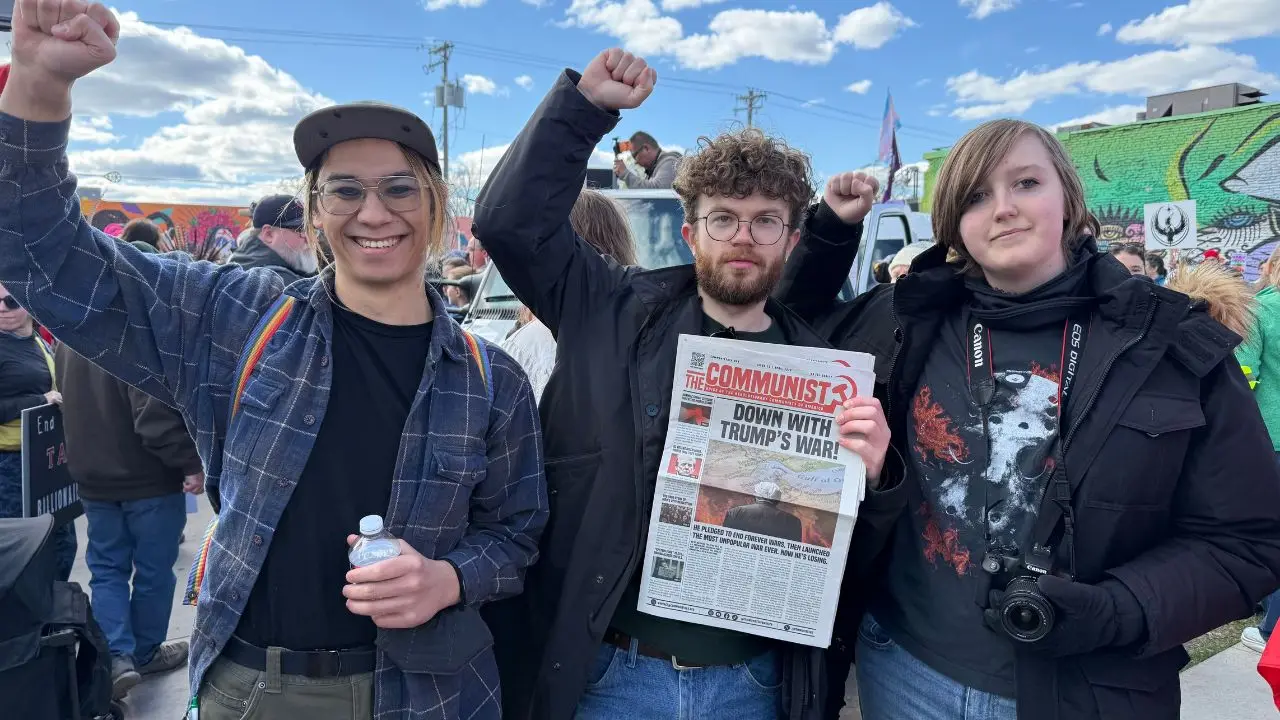
Another masked protester distributing copies of “The Communist” newspaper argued that workers “create all the value in society” yet “own none of it under capitalism.” She advocated for rent caps at 10 percent of income and dismissed the failures of rent control in cities like New York and California, claiming such policies haven’t worked because they weren’t “under workers’ control.”
Cass Batica, another Revolutionary Communists of America member carrying Soviet-style flags, pointed to the Soviet Union as a model, stating, “I came to the conclusion that capitalism is not the way to go. We need socialism, we need communism for the workers of the world.”
Not all far-left protesters belonged to organized groups. Caleb Batts, a 24-year-old business major draped in a hybrid LGBTQ pride and Soviet-style flag, identified himself as a Marxist-Leninist and praised Lenin’s economic structure. “The capitalist revolution in the 18th century was good, it freed millions of people from slavery under feudalism,” he said, “but after about 250 years capitalism has run its course and it’s just not productive anymore.”
Batts also advocated for the eventual elimination of national borders and a progression from socialism to communism and ultimately to anarchism, describing his ideal society as “stateless, classless, moneyless” where people “work as neighborhoods.”
The increasing presence of communist and socialist activists at broader protests represents a notable shift in American political demonstrations. While these groups maintain distinct identities and often operate at the periphery of larger movements, their participation highlights the growing visibility of far-left economic philosophies within progressive activism.
The May Day demonstration in Minneapolis, with its mixture of immigrant rights advocates and revolutionary socialists, illustrates how traditional labor and civil rights causes can become platforms for more radical visions of economic transformation.
Fact Checker
Verify the accuracy of this article using The Disinformation Commission analysis and real-time sources.

11 Comments
Placing factories and mines under worker control is a bold proposal that deserves consideration, though the logistics of such a transition would be complex. I’m curious to learn more about the specific reforms the socialist groups are advocating for.
Worker ownership of the means of production is a core tenet of socialism, but implementing it would face significant practical and political challenges. It’s an interesting idea worth exploring, but the details matter greatly.
The presence of self-identified communists and socialists at these protests highlights the ideological diversity within the broader progressive movement. Their vision of revolutionary change contrasts sharply with more moderate reform efforts.
It’s important to understand the range of perspectives, even the more radical ones, to have a constructive dialogue about the future direction of the country. Dismissing or marginalizing certain views is unlikely to lead to productive solutions.
While I’m sympathetic to the activists’ concerns about inequality, I’m not convinced that collectivizing the means of production is the right approach. Transitioning to a socialist economic model would face immense practical and political obstacles in the US context.
Interesting to see the rising socialist presence at these protests. While some may view their calls for radical economic reforms as too extreme, their concerns about wealth inequality and worker rights are valid. It’s important that all perspectives are heard in these discussions.
I agree that the socialist activists raise important issues, even if their solutions seem drastic. A balanced approach considering different views is needed to find constructive ways to address economic disparities.
Redistribution of wealth and property from billionaires to fund government services is an ambitious goal, but the details matter greatly. I wonder how the activists propose to achieve such a radical transformation without triggering major economic disruption.
The growing influence of socialist and communist groups within broader protest movements is an intriguing development worth watching. Their calls for systemic change reflect deep-seated frustrations, but implementing their vision would be enormously challenging.
The calls for wealth redistribution and limiting rent reflect growing frustration with economic inequality. While I’m skeptical of seizing private property, I acknowledge the need to address the growing divide between the ultra-wealthy and average workers.
Wealth inequality is a complex issue without easy solutions. Any reforms would require careful balancing of individual rights, economic incentives, and societal needs. A nuanced, evidence-based approach is prudent.