


Listen to the article
Nationwide May Day Protests Unite Radical Left Groups with Democratic Organizations
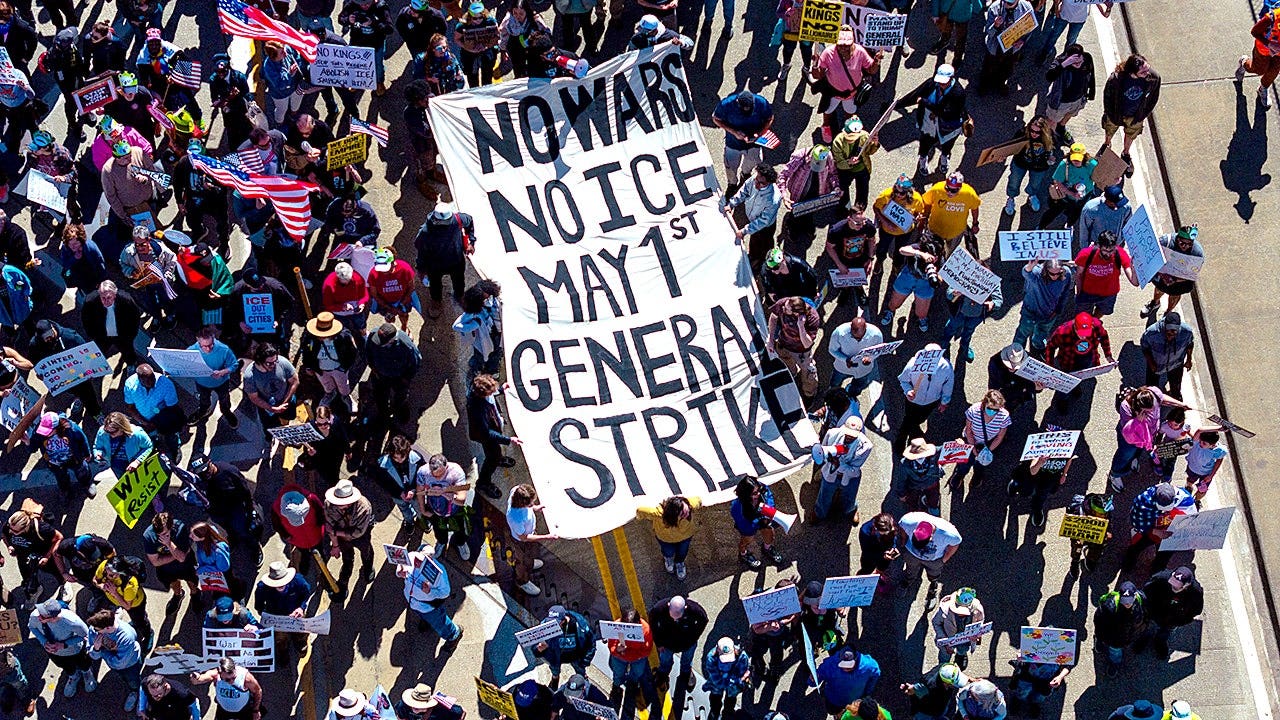
Some 600 organizations, ranging from self-described communist groups to Democratic Party affiliates, are mobilizing across the United States today for May Day demonstrations. The coordinated effort includes an estimated 3,000 protests and events under the banner “Workers Over Billionaires,” with organizers calling for Americans to skip work, school, and shopping.
A Fox News Digital investigation has identified what critics describe as a “red-blue” network with combined annual revenue of approximately $2 billion working to advance what some characterize as an anti-American agenda. The coalition brings together traditional labor unions, mainstream Democratic organizations, and far-left groups in a display of growing ideological overlap.
At the center of the mobilization are chapters of the Democratic Socialists of America alongside a network of groups funded by Neville Roy Singham, an American-born tech entrepreneur now based in Shanghai. These Singham-backed organizations—including the People’s Forum, the Party for Socialism and Liberation, ANSWER Coalition, and Code Pink—have been criticized for promoting narratives aligned with Chinese Communist Party propaganda.
Several openly communist organizations are participating in the demonstrations. The Communist Party of the USA has called for workers to “rise against MAGA on May Day,” while the Revolutionary Communist Party has issued statements advocating for the dismantling of the “capitalist-imperialist system.” The Maoist Communist Union has summoned members to join an “Anti-Imperialist Contingent” at New York City protests.
What has raised concerns among political observers is the growing alliance between these radical groups and mainstream Democratic organizations. The coalition includes nonprofits closely aligned with Democratic politics such as Indivisible, MoveOn.org, and the American Federation of Teachers, as well as at least 13 state and local chapters of the Democratic National Committee, including the California Democratic Party.
The California Democratic Party, which describes itself as “the largest state party in the nation with more than 10 million members,” is using Democratic tech platform Mobilize.us to promote “Workers over Billionaires May Day rally” protests across the state. Other Democratic Party affiliates, including the Ohio Democratic Party Progressive Caucus, North Carolina’s Young Democrats of Moore County, and the Young Democrats of Wisconsin, are listed as official organizers for the “May Day Strong” coalition.
“The increasing willingness of mainstream Democrats to align with extremist socialist groups is a major factor in why the Democratic Party is losing the center more and more, and why so many lifelong Democrats find themselves feeling politically homeless,” Democratic strategist Melissa DeRosa told Fox News Digital.
“May Day has a proud history of honoring workers,” she continued, “but too many Democratic organizations have allowed that tradition to be hijacked by the activist fringe—including groups aligned with the Democratic Socialists of America, pushing a fantasy agenda that has failed everywhere it has been tried.”
Behind the scenes, the coalition has demonstrated sophisticated coordination. On Thursday afternoon, the “May Day Strong” coalition issued a professionally composed media advisory, with metadata identifying the sender as a public relations expert associated with firms that have worked with teacher unions closely aligned with the Democratic Party.
The advisory highlighted planned actions including student walkouts expected to involve more than 100,000 students and coordinated efforts to promote the message “No Work, No School, No Shopping.” The coalition’s core demands include “Tax the rich,” “No ICE. No War,” and “Expand Democracy, not corporate power.”
Traditional Democratic-aligned organizations participating in the protests include the Illinois Federation of Teachers, Chicago Teachers Union, National Education Association, AFL-CIO, American Federation of Teachers, and the United Auto Workers.
Political analysts suggest this alliance reveals a growing challenge within Democratic politics, as the party’s activist infrastructure increasingly overlaps with groups promoting rhetoric that critics view as anti-American. Indivisible, which has received millions in funding from George Soros’ philanthropy network over the years, has at least 200 chapters nationwide supporting May Day events, appearing alongside about 80 chapters of the Democratic Socialists of America.
“The Democratic Party used to speak the language of work, wages, dignity, family, safety and upward mobility,” DeRosa observed. “Now it’s morphing into a pamphlet for the Democratic Socialists of America: slogans instead of policy, disruption instead of leadership and the demonization of free enterprise instead of a serious plan to help working families get ahead.”
As the protests unfold across the country today, the evolving alliance between traditional Democratic organizations and radical left groups signals what some see as a significant shift in the American political landscape.
Fact Checker
Verify the accuracy of this article using The Disinformation Commission analysis and real-time sources.

10 Comments
Protests of this scale, bringing together such a diverse array of stakeholders, are always noteworthy. Whether one agrees with the specific demands or not, the ability to coordinate this level of mobilization across ideological lines is an interesting development worth following closely.
Absolutely, the scope and coordination of these protests is certainly impressive, regardless of one’s political views. It will be insightful to see how the messaging and demands are received, and whether any tangible outcomes or policy changes result from this level of collective action.
While the political affiliations of the organizers may be contentious, the underlying issues they’re seeking to highlight – worker rights, economic inequality, etc. – are valid concerns that merit serious consideration. It will be interesting to see how these protests are perceived and what, if any, impact they have.
I agree, the core issues being raised are important and deserve attention, even if one may not fully align with the specific political agendas of the organizers. The ability to bring together such a diverse coalition is noteworthy and suggests there is widespread public interest in these topics.
The coordination and scale of these planned protests is noteworthy. Whether one agrees with the specific aims or not, the ability to organize such a broad coalition across the political divide is an interesting development worth studying further. Curious to see how the public and policymakers respond.
Given the diverse array of groups involved, I’m curious to see how unified the messaging and demands will be at these protests. The ability to bring together such a wide-ranging coalition is impressive, but translating that into coherent, impactful action may prove challenging.
This seems like a concerted effort to draw attention to economic and social inequities. While the political leanings of the organizers may be divisive, the core issues they’re highlighting – worker rights, wealth disparities, etc. – are important topics deserving of public discourse. Looking forward to seeing how this unfolds.
This is certainly a significant mobilization, with a wide range of groups involved. While the motivations and agendas may vary, the common thread seems to be a desire to amplify the concerns of workers. It will be worth following how the events unfold and the societal impact, if any.
Interesting to see such a diverse coalition coming together for these protests. Regardless of one’s political leanings, it’s important to respect the right to peacefully assemble and voice concerns. I wonder how the messaging and demands will be received across the political spectrum.
The coordination and scale of these planned protests is certainly striking. Whether one agrees with the specific aims or not, the ability to organize such a broad coalition across the political divide is an interesting development. I’ll be curious to see how the public and policymakers respond to the messaging and demands.