


Listen to the article
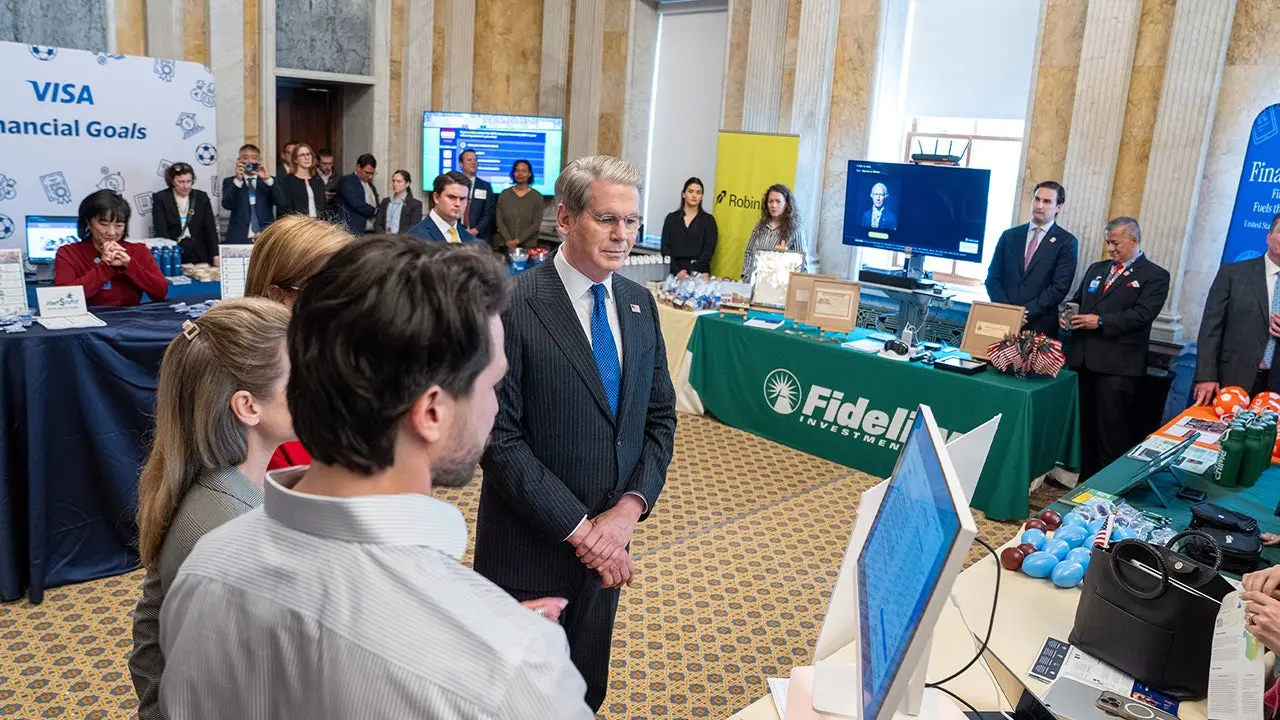
Treasury Secretary Scott Bessent marked the conclusion of Financial Literacy Month by hosting an educational fair at the U.S. Department of the Treasury on Thursday, welcoming more than 50 students from the greater Washington D.C. area for a day of interactive financial education.
The event, designed to promote financial knowledge among young Americans, featured a variety of engaging activities including “financial soccer” – a fast-paced quiz game testing participants’ understanding of financial concepts – alongside interactive booths, resource distribution, and exclusive tours of the Treasury Vault.
“We live in the greatest country in the history of the world and on the eve of our 250th anniversary, understanding what has driven our success is the key to our future and what will lead the nation successfully for the next 250 years,” Bessent remarked in a statement about the initiative.
The Treasury partnered with 18 financial organizations, including industry leaders Visa, Robinhood, and Lincoln Financial, to deliver the educational experience. This collaborative approach underscores the growing recognition among both government and private sectors of the critical importance of financial education in empowering future generations.
The fair represents just one component of a broader Treasury initiative launched at the beginning of April, reflecting Bessent’s personal conviction about the relationship between financial literacy and economic opportunity in America.
“In my own life experiences, as an economic historian, and now as the 79th Treasury Secretary, it is my firm belief that financial literacy is what fuels the American Dream. Understanding how to make informed financial decisions unlocks opportunity for every American and their families,” Bessent explained in a press release earlier this month.
Financial literacy in the United States has become an increasingly pressing concern in recent years. According to reporting by the Consumer Financial Protection Bureau, less than 30% of young Americans are considered financially literate, while approximately 74% of students express a need for financial education. These statistics highlight a significant knowledge gap that Treasury initiatives aim to address.
Throughout April, the Treasury Department organized several events to promote financial literacy across different demographics, including a roundtable with community bankers and a forum in partnership with the Association of Mature American Citizens. This multi-faceted approach recognizes that financial education needs vary across age groups and communities.
Financial Literacy Month, first officially recognized by the U.S. Senate in 2004, has grown in significance as the financial landscape becomes increasingly complex. With evolving technologies, investment platforms, and financial products, the ability to make informed financial decisions has become essential for economic wellbeing and stability.
The emphasis on financial education comes at a time when Americans face various economic challenges, from student loan debt and retirement planning to navigating investment opportunities in an increasingly digital financial ecosystem. By investing in financial literacy at a young age, the Treasury aims to equip the next generation with tools necessary for sound financial decision-making.
This latest initiative aligns with broader governmental efforts to strengthen Americans’ relationship with money and financial systems. By bringing financial education directly to students through engaging, interactive methods, the Treasury Department is attempting to make what can sometimes be viewed as complex or intimidating subjects more accessible and relevant to young people’s lives.
As the United States approaches its 250th anniversary, Bessent’s focus on financial literacy reflects a vision of economic empowerment as fundamental to the nation’s continued prosperity and the individual success of its citizens.
Fact Checker
Verify the accuracy of this article using The Disinformation Commission analysis and real-time sources.

26 Comments
If AISC keeps dropping, this becomes investable for me.
Good point. Watching costs and grades closely.
If AISC keeps dropping, this becomes investable for me.
Good point. Watching costs and grades closely.
Good point. Watching costs and grades closely.
The cost guidance is better than expected. If they deliver, the stock could rerate.
Interesting update on Bessent Hosts Financial Literacy Fair, Promotes Education as Path to American Dream. Curious how the grades will trend next quarter.
Good point. Watching costs and grades closely.
Good point. Watching costs and grades closely.
Interesting update on Bessent Hosts Financial Literacy Fair, Promotes Education as Path to American Dream. Curious how the grades will trend next quarter.
Good point. Watching costs and grades closely.
If AISC keeps dropping, this becomes investable for me.
Good point. Watching costs and grades closely.
Interesting update on Bessent Hosts Financial Literacy Fair, Promotes Education as Path to American Dream. Curious how the grades will trend next quarter.
Good point. Watching costs and grades closely.
Good point. Watching costs and grades closely.
Interesting update on Bessent Hosts Financial Literacy Fair, Promotes Education as Path to American Dream. Curious how the grades will trend next quarter.
Good point. Watching costs and grades closely.
If AISC keeps dropping, this becomes investable for me.
Good point. Watching costs and grades closely.
Good point. Watching costs and grades closely.
If AISC keeps dropping, this becomes investable for me.
Good point. Watching costs and grades closely.
Good point. Watching costs and grades closely.
Nice to see insider buying—usually a good signal in this space.
Good point. Watching costs and grades closely.