


Listen to the article
Republican Lawmakers Silent as War Powers Deadline for Iran Conflict Passes
Many Republicans who expressed concerns about President Donald Trump’s military actions in Iran had emphasized the importance of a May 1 deadline for congressional authorization. However, that deadline is now passing without action as GOP lawmakers continue to defer to the White House on the matter.
Under the War Powers Resolution of 1973, Congress must either declare war or authorize the use of force within 60 days—a requirement that falls on Friday—or within 90 days if the president requests an extension. Despite this legal framework, Congress has made no attempt to enforce these requirements, with lawmakers leaving Washington for a week-long recess after the Senate rejected a Democratic attempt to halt the war for the sixth time.
The Trump administration has shown little interest in seeking congressional approval. Administration officials are arguing that the deadlines set by law don’t apply because the Iran conflict effectively ended when a ceasefire began in early April.
Senate Majority Leader John Thune (R-S.D.) made the Republican position clear on Thursday, stating, “I’m listening carefully to what the members of our conference are saying, and at this point I don’t see” a plan to vote on authorizing force in Iran or otherwise weighing in on the conflict.
The Republican reluctance to challenge Trump on the war comes at a politically sensitive moment, with mounting public frustration over both the conflict itself and its impact on domestic gas prices. Despite these concerns, most GOP lawmakers maintain they support Trump’s wartime leadership or are willing to give him more time amid what they describe as a fragile ceasefire.
Senator Kevin Cramer (R-N.D.) indicated he would vote for a war authorization if Trump requested it, but questioned whether the War Powers Resolution itself is constitutional. “Our founders created a really strong executive, like it or not like it,” Cramer said, reflecting a view held by many in his party about presidential war powers.
Some Republican senators have signaled they want Congress to eventually have a formal role. Alaska Senator Lisa Murkowski announced in a floor speech Thursday that she will introduce a limited authorization for use of military force when the Senate returns from recess if the administration hasn’t presented what she called a “credible plan” by then.
“I do not believe we should engage in open-ended military action without clear accountability,” Murkowski stated. “Congress has a role.”
A small group of GOP senators have consistently argued that Congress should assert its authority over the conflict. Maine Senator Susan Collins broke ranks with her party on Thursday, voting with Democrats for the first time to halt the war. In a statement, Collins emphasized that “the president’s authority as commander-in-chief is not without limits,” adding that the 60-day deadline in the War Powers Resolution “is not a suggestion, it is a requirement.”
Other Republicans, including Senators John Curtis of Utah, Thom Tillis of North Carolina, and Josh Hawley of Missouri, have also expressed support for an eventual vote on authorization. Curtis took a particularly firm stance, saying he would not support continued funding for the war until Congress votes to authorize it.
“It is time for decision-making from both the administration and from Congress—and that can happen in league with one another, not in conflict,” Curtis said.
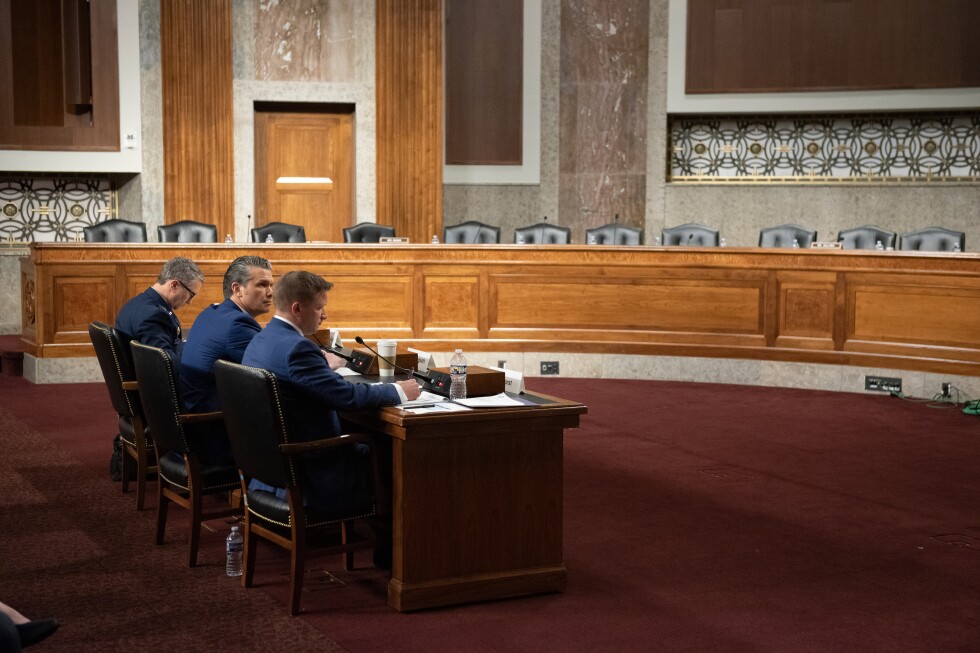
The Trump administration’s position hinges on its interpretation of the current ceasefire. Defense Secretary Pete Hegseth stated during a Thursday hearing, “We are in a ceasefire right now, which our understanding means, the 60-day clock pauses or stops.” A senior administration official, speaking anonymously, claimed that “the hostilities that began on Saturday, Feb. 28 have terminated” and noted that U.S. military forces and Iran have not exchanged fire since the two-week ceasefire began on April 7.
The administration maintains this position despite the fact that Iran continues its blockade of the Strait of Hormuz, a crucial global oil chokepoint, while the U.S. Navy maintains a counter-blockade preventing Iranian oil tankers from reaching international markets.
Democrats have rejected the administration’s interpretation of the law. “I do not believe the statute would support that,” Virginia Senator Tim Kaine told Hegseth during the hearing. California Senator Adam Schiff added that “ceasing to use some forces while using others does not somehow stop the clock.”
For some Democrats, the situation comes as no surprise. Representative Adam Smith, the ranking Democrat on the House Armed Services Committee, told The Associated Press: “Is the expectation that the Trump administration is going to follow the law? I do not have that expectation.”
As the May 1 deadline passes with no congressional action, the constitutional question of war powers remains unresolved, continuing a decades-long pattern of executive branch expansion and congressional deference on matters of war and peace.
Fact Checker
Verify the accuracy of this article using The Disinformation Commission analysis and real-time sources.

14 Comments
This is a concerning development that bears close watching. Congress must be vigilant in ensuring the administration follows the appropriate legal channels, regardless of party affiliation.
Well said. The American people deserve leaders who will stand up for the rule of law, not simply defer to the executive branch.
This is a complex situation, with the administration arguing the deadlines don’t apply. It will be interesting to see if Congress pushes back or continues to defer to the White House on Iran policy.
The Republican leadership seems content to let the administration handle this without much Congressional oversight. It remains to be seen if this approach will hold up.
The administration’s argument that the deadlines don’t apply is questionable. Congress should scrutinize that claim and not simply accept it at face value.
I agree. This is an important test of the balance of powers, and Congress needs to assert its rightful role in the process.
This seems like a troubling pattern of the executive branch sidestepping Congress on major foreign policy decisions. Lawmakers need to take a firmer stand in upholding their constitutional role.
Absolutely. The American people deserve to have their elected representatives actively engaged in these critical decisions, not deferring to the White House.
It’s disappointing to see Republican lawmakers standing by while the administration appears to disregard the law. Oversight and accountability should be a bipartisan concern.
Exactly. This isn’t about partisan politics, it’s about upholding the Constitution and the proper functioning of our democratic institutions.
The lack of action from Congress on this issue is concerning. The War Powers Resolution exists for a reason, and lawmakers should not be abdicating their responsibility to provide proper oversight.
I agree. Congress needs to assert its authority and ensure the administration is adhering to the legal framework, regardless of political calculations.
The administration’s interpretation of the law seems questionable, and Congress should not simply accept it without rigorous scrutiny. Lawmakers have a duty to provide oversight.
Agreed. This is a crucial test of the separation of powers, and Congress must be willing to challenge the executive branch when necessary.