


Listen to the article
By Julienne G. Tan
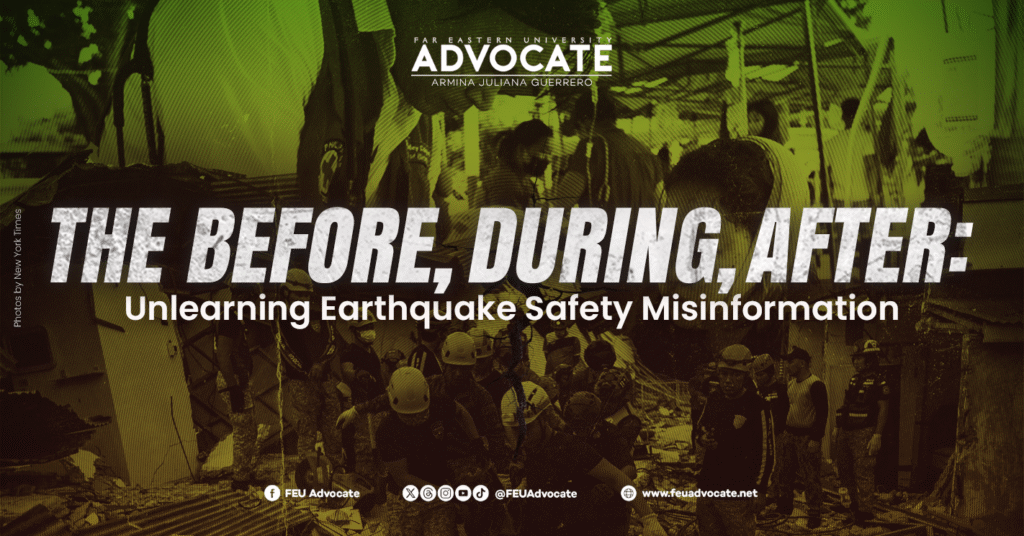
When a 5.0-magnitude earthquake from Zambales rippled through Metro Manila on October 11, the city fell into a quivering silence. At Far Eastern University (FEU), students rushed outside as phones lit up with alerts and anxious messages. Within minutes, social media was filled with rumors, false warnings, and conflicting safety tips. What began as a brief tremor quickly spiraled into a frenzy of confusion and fear—both on the ground and online.
The quake struck amid a series of stronger tremors. On September 30, a magnitude 6.9 quake hit Northern Cebu, shaking homes and nerves across Visayas. Less than two weeks later, a 7.4 earthquake rocked Davao Oriental on October 10, serving as a stark reminder of the Philippines’ deep seismic vulnerability. Yet as powerful as these physical tremors were, the waves of misinformation that followed proved equally dangerous.
Even in a country long accustomed to earthquakes, confusion stemming from panic and uncertainty remains a significant hazard. False notions of safety persist, demonstrating how fear-based habits are often harder to unlearn than learn.
In moments of panic, people instinctively fall back on what feels familiar. Habits, even dangerous ones, become comforting reflexes when the world begins to shake. Among these reflexes, the strongest is the urge to run—ostensibly toward safety, but often into greater danger.
When fear outruns reason, the consequences can be deadly. When the ground trembles, the body reacts before the brain does. The instinct to flee and find open air feels rational, but in urban environments surrounded by concrete buildings, glass facades, and power lines, that reflex can lead to catastrophe.
The Philippine Institute of Volcanology and Seismology (PHIVOLCS) warns that danger often lurks beyond doorways: shattering glass, falling electrical wires, and collapsing exterior walls can pose greater threats to those fleeing buildings than remaining inside under sturdy cover.
During an earthquake, the body floods with adrenaline, urging flight over thought. In that split second, each hurried step can become a hazard in a moment when staying still might save lives. Safety experts emphasize that survival often depends on resisting the body’s own panic response—drop, cover, and hold—even when every instinct urges movement.
PHIVOLCS emphasizes that when there is no immediate shelter, crouching low and guarding your head becomes the next best defense before carefully finding an open space once tremors subside.
Yet once the physical shaking stops, another danger emerges: misinformation. In the search for control and understanding, people often cling to any post or claim that promises safety or explanation.
When the earth moves, Filipinos search for meaning through group chats, social media posts, and neighborhood stories of animals behaving strangely before quakes. In the vacuum before official information arrives, baseless assumptions quickly fill the void.
The confusion is increasingly compounded by artificial intelligence. In the aftermath of recent earthquakes, AI-generated videos and fake CCTV footage spread within minutes, followed by fabricated news reports that heighten fear. These digital manipulations blur the line between fact and fiction, especially for those less familiar with spotting synthetic media.
After almost every significant tremor, familiar myths resurface—stories of animals sensing danger before humans, or supposed predictions that conveniently appear online shortly after the quake. These narratives spread rapidly not because people are naive, but because uncertainty feels unbearable. In disaster’s chaos, even fabricated certainty offers comfort.
The United States Geological Survey (USGS) reports no reliable evidence that animals can predict earthquakes. While some animals may sense the first faint P-waves seconds before humans, this interval is far too brief to provide meaningful warning. Most anecdotes about animal “predictions” reflect confirmation bias, coincidence, or retrospective pattern-finding.
The same desire for control fuels belief in online earthquake predictions. Despite their popularity, no website or application can accurately predict when, where, or how strong an earthquake will be. Most monitoring tools merely detect shaking once it has already begun.
Many still treat these tools like oracles—alongside viral “psychic predictions” that flood social media after every tremor. Whether presented as science or superstition, these forecasts provide more psychological comfort than actual certainty.
Online, panic doesn’t remain private; it amplifies and spreads, transforming individual fear into collective misinformation. Social media platforms inherently prioritize emotional, immediate reactions over verified information, creating perfect conditions for falsehoods to outpace facts.
For many students, the moments after the recent quake were filled with tension and uncertainty. When the ground finally stilled, a false sense of security led some to consider returning indoors—overlooking a critical danger: aftershocks.
In an interview with FEU Advocate, Ella Ibal, a first-year Nursing student, recalled that even after the shaking from the October 11 earthquake subsided, fear lingered as students turned to their phones and peers for reassurance.
“The atmosphere after the quake was tense but controlled. Within minutes, responders were guiding everyone to safety, but even then, people were still checking their phones, asking if more shaking was coming,” she said.
The USGS notes that aftershocks frequently follow larger earthquakes and can further damage already weakened structures. Buildings that survived the initial tremor may harbor hidden fractures, compromised walls, or weakened foundations. Even a relatively minor aftershock may topple structures that appeared intact.
When tremors subside, safety experts advise resisting the urge to reenter buildings immediately. Instead, remain in clear spaces and watch for signs of structural damage such as cracks, sagging ceilings, or fallen debris that might indicate compromised integrity.
Despite years of earthquake drills and public advisories throughout the Philippines, false safety tips still circulate faster than official guidance. This persistence reveals deeper issues of institutional mistrust and information gaps.
When government responses to disasters are perceived as delayed or inadequate, people become desperate for actionable information. This vacuum creates opportunities for self-proclaimed “experts” and viral posts to thrive, offering simplistic but incorrect solutions.
Ibal witnessed this firsthand during the earthquake at FEU, observing how fear and misinformation spread simultaneously. “No matter how strong the earthquake was, it was the fear and panic that spread even faster than the shaking itself. I realized that being prepared isn’t just about knowing what to do, but also about controlling how you react in the moment,” she reflected.
True preparedness depends on collective effort that connects educational institutions, workplaces, and communities. It begins when earthquake drills are taken seriously, when employees understand proper response protocols, and when local leaders ensure verified information reaches everyone promptly. Together, these actions build lasting resilience.
The earth beneath the Philippines will always move, and preparedness remains the only viable solution. Every verified fact shared and every rumor countered does more to protect lives than panic and misinformation ever could. In the noise that follows disaster, reason must speak louder than fear.
Fact Checker
Verify the accuracy of this article using The Disinformation Commission analysis and real-time sources.

10 Comments
Earthquakes are always unsettling, and the tendency to spread unverified safety tips on social media is understandable. But as this piece shows, fact-checking and disseminating accurate information needs to be a priority during emergencies. Misinformation can be just as hazardous as the physical tremors.
The article raises important points about the challenges of overcoming earthquake safety myths, even in a country accustomed to tremors. Proactive public education and rapid response to misinformation online could make a big difference in preparing communities for the next big quake.
Interesting look at the spread of earthquake safety misinformation during recent tremors in the Philippines. It’s concerning how fear and uncertainty can fuel the spread of false tips, even in a seismically active region. Unlearning dangerous habits is often harder than learning them.
It’s alarming to see how quickly misinformation can spread during a crisis like an earthquake. The article makes a good point about the difficulty of unlearning bad habits, even in a seismically active region. Effective public awareness campaigns are essential for disaster risk reduction.
This is a timely look at the dangers of earthquake safety misinformation. In a crisis, people often revert to familiar but potentially unsafe habits. Proactive public education and rapid response to counter false claims online could make a real difference in keeping people safe.
Agreed, clear communication from authorities is key to preventing the spread of dangerous misinformation during natural disasters.
The Philippines’ vulnerability to powerful earthquakes highlights the critical need for public preparedness. As this article notes, unlearning entrenched safety myths can be challenging. Investing in comprehensive earthquake education programs could help save lives when the ground starts shaking.
This is a concerning look at the very real dangers posed by earthquake safety misinformation, even in a place like the Philippines that regularly experiences tremors. Fact-checking and rapid response to counter false claims online should be a top priority for disaster management authorities.
The article highlights an important issue – how social media can amplify confusion and panic during natural disasters. Providing clear, authoritative safety information is crucial to counter misinformation and keep people safe. Educating the public on proper quake response is an ongoing challenge.
Earthquake safety is a serious issue, and this article highlights how social media can inadvertently spread dangerous misinformation during a crisis. Providing clear, authoritative guidance and quickly addressing false claims is crucial to keeping people safe when the ground starts shaking.