


Listen to the article
South Africa’s Ramaphosa Denounces US Claims of White Genocide as “Blatant Misinformation”
South African President Cyril Ramaphosa has forcefully rejected allegations from the United States about the treatment of white South Africans, calling such claims “blatant misinformation” in a televised address on Sunday evening.
The diplomatic tension has escalated since Donald Trump’s return to the White House, with the American president repeatedly propagating unfounded claims of “white genocide” targeting the Afrikaner population—descendants of European colonizers who remain a minority in post-apartheid South Africa.
“As a country, we are aware that the stance taken by the US administration has been influenced by a sustained campaign of disinformation by groups and individuals within our country, in the US and elsewhere,” Ramaphosa stated during his broadcast on SABC, the country’s public broadcaster.
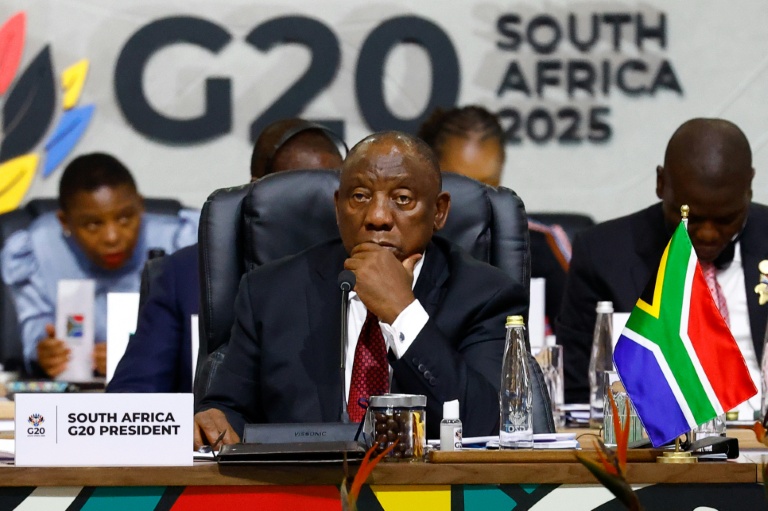
The dispute recently took a more concrete form when the United States boycotted the G20 summit held in Johannesburg last weekend. In a further escalation, Trump announced last Wednesday that South Africa would be excluded from the next G20 gathering, which he plans to host at his family-owned golf resort in Miami.
According to Ramaphosa, American officials justified their non-participation by citing “baseless and false allegations that South Africa is perpetrating genocide against Afrikaners and the confiscation of land from white people.” The South African leader categorically rejected these assertions.
The accusations touch on sensitive historical wounds in South Africa, where land ownership remains heavily skewed along racial lines nearly three decades after the end of apartheid. While various land reform initiatives have been proposed and debated in recent years, claims of systematic violence against white farmers have been repeatedly debunked by fact-checkers and research organizations.
The rhetoric from Washington reflects a concerning trend of misinformation that has gained traction in certain right-wing circles internationally. These narratives often misrepresent complex socioeconomic challenges in South Africa as racially motivated persecution.
Ramaphosa expressed concern about the potential economic repercussions of the diplomatic rift, warning that “these people who are spreading disinformation are endangering and undermining South Africa’s national interests, destroying South African jobs and weakening our country’s relations with one of our most important partners.”
The United States represents a significant trading partner for South Africa, with bilateral trade reaching approximately $21 billion in 2023. American companies have substantial investments across various sectors of the South African economy, including manufacturing, technology, and financial services.
Despite the escalating tensions, Ramaphosa maintained that South Africa remains open to dialogue with Washington. “South Africa is willing to continue to engage in dialogue with the United States government, and to do so with respect and with dignity as equal sovereign countries,” he emphasized.
Political analysts note that this dispute comes at a challenging time for South Africa. The country is navigating economic headwinds, including high unemployment and energy shortages, while also working to maintain its non-aligned diplomatic stance in an increasingly polarized global landscape.
South Africa’s government has consistently defended its foreign policy independence, which has included maintaining cordial relations with countries like Russia and China—positions that have sometimes put it at odds with Western powers, including the United States.
As the diplomatic standoff continues, observers worry about potential economic consequences for South Africa if relations with the United States deteriorate further, particularly regarding preferential trade arrangements and development assistance programs that benefit millions of South Africans.
Fact Checker
Verify the accuracy of this article using The Disinformation Commission analysis and real-time sources.

14 Comments
This appears to be a complex geopolitical issue with historical roots. I hope the leaders on both sides can find a path forward that promotes stability, respects human rights, and avoids escalation of tensions.
This is a complex political dispute with a long history. While I don’t have a strong opinion, I hope both countries can find a diplomatic resolution that respects South Africa’s sovereignty and addresses any legitimate concerns.
Agreed, these types of international disagreements often have nuanced underlying issues. Keeping an open dialogue will be key to finding common ground.
It’s concerning to hear allegations of misinformation being used to influence policy decisions. I’m curious to learn more about the specific claims and evidence on both sides of this dispute.
Yes, getting the facts straight is important. Hopefully the leaders can have a constructive dialogue to better understand each other’s perspectives.
Disputes over alleged human rights abuses are always sensitive. I hope both the US and South Africa can approach this issue objectively and seek a resolution that upholds international norms.
Agreed, these types of disputes require nuanced diplomacy. Cooler heads should prevail to avoid escalation that could harm both countries’ interests.
Tensions between major powers can have ripple effects on global markets and supply chains. I’ll be watching closely to see how this dispute evolves and what implications it might have for the mining and energy sectors.
Good point. Any disruptions to trade or investment in those critical industries could have far-reaching economic consequences.
The dispute over ‘white genocide’ claims seems to be a flashpoint. I wonder if there are opportunities for objective, fact-based dialogue to address any legitimate concerns while respecting South Africa’s democratic processes.
The mining and energy sectors in South Africa are critical to the country’s economy. I wonder how this diplomatic tension might impact investment and operations in those industries.
It’s concerning to see geopolitical tensions rise, especially around issues of national sovereignty. I hope both the US and South Africa can find a constructive path forward that respects their respective interests.
Absolutely. Maintaining open dialogue and mutual understanding will be crucial to navigating this complex situation.
As a major global producer of key minerals and energy resources, stability in South Africa is important for global supply chains. I hope this disagreement can be resolved without disrupting the flow of critical commodities.