


Listen to the article
Bangladesh Information Minister Emphasizes Need for Accurate Data in Free Press Environment
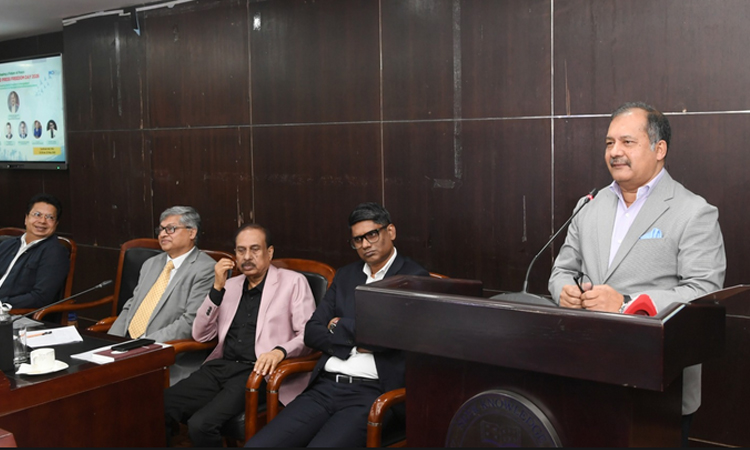
Information and Broadcasting Minister Zahir Uddin Swapon declared that accurate and objective data is the fundamental requirement for ensuring the free flow of information in today’s media landscape. The minister made these remarks during a seminar commemorating World Press Freedom Day 2026 at North South University in Dhaka.
“While freedom of information is desirable, preventing misinformation and ensuring clean information remains the biggest challenge for society and the state,” Swapon told attendees at the event organized by the university’s Media, Communication and Journalism Department.
The minister compared the importance of information flow to a basic human necessity, stating that “the free flow of information is as essential to civilization as oxygen is to human survival.” He elaborated that just as humans cannot survive without oxygen, a state or society cannot function properly without accurate information.
Addressing the growing digital challenges facing media worldwide, Swapon acknowledged that while information is abundant in the digital age, reliable information remains scarce. “Digital hazards and misinformation have now turned into a global crisis,” he noted, pointing to the lack of accountability in Bangladesh’s political and social culture as a contributing factor.
The government is working toward a sustainable framework to ensure media freedom while maintaining information integrity, according to the minister. “The government does not aim to act as an authoritarian ruler, but rather as a servicing manager to ensure the proper flow of information,” he emphasized.
As part of these efforts, Swapon revealed plans to establish a “resourceful network” involving journalism departments, educators, and students from universities across Bangladesh to promote accurate journalism and combat misinformation.
World Press Freedom Day, observed annually on May 3, focuses on fundamental principles of press freedom, evaluates media independence globally, defends media against attacks, and honors journalists who have lost their lives in the line of duty.
The seminar featured several prominent media figures, including Matiur Rahman Chowdhury, President of the Newspaper Owners’ Association of Bangladesh and editor-in-chief of Manabzamin. Chowdhury highlighted the precarious state of mainstream journalism, noting that traditional media outlets are increasingly becoming victims of unfair competition from social media and other digital platforms that spread misinformation.
“While mainstream journalism faces multiple challenges, misinformation spread through social media and ‘photo cards’ is creating confusion among the public,” Chowdhury said, underscoring the existential threat this poses to established media organizations.
Other speakers included North South University Vice-Chancellor Professor Abdul Hannan Chowdhury, Aziz Al Kaiser, chairman of the NSU’s Board of Trustees, Dewan Hanif Mahmud, General Secretary of the Editors’ Council and Editor of Bonik Barta, and Susan Vize, Bangladesh Representative of UNESCO.
Dr. S.M. Rezwan Ul Alam, Associate Professor and Chair of the Media, Communication and Journalism Department, presented the keynote paper, while AHM Bazlur Rahman, founder and Chief Executive Officer of the Bangladesh NGOs Network for Radio and Communication, served as the designated discussant.
Faculty members and students actively participated in the seminar, raising various challenges facing Bangladesh’s journalism sector and offering proposals to strengthen press freedom in the country.
The event underscored the delicate balance between ensuring press freedom and combating the spread of false information, particularly as digital platforms continue to reshape the media landscape in Bangladesh and worldwide.
Fact Checker
Verify the accuracy of this article using The Disinformation Commission analysis and real-time sources.

10 Comments
Ensuring accurate and objective data is critical for enabling free and transparent information flow. The minister’s remarks highlight the essential role of reliable information in the functioning of a healthy society.
The minister’s remarks highlight the delicate balance between freedom of information and the need to prevent misinformation. Striking this balance will be crucial for maintaining a healthy information ecosystem.
Absolutely. Developing robust fact-checking mechanisms and media literacy programs could help citizens navigate the digital landscape and discern credible information from misinformation.
The minister’s emphasis on the fundamental requirement of accurate data is a timely reminder in an era where information can be easily manipulated or distorted. Upholding data integrity is essential for a well-functioning democracy.
It’s encouraging to see government officials recognizing the importance of objective data and the free flow of information. This could pave the way for policies that promote transparency and accountability in the media sector.
I appreciate the minister’s emphasis on the importance of factual data to counter misinformation. In the digital age, maintaining the integrity of information is a growing challenge that requires proactive measures.
Agreed. Raising awareness about the need for quality information is an important first step. Implementing robust fact-checking processes and media literacy initiatives could also help address this issue.
The minister’s statement underscores the vital role of the media in providing reliable information to the public. Ensuring the free flow of objective data is crucial for empowering citizens and promoting transparency in governance.
While the digital revolution has made information more abundant, the minister rightly points out that reliable information remains scarce. This challenge requires innovative solutions to ensure the credibility of news and data.
The comparison of free information flow to oxygen for human survival is a powerful analogy. It underscores how fundamental accurate data is for the proper functioning of a state or society.