


Listen to the article
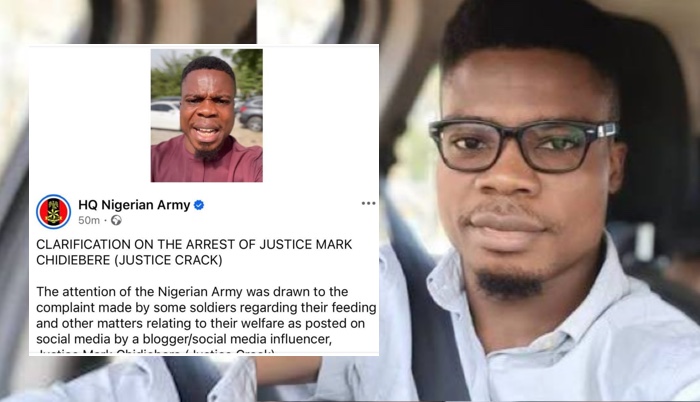
Nigerian Army Arrests Blogger Justice Chidiebere Over Alleged Misinformation
The Nigerian Army has detained blogger and social media influencer Justice Mark Chidiebere, known as “Justice Crack,” following his dissemination of soldier complaints regarding feeding conditions and welfare issues. Military authorities claim the blogger encouraged discontent within military ranks and violated the Armed Forces’ Social Media Policy.
Acting Director of Army Public Relations, Colonel Apollonia Anele, confirmed the arrest in a statement released Sunday. According to Anele, preliminary investigations suggest Chidiebere engaged with soldiers on various issues in a manner that appeared to foster dissatisfaction among troops.
“Justice Chidiebere was picked by the Nigerian Army alongside the soldiers for investigation. While the soldiers remain in our custody, Chidiebere has been handed over to the relevant civil authorities for further investigation and possible prosecution,” Colonel Anele stated.
The arrest comes amid escalating tensions between military leadership and those highlighting potential welfare issues within the armed forces. The case has raised concerns about press freedom and the treatment of whistleblowers in Nigeria’s security sector.
The Nigerian Army maintains that Chidiebere’s social media posts contained misinformation designed to mislead the public about conditions faced by soldiers, particularly those deployed in the northeastern region where the military continues to combat insurgent groups.
Headquarters Theatre Command Joint Task Force (North East), Operation Hadin Kai (OPHK), had previously rejected claims about inadequate feeding arrangements, describing them as “misleading and inconsistent with the actual welfare and feeding arrangements of troops.”
Lieutenant Colonel Sani Uba, Media Information Officer of Joint Task Force (North East) Operation Hadin Kai, provided additional context, stating that a comprehensive internal review had been conducted following the circulation of the controversial images.
“Following a detailed internal review conducted in line with established procedures, the Theatre Command wishes to categorically state that the images and narratives being circulated are misleading and do not reflect the actual feeding arrangements or welfare standards of troops in the North East Theatre,” Lt. Col. Uba explained.
Military officials specifically addressed one incident involving what they described as a deliberately misleading image. “A specific incident was identified involving personnel who deliberately circulated a misleading image of a partially consumed meal, intended to create a false impression of troop feeding conditions,” the statement noted.
The Nigerian military has faced criticism in recent years regarding troop welfare and operational conditions, particularly in the protracted fight against Boko Haram and other insurgent groups in the country’s northeast. Analysts suggest that addressing legitimate welfare concerns is crucial for maintaining morale in these challenging deployments.
Human rights organizations have expressed concern about the arrest, noting that detaining journalists or social media personalities for sharing information could have a chilling effect on reporting about military affairs and accountability.
The case highlights the delicate balance between national security concerns and freedom of information in Nigeria. Military establishments worldwide often struggle with managing social media policies that prevent operational security breaches while respecting freedom of expression.
Colonel Anele emphasized that the Nigerian Army “remains committed to the rule of law and will continue to work with relevant agencies to ensure justice is served.” Meanwhile, the Theatre Command has reassured the public that troop welfare remains a priority, stating that soldiers receive rations “strictly in accordance with approved military feeding scales.”
As investigations continue, the case underscores ongoing tensions between military institutional control over information and growing demands for transparency and accountability in Nigeria’s security sector operations.
Fact Checker
Verify the accuracy of this article using The Disinformation Commission analysis and real-time sources.

8 Comments
This is a complex situation that touches on important issues of national security, press freedom, and civil-military relations. While the military has a duty to maintain order, unduly restricting the flow of information can undermine public trust. Hopefully a fair and transparent investigation can shed light on the nuances.
Well said. Constructive criticism and open dialogue, when handled responsibly, can actually strengthen an institution like the military. Resorting to heavy-handed tactics risks alienating both the media and the public they serve.
The arrest of this blogger is concerning and raises valid questions about the military’s approach to managing internal dissent and criticism. While national security is paramount, maintaining a free press and upholding civil liberties are also crucial in a democracy. Striking the right balance will be key.
This case raises concerning questions about press freedom and the military’s handling of internal dissent. Arresting a blogger for simply reporting on soldier complaints seems like a heavy-handed tactic that could backfire. Transparency and open dialogue are important, even on sensitive issues.
I agree, the military’s response seems disproportionate. Silencing criticism rarely resolves underlying problems and can breed further resentment. Striking the right balance between security and free expression is crucial, especially for a professional armed force.
This situation highlights the delicate balance between national security and the public’s right to information. While the military has a duty to maintain order, unduly restricting press freedoms can undermine public trust. Hopefully a fair investigation can shed light on the nuances of this case.
Absolutely. Transparent and accountable institutions are essential in a democracy. Overreacting to criticism rarely improves conditions and often backfires. The military leadership should tread carefully to uphold both security and civil liberties.
Interesting development in Nigeria. The military’s arrest of a blogger for reporting on soldier complaints raises valid concerns about press freedom and the treatment of internal dissent. Striking the right balance is crucial, as open dialogue can help address issues constructively.