


Listen to the article
Nigeria Launches First Global UNESCO Institute for Media Literacy to Combat Misinformation
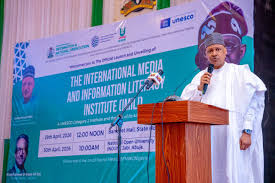
Nigeria has established the world’s first UNESCO Category 2 Institute dedicated to Media and Information Literacy, marking a significant milestone in global efforts to combat misinformation and disinformation. The International Media and Information Literacy Institute (IMILI) was officially launched Wednesday in Abuja, positioning Nigeria as a leader in advancing information integrity worldwide.
Minister of Information and National Orientation, Alhaji Mohammed Idris, described the launch as “a moment of pride not just for Nigeria, but for Africa and the global community.” He emphasized that securing this prestigious institute reflected Nigeria’s sustained effort and commitment through a rigorous competitive process.
“By hosting the world’s first UNESCO Category 2 Institute dedicated to Media and Information Literacy, we are affirming our leadership in promoting informed citizenship, strengthening democratic discourse, and advancing global efforts to safeguard information integrity,” Idris said.
The institute, which represents Nigeria’s first UNESCO Category 2 Institute in the information and communication sector, comes at a critical time when digital misinformation presents growing challenges to democracies worldwide. IMILI will serve as an international hub for research, policy dialogue, capacity building, and cross-sector collaboration.
The Tinubu administration has provided foundational support for IMILI’s launch, establishing governance frameworks that meet UNESCO standards. Idris assured that the institute will operate independently, professionally, and transparently, following international best practices.
UNESCO Assistant Director-General for Communication and Information, Mariya Gabriel, expressed strong approval after touring IMILI’s facilities at the National Open University of Nigeria in Abuja. “We have a very strong foundation to unlock the full potential of Nigeria, leading in media information literacy,” Gabriel noted.
She emphasized the institute’s practical approach would focus on training educators, civil servants, teachers, and media professionals to provide concrete solutions to information integrity challenges. “What I already have seen is that collaborative research, multi-stakeholder approach and working with the entire ecosystem of information integrity has a very solid foundation here,” Gabriel added.
The journey to establish IMILI began in 2022, as highlighted by Nigeria’s Permanent Representative to UNESCO, Dr. Hajo Sani, who expressed satisfaction at seeing the concept become reality. “We are very happy that we are showing the world that Nigeria has the ability and capability to push forward media and information literacy at a higher level,” Dr. Sani said, emphasizing the institute’s global, not just regional, significance.
IMILI Director Dr. Sharon Omotosho outlined the institute’s mission to address the growing challenges of the digital information landscape. “We are willing to address the situation around misinformation, disinformation, hate speech, and all the challenges that come with the use of artificial intelligence and digital platforms,” she stated.
The institute will provide comprehensive services including training programs, advocacy support, research initiatives, and policy development across various sectors. These efforts align with increasing global concern about information disorder and its effects on public discourse and democratic processes.
In an era where distinguishing fact from falsehood has become increasingly difficult, IMILI represents a significant step toward building resilient knowledge systems that empower citizens to engage critically with digital environments and participate meaningfully in democratic processes.
The establishment of this pioneering institute underscores Nigeria’s growing influence in global information governance and reflects the country’s commitment to leading solutions to one of the most pressing challenges of the digital age.
Fact Checker
Verify the accuracy of this article using The Disinformation Commission analysis and real-time sources.

6 Comments
Kudos to Nigeria for securing this prestigious institute. Media and information literacy is critical in today’s digital age to help people discern fact from fiction. This will be a valuable resource for the whole continent.
Absolutely, equipping people with the skills to critically evaluate information sources is key to combating the spread of fake news.
This is an encouraging development. With misinformation and disinformation becoming increasingly pervasive, having a dedicated institute to promote media and information literacy is much needed. Kudos to Nigeria for taking the lead on this.
I’m curious to see how this institute will develop and what kind of programs and resources it will offer. Combating misinformation is a pressing challenge worldwide, so this could be an important model for other countries to follow.
Establishing the first UNESCO Institute for Media Literacy in Nigeria is a significant achievement. In an era of information overload, cultivating critical thinking and media analysis skills is vital for an informed citizenry. I hope this sets an example for other nations to follow.
This is a great initiative by Nigeria to combat misinformation and disinformation. Establishing the first UNESCO Institute for Media Literacy is an important step in promoting informed citizenship and strengthening democratic discourse globally.