


Listen to the article
Digital Misinformation Campaigns Shaped 2026 West Bengal Assembly Elections
The 2026 West Bengal Assembly elections transformed into a sophisticated digital information battleground where misinformation played a decisive role in shaping voter perceptions. An investigation by DFRAC (Digital Fact-checking and Research Analysis Centre) has revealed that social media platform X became the primary arena for coordinated networks deploying systematic misinformation campaigns.
Rather than focusing on traditional democratic processes like policy debates and voter outreach, political actors invested heavily in manufacturing narratives and distorting facts. DFRAC’s analysis identified an embedded misinformation ecosystem operating with unprecedented scale, speed, and sophistication – all designed to influence electoral behavior.
Throughout the election cycle, researchers monitored viral posts, trending hashtags, and engagement patterns including shares, reposts, and comments. The study examined various content types – videos, images, and text-based claims – while tracking how narratives clustered and amplified to create a veneer of legitimacy. Cross-verification with credible sources and forensic techniques like reverse image searching helped identify manipulated or misattributed content.
“What we discovered wasn’t isolated incidents of fake news, but interconnected networks purposefully engineering public perception,” said a DFRAC researcher who requested anonymity due to safety concerns. “The sophistication suggests significant resources behind these operations.”
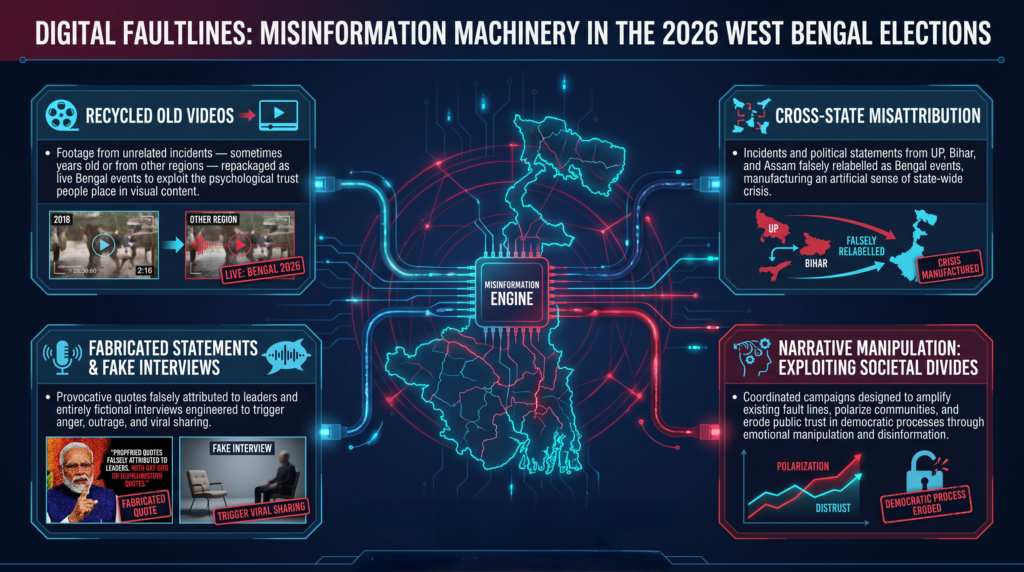
One prevalent tactic involved recycling old videos to manufacture a false present. Content from unrelated incidents – sometimes years old or from entirely different regions – was repackaged as current events unfolding in West Bengal. Videos showing communal clashes from other states appeared as “evidence” of ongoing violence in Bengal. This strategy proved particularly effective because visual content carries strong psychological impact, especially when it reinforces existing beliefs.
Similarly, cross-state misattribution emerged as a common approach. Events from states like Uttar Pradesh, Bihar, and Assam were falsely labeled as occurring in West Bengal. Political statements made elsewhere were edited to appear directed at Bengal’s electorate. This created an artificial sense of crisis while importing politically charged narratives into the state’s discourse.
“Many voters lack the time, resources, or digital literacy to verify the geographical origins of content they consume,” explained Dr. Sudip Chakraborty, a political communication expert at Jadavpur University. “When bombarded consistently with misattributed information, even discerning citizens begin to develop a distorted perception of reality.”
Beyond visual manipulation, fabricated statements emerged as another powerful tool. Quotes were falsely attributed to political figures, often designed to appear provocative or inflammatory. In some instances, entirely fictional interviews circulated widely. These fabrications aimed to provoke emotional reactions like anger or fear, encouraging further sharing while eroding public trust.
Individual pieces of misinformation weren’t isolated but interconnected in what analysts call “narrative engineering.” Coordinated campaigns ensured that multiple forms of misleading content – videos, text posts, fabricated quotes, and selective statistics – reinforced single narratives. For example, a false claim about communal tension might be simultaneously supported by an old video presented as current, a fabricated political statement, and misleading statistics.
Perhaps most concerning was the amplification of communal divisions. A significant portion of misleading content explicitly targeted religious and ethnic identities, often portraying one community as victims and another as aggressors. While such narratives aren’t new to Indian politics, their digital amplification marked a dangerous escalation.
“Social media platforms enabled these divisive messages to reach vast audiences within minutes,” noted election observer Priya Sharma. “Many users unwittingly became participants in the misinformation cycle by sharing unverified content with their networks.”
The West Bengal case study highlights broader concerns for India’s democratic processes. As digital platforms increasingly dominate political communication, addressing misinformation becomes critical to electoral integrity. Experts suggest that without meaningful regulatory frameworks and improved digital literacy, future elections across India may face similar challenges.
The findings underscore a troubling evolution in campaign tactics where manufacturing perception can potentially outweigh actual governance records and policy proposals in influencing voter decisions.
Fact Checker
Verify the accuracy of this article using The Disinformation Commission analysis and real-time sources.

40 Comments
Misinformation campaigns pose a serious risk to the democratic process. I hope the authorities take decisive action to address this issue and restore public confidence in the integrity of the upcoming elections.
I share your concerns. Coordinated efforts to identify and counter these manipulative tactics will be crucial in safeguarding the fairness and legitimacy of the electoral system.
The findings from this investigation underscore the urgent need for electoral reforms and stronger digital safeguards. Voters must be able to rely on accurate information to make informed choices.
Agreed. Addressing the vulnerabilities exposed by these coordinated misinformation campaigns is crucial for the health of our democracy.
This is a worrying development. Maintaining the integrity of elections is essential for a healthy democracy. I hope the relevant authorities take decisive action to address the issue of misinformation.
Absolutely. Coordinated efforts to enhance digital literacy, platform accountability, and fact-based reporting will be critical to ensuring a fair and transparent electoral process.
This is deeply concerning. Misinformation campaigns that distort the democratic process are a threat to the integrity of elections. Rigorous fact-checking and transparency are essential to combat these tactics.
I agree, the scale and sophistication of these coordinated misinformation efforts is alarming. Voters deserve accurate information to make informed decisions.
Deeply concerning to see the scale and sophistication of these misinformation efforts aimed at shaping voter perceptions. Strengthening digital verification tools and media literacy education is crucial.
I agree. Protecting the integrity of elections must be a top priority for policymakers and tech platforms alike.
It’s troubling to see how social media platforms can be exploited to sway electoral outcomes through manipulative tactics. Strengthening media literacy and digital verification tools is crucial.
Absolutely. Building public resilience against misinformation should be a top priority to safeguard the democratic process.
Disturbing to see the scale of misinformation campaigns designed to influence voter behavior. Fact-based reporting and digital literacy initiatives are essential to combat these tactics.
Precisely. Restoring trust in democratic institutions requires a multifaceted approach to tackle the spread of online disinformation.
The potential for misinformation to influence election outcomes is truly alarming. Strengthening digital literacy and platform accountability should be top priorities to combat this threat and uphold democratic values.
Absolutely. Transparency, fact-based reporting, and public awareness campaigns will be essential to ensuring a fair and credible electoral process.
Concerning to hear about the potential for misinformation campaigns to undermine fair elections. Robust fact-checking and transparency from officials will be crucial to maintaining public trust.
I agree, misinformation is a serious threat to democratic processes. Strengthening digital literacy and improving platform accountability could help address this challenge.
This is a very concerning development. Misinformation can seriously undermine the fairness and legitimacy of elections. I hope the authorities take robust action to address this challenge and protect the democratic process.
Agreed. Coordinated efforts by officials, media, and civil society to identify and counter these manipulative tactics will be crucial in preserving the integrity of the elections.
This investigation highlights the urgent need for robust election security measures and greater transparency around political advertising and content amplification online. Voters deserve accurate information to make informed choices.
Absolutely. Addressing the vulnerabilities exposed by these coordinated misinformation campaigns is essential for safeguarding the democratic process.
This is a worrying trend, but I’m glad to see the Digital Fact-checking and Research Analysis Centre investigating the issue. Transparency and fact-based reporting will be key to countering manipulation.
Absolutely. Fact-based, impartial analysis from credible sources is vital to combat the spread of misinformation and preserve the integrity of elections.
This is a concerning development that threatens the foundational principles of free and fair elections. Rigorous oversight and enforcement are needed to ensure the integrity of the democratic process.
I share your concerns. Protecting the sanctity of elections should be a top priority for policymakers and tech platforms alike.
This investigation highlights the insidious nature of coordinated misinformation campaigns and their potential to undermine the democratic process. Voters deserve accurate, unbiased information to make informed choices.
Absolutely. Restoring trust in democratic institutions requires a comprehensive strategy to combat the spread of online disinformation.
It’s alarming to learn about the scale and sophistication of these misinformation campaigns. Strengthening digital literacy and platform accountability should be top priorities to safeguard the democratic process.
I share your concern. Coordinated efforts by officials, media, and civil society will be necessary to identify and counter these manipulative tactics.
Misinformation campaigns can have a devastating impact on the democratic process. I’m glad to see the Digital Fact-checking and Research Analysis Centre investigating this issue. Transparency and credible information will be key to countering manipulation.
I concur. Strengthening digital literacy and platform accountability should be top priorities to safeguard the integrity of elections and maintain public trust in the democratic system.
Deeply troubling to see how political actors are exploiting social media to distort the electoral process. Robust fact-checking, media literacy, and campaign finance transparency are essential to combat this threat.
I concur. The integrity of elections must be protected, and policymakers need to act decisively to address the challenges posed by digital misinformation.
This is a very worrying trend that threatens the foundations of democracy. Robust fact-checking, transparency, and public education will be essential to combating the spread of misinformation and preserving the integrity of the elections.
I agree completely. Maintaining the credibility and fairness of the electoral process should be a top priority for all stakeholders in a healthy democracy.
Misinformation is a serious threat to free and fair elections. I hope the authorities take strong action to address this issue and restore public trust in the democratic process.
Agreed. Robust fact-checking, transparency, and public awareness campaigns will be crucial to combat the spread of misleading narratives and protect the integrity of the elections.
This investigation highlights the urgent need for robust election security measures and greater transparency around political advertising and content amplification online. Voters must be able to trust the integrity of elections.
I agree, these findings underscore the critical importance of election integrity. Policymakers must act swiftly to address this threat to democracy.