


Listen to the article
Memorial University Faces Backlash Over Equity-Focused Faculty Hiring
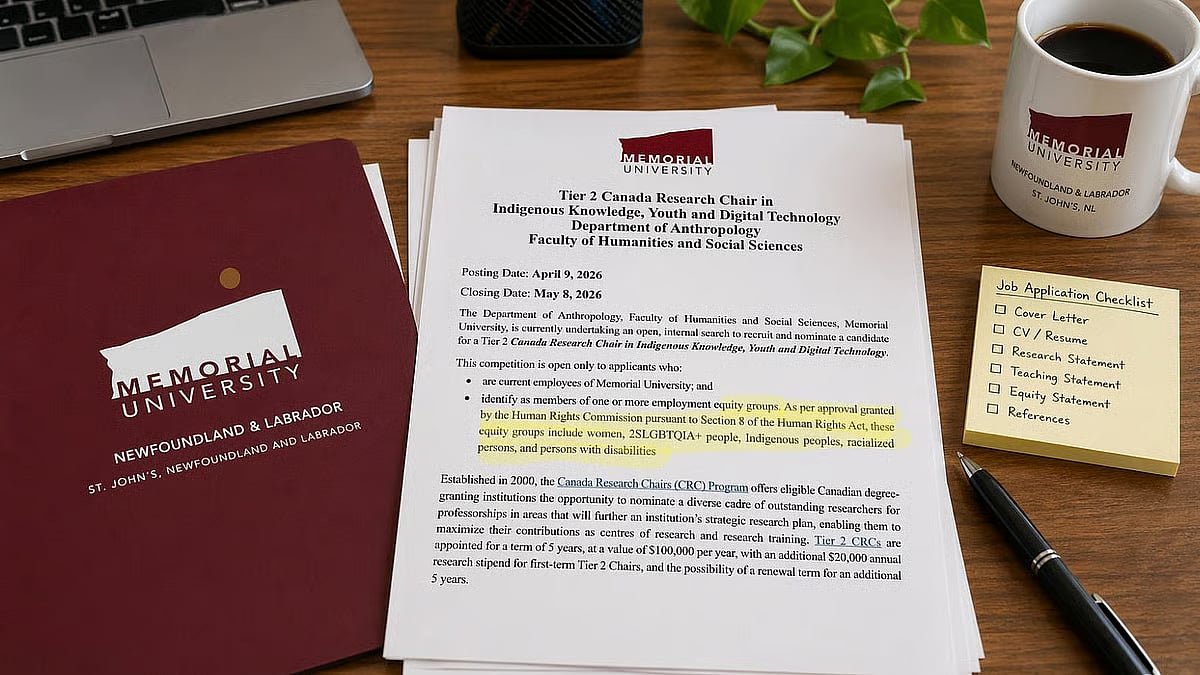
Memorial University in Newfoundland is dealing with significant public criticism following its recent announcement of five professor positions that require applicants to identify with designated equity groups. The controversial hiring initiative has sparked heated debate across social media platforms and within academic circles about the balance between diversity initiatives and merit-based employment practices.
The positions, advertised across various departments at the university, explicitly state that candidates must self-identify as members of one or more equity-deserving groups, including women, Indigenous peoples, persons with disabilities, visible minorities, and LGBTQ2S+ individuals. According to university documents, the hiring approach aligns with Memorial’s broader equity, diversity, and inclusion (EDI) strategic framework adopted in recent years.
“We are committed to addressing historical and current underrepresentation in our faculty,” said Dr. Eleanor Parsons, Memorial’s Vice President of Academic Affairs, in a statement responding to the criticism. “These targeted positions are just one component of our comprehensive approach to creating a more inclusive campus environment.”
Critics of the hiring policy have voiced concerns about potential violations of merit-based hiring principles and questioned whether such requirements might contravene anti-discrimination laws. Social media platforms have seen thousands of comments debating the university’s approach, with hashtags like #MemorialHiring trending regionally.
The Canadian Association of University Teachers (CAUT) has weighed in on the controversy, noting that while they support efforts to address systemic barriers in academia, hiring practices must be carefully designed to avoid creating new forms of discrimination.
“There’s a delicate balance between proactive measures to improve representation and ensuring that all qualified candidates receive fair consideration,” said Dr. Martin Reynolds, a CAUT spokesperson. “Universities must be thoughtful about how they structure these initiatives.”
Memorial University isn’t the first Canadian institution to implement such targeted hiring practices. Several universities across the country have adopted similar approaches in recent years, though few have made equity identification a mandatory requirement for application eligibility.
Statistics Canada data indicates that certain demographic groups remain significantly underrepresented in academic positions nationwide, particularly at senior levels. Indigenous scholars, for example, represent less than 1.5% of full-time faculty at Canadian universities, despite Indigenous peoples comprising 4.9% of the Canadian population.
The provincial government has maintained a careful distance from the controversy. A spokesperson for Newfoundland and Labrador’s Department of Education commented only that “universities maintain hiring autonomy within the bounds of provincial human rights legislation.”
Legal experts suggest the situation falls into somewhat ambiguous territory. “The Canadian Human Rights Act and provincial equivalents do allow for special programs designed to address historical disadvantages,” explained employment attorney Sarah Michaels. “However, these programs typically must be carefully structured to ensure they remain proportional and time-limited.”
Student reaction on campus has been mixed. The Memorial University Students’ Union released a statement supporting the university’s commitment to diversifying faculty but called for greater transparency around the implementation of such policies.
“Students benefit from seeing themselves represented in their professors and mentors,” said Maya Chen, a third-year sociology student. “But there’s also concern about how these policies might affect the overall candidate pool and the perception of qualifications.”
Memorial University officials have indicated they will proceed with the hiring process while engaging with community feedback. The university plans to host a series of town halls to discuss their EDI initiatives more broadly and address concerns about their implementation.
Industry observers note that this controversy reflects broader tensions in higher education as institutions attempt to address historical inequities while maintaining traditional academic values around merit and open competition.
As Canadian universities continue navigating these complex waters, Memorial’s experience may serve as an important case study in how institutions communicate and implement diversity initiatives in faculty hiring—and the potential public relations challenges they face when doing so.
Fact Checker
Verify the accuracy of this article using The Disinformation Commission analysis and real-time sources.

16 Comments
Equity in hiring is an important goal, but the details matter. I hope Memorial can demonstrate that their approach still prioritizes merit and qualifications, even with the focus on designated groups.
Well said. Maintaining high standards while also addressing underrepresentation is a delicate challenge.
This is a timely issue that many universities are grappling with. Memorial’s response will be closely watched, as they try to advance diversity while also upholding academic integrity.
Agreed, the outcome here could set an important precedent for how institutions balance these competing priorities.
It’s a complex issue without easy answers. Memorial is trying to make progress on equity, but the public criticism suggests they need to do a better job explaining their reasoning and process.
Absolutely, open and honest dialogue will be crucial to navigating this sensitive topic and finding the right balance.
The backlash against Memorial’s equity-focused hiring is understandable, given concerns about potential reverse discrimination. However, I hope they can find a way to meaningfully address underrepresentation without compromising merit.
Well said. It’s a delicate balance that will require careful planning and clear communication from the university.
As a public university, Memorial has an obligation to consider equity and inclusion in their hiring. However, I hope they don’t overlook other important criteria like relevant qualifications and experience.
Good point. Quality of the candidates should still be the primary consideration, even with the focus on equity groups.
I’m curious to learn more about Memorial’s broader EDI framework and how these targeted faculty positions fit into their overall diversity strategy. Addressing underrepresentation is important, but the approach matters.
Good point. Understanding the larger context and intentions behind this initiative would provide helpful context.
Interesting initiative by Memorial to address equity and diversity in their faculty. While the focus on designated groups is notable, I wonder how they’ll ensure the hiring process remains merit-based as well.
Agreed, it’s a tricky balance to strike. Curious to see how they’ll implement this in a fair and transparent way.
With the heated debate around this, Memorial will need to communicate their rationale and process clearly to both appease critics and ensure the integrity of their hiring decisions.
Agreed, transparency will be key to addressing the backlash and demonstrating a fair, merit-based approach.