


Listen to the article
Gambia Launches First National Misinformation Response Center in West Africa
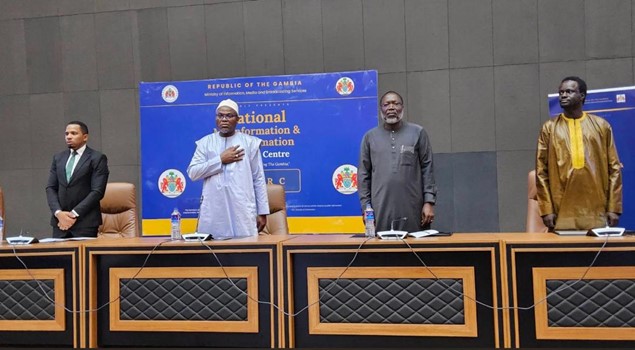
Gambia has positioned itself at the forefront of combating digital misinformation with the launch of the National Misinformation and Disinformation Response Centre (NMDRC), making it the first country in West Africa to establish such a national response mechanism.
In a country where approximately 1.3 million citizens are online and 600,000 actively use social media platforms, officials warned that the spread of false information has become virtually instantaneous, creating unprecedented challenges for maintaining public trust and social cohesion. Unlike the era of “Radio Kankang” (traditional community radio), today’s digital landscape allows manipulated videos and fabricated WhatsApp audio recordings to damage reputations within hours.
During the launch ceremony, The Gambia’s Vice President delivered a compelling address emphasizing the government’s commitment to truth and transparency rather than information control. “This Centre is not about control, it is about clarity. Not censorship but truth,” he stated firmly.
The Vice President described the NMDRC as a groundbreaking platform designed to be free, accessible, and independent, enabling Gambians to verify information, challenge false narratives, and make informed decisions in an increasingly complex digital environment. From questionable WhatsApp messages to viral videos, citizens now have a trusted resource to fact-check content that might otherwise divide communities or erode public confidence in institutions.
This landmark initiative, supported by the Economic Community of West African States (ECOWAS) and driven by local innovation, represents a significant step in strengthening democratic processes through increased accountability and combating harmful falsehoods that threaten national unity.
Dr. Ismaila Ceesay, Minister for Information, Media and Broadcasting Services, highlighted the pioneering nature of the initiative, noting that Gambia’s leadership under President Adama Barrow continues to strengthen systems promoting accurate information and government accountability.
“We are not here simply to launch a platform. We are here to make a clear and deliberate statement,” Dr. Ceesay remarked. He further emphasized that governments have a fundamental responsibility to protect the information ecosystem upon which democracy depends, warning that when the foundation of shared facts deteriorates, everything built upon it—community bonds, economic stability, and democratic institutions—becomes vulnerable.
The regional significance of the NMDRC was underscored by ECOWAS Commission President Dr. Omar Alieu Touray, who renewed the regional body’s support for Gambia’s development initiatives. Dr. Touray expressed hope that the center would serve as a model for other West African nations confronting similar challenges in their digital information spaces.
His endorsement signals that ECOWAS views the NMDRC not merely as a domestic Gambian project but as a strategic component of broader efforts to enhance democratic resilience across West Africa. As disinformation campaigns increasingly transcend national borders, regional coordination becomes essential for effective responses.
Media experts participating in the launch discussed how the rapid evolution of technology has fundamentally changed how information spreads in West African societies. While increased connectivity has brought many benefits, it has also created vulnerabilities that require innovative solutions.
The NMDRC represents a proactive approach to these challenges, offering verification tools, media literacy resources, and rapid response capabilities during information crises. By focusing on empowerment rather than restriction, Gambian authorities hope to build a more discerning public capable of navigating complex information landscapes.
As the first initiative of its kind in the region, the center will likely face significant scrutiny regarding its effectiveness, independence, and ability to remain neutral in politically sensitive situations. However, its establishment reflects growing recognition across Africa that protecting information integrity is becoming as essential to national security and democratic stability as traditional concerns.
Fact Checker
Verify the accuracy of this article using The Disinformation Commission analysis and real-time sources.

13 Comments
This is a bold move by Gambia to tackle the growing problem of misinformation. With over a million citizens online, the ability to quickly verify claims and provide accurate information is essential for maintaining social cohesion and public trust.
The vice president’s emphasis on truth and transparency rather than censorship is a commendable approach. I’m hopeful this center will serve as a model for other countries in the region to follow.
This is an encouraging development. Misinformation can be incredibly damaging, so having a dedicated national entity to quickly respond and provide accurate information is a smart investment. Kudos to Gambia for being proactive on this issue.
I hope other countries in the region follow Gambia’s lead and establish similar centers. Addressing misinformation at a national level is crucial for maintaining public trust and social cohesion.
The launch of Gambia’s National Misinformation and Disinformation Response Centre is a timely and commendable initiative. With over 600,000 active social media users, having a centralized entity to verify claims and provide accurate information is essential.
I’m encouraged to see the government’s commitment to truth and transparency. Maintaining public trust should be the top priority, and this center seems well-positioned to achieve that goal.
Gambia’s new misinformation response center is an important step in the right direction. In an era of rapid digital communication, having a dedicated national entity to swiftly address false claims is crucial for safeguarding public discourse.
Gambia is taking an innovative approach to an increasingly complex problem. I’m curious to learn more about the center’s specific strategies and how they plan to work with social media platforms and the public to curb the spread of misinformation.
Establishing a specialized national center to tackle misinformation is a smart move, especially in today’s digital landscape where false narratives can spread so rapidly. Kudos to Gambia for being a trailblazer in West Africa on this issue.
The vice president’s emphasis on clarity and truth over control and censorship is reassuring. It will be interesting to see how effective the center is in verifying claims and correcting falsehoods.
It’s great to see Gambia taking a strong stance against the proliferation of misinformation. In today’s digital age, combating the spread of false narratives is an ongoing challenge that requires a coordinated, national-level response.
This is an important initiative to combat the growing threat of misinformation in Gambia. With over 1 million citizens online, having a national response center to quickly address false claims is crucial for maintaining public trust.
I’m glad to see the government is taking a proactive stance, focusing on truth and transparency rather than censorship. This could set a positive example for other African nations.