


Listen to the article
Kuki-Zo Council Denies Involvement in Deadly Ukhrul Ambush, Calls for Responsible Reporting
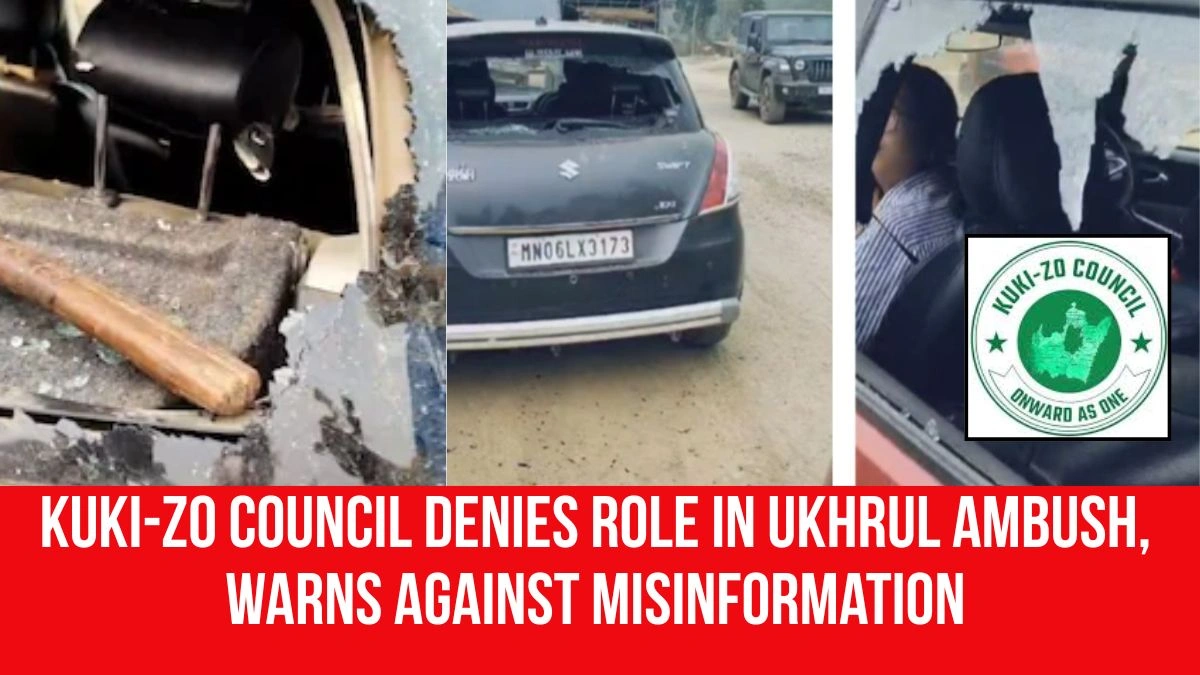
The Kuki-Zo Council (KZC) has issued a firm denial of any connection to Thursday’s deadly ambush in Manipur’s Ukhrul district that claimed the lives of a soldier and a civilian. The attack, which occurred at TM Khasom under Litan police station jurisdiction, has reignited security concerns in the already volatile region.
“We unequivocally deny any role of the Kuki-Zo community in this unfortunate incident,” stated the KZC in an official release. The council further suggested that preliminary intelligence from the ground indicates the violence may instead be connected to existing tensions among other factional groups operating in the area.
The ambush took place around 2:30 PM when armed militants opened fire on a convoy of passenger vehicles traveling from Imphal to Ukhrul. Reports indicate that between five and six vehicles sustained damage in the attack. The deceased have been identified as 46-year-old SW Chinaoshang, a soldier from Tashar village, and civilian Yaruingam Vashum from Kharasom village. Both victims belonged to the Tangkhul Naga community.
The KZC expressed significant concern over what it characterized as a troubling pattern of immediate blame being directed at the Kuki-Zo community whenever violent incidents occur involving either Meitei or Naga groups in Manipur. According to the council, such hasty allegations without proper investigation not only distort the factual narrative but also unfairly damage the community’s reputation.
“This recurring tendency to blame our community without verification is deeply concerning and counterproductive to peace efforts in the region,” a KZC spokesperson noted in the statement.
The timing of the attack carries particular significance as it occurred just one day after Manipur Chief Minister Y. Khemchand Singh visited Ukhrul district and officially reopened the Ukhrul highway. The ambush underscores the persistent security challenges facing the state despite government initiatives aimed at restoring normalcy to the conflict-affected region.
Security analysts familiar with the region point out that this incident highlights the fragile peace in Manipur, where ethnic tensions have historically created complex security dynamics. The state has witnessed numerous violent episodes over the past several years, with different communities often finding themselves caught in cycles of accusation and counter-accusation.
The KZC has urged media organizations, social media users, and authorities to exercise restraint and ensure thorough fact-checking before making or publishing accusations about responsibility for the attack. The council emphasized that spreading unverified information could potentially worsen tensions in an already volatile environment.
“At this critical juncture, responsible reporting and communication are essential for preventing further polarization among communities,” the statement added.
Local security forces have reportedly increased their presence in the area following the attack, with additional checkpoints established along major roads connecting Imphal and Ukhrul. Authorities have launched an investigation to identify the perpetrators behind the ambush, though no arrests have been reported thus far.
This incident occurs against the backdrop of Manipur’s complex ethnic landscape, where relations between various communities—including Meitei, Naga, and Kuki-Zo groups—have experienced periodic tensions. Regional experts suggest that addressing the underlying causes of these conflicts remains crucial for establishing lasting peace in the northeastern state.
As the investigation continues, residents of Ukhrul district and surrounding areas have been advised to remain vigilant and report any suspicious activities to the appropriate authorities.
Fact Checker
Verify the accuracy of this article using The Disinformation Commission analysis and real-time sources.

16 Comments
The Kuki-Zo Council’s statement denying involvement and warning against misinformation is an important step. Maintaining transparency and avoiding premature accusations will be key to resolving this incident and preventing further escalation.
Absolutely. Fostering trust and cooperation between different stakeholders in the region is vital. I hope the authorities can conduct a thorough, impartial investigation to uncover the truth and chart a path forward.
The Kuki-Zo Council’s swift denial and warning against misinformation is a prudent move. In these volatile situations, maintaining impartiality and focusing on facts is crucial. I hope the authorities can conduct a thorough investigation to uncover the truth and bring the perpetrators to justice.
Absolutely. Transparency and accountability are key to building trust and preventing further escalation. A balanced, evidence-based approach will be essential to resolving this incident and addressing the broader security concerns in the region.
This is a tragic and concerning development. My condolences go out to the families of the victims. I hope the authorities can get to the bottom of what happened and bring the perpetrators to justice, while also working to improve regional security.
Agreed, justice and accountability are crucial. But this will also require addressing the deeper social and political issues driving conflict in the region. A comprehensive approach focused on sustainable peace is needed.
The Kuki-Zo Council’s clear denial of involvement is a welcome step. However, the broader security situation in the region remains quite volatile. I hope the authorities can work to defuse tensions and prevent further violence.
Absolutely. Tensions between different ethnic and militant groups in this area have a long and complex history. Resolving this incident will require nuanced diplomacy as well as effective law enforcement.
This is a tragic and concerning development. My condolences go out to the families of the victims. While the Kuki-Zo Council’s denial is noteworthy, the broader security dynamics in the region remain highly complex. I hope the authorities can work to uncover the truth and chart a path forward that prioritizes peace and stability.
Agreed. Resolving this incident will require a nuanced, multi-faceted approach that addresses the underlying drivers of conflict. Effective conflict resolution and peacebuilding efforts, guided by facts and evidence, should be the top priority.
The Kuki-Zo Council’s clear denial and warning against misinformation is a responsible step. In situations like this, it’s crucial that we avoid premature accusations and instead focus on a thorough, impartial investigation to uncover the truth. Maintaining regional security and stability should be the primary objective.
Well said. Avoiding the spread of unverified information and building trust between all stakeholders will be essential to finding a constructive solution. I hope the authorities can work diligently to identify the perpetrators and address the underlying causes of this incident.
This is a concerning incident, though I’m glad the Kuki-Zo Council has denied any involvement. It’s important we wait for the full facts to come to light before drawing conclusions. Maintaining peace and security in this region should be the top priority.
Agreed. Misinformation and finger-pointing will only exacerbate tensions. A thorough and impartial investigation is needed to uncover the truth and identify the responsible parties.
This is a complex and troubling situation. While the Kuki-Zo Council’s denial is noteworthy, the broader security challenges in the region remain significant. I hope the authorities can work to address the root causes of conflict and instability in a sustainable manner.
Agreed. Tackling the deeper socioeconomic and political dynamics driving violence in this region will require a holistic, long-term approach. Effective conflict resolution and peacebuilding efforts should be the priority.