


Listen to the article
In a dramatic shift from traditional forecasting methods, the Korea Meteorological Administration (KMA) has issued a stern warning against false rainy season predictions circulating on social media platforms, calling them “fake news” and urging public caution.
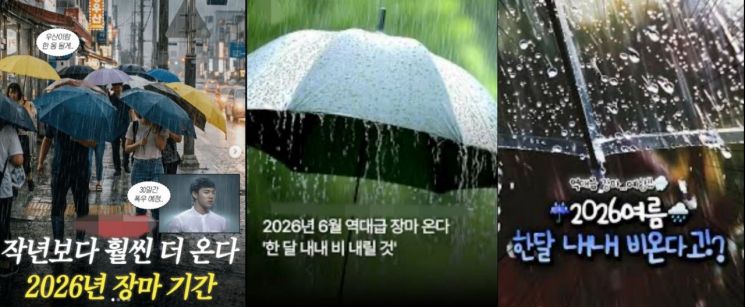
The agency took to its official social media channels on April 14 to address viral posts claiming “Record-breaking rainy season in June 2026” and “Rain for an entire month,” stating unequivocally that “there has been no official announcement regarding the rainy season forecasts circulating on social media.” The KMA emphasized its hope to prevent public confusion stemming from these unauthorized predictions.
The misleading posts have gained traction by using authoritative-sounding phrases like “2026 rainy season period revealed” and “Record-breaking rainy season expected,” creating the impression of legitimate forecasts. In reality, these posts merely repackage historical climate data—the average rainy season patterns from 1991 to 2020—and present them as current predictions.
According to historical data maintained by the KMA, the Korean rainy season typically begins around June 19 in Jeju Island and lasts until July 20, while southern regions experience it from June 23 to July 24, and central regions from June 25 to July 26. However, meteorologists stress that these dates reflect statistical averages rather than reliable forecasts for any specific year.
Weather experts explain that the Korean rainy season, known locally as “jangma,” is primarily influenced by the position and intensity of the stationary front formed between the North Pacific high-pressure system and cold, dry air masses from the north. The interaction between these weather systems determines whether the rainy season will feature prolonged precipitation or shorter, less intense rainfall periods.
Climate change has significantly altered traditional rainy season patterns across the Korean Peninsula in recent years. The classic pattern of steady, continuous rainfall has increasingly given way to intense localized downpours and extreme precipitation events, making historical averages less reliable as predictive tools.
This fundamental shift in weather patterns prompted the KMA to discontinue its practice of announcing rainy season start and end dates in advance, a policy change implemented in 2009. The agency now follows an approach similar to meteorological authorities in neighboring Japan and China, which also refrain from predicting specific rainy season timeframes.
Instead of long-range seasonal forecasts, the KMA now focuses on short and medium-term predictions, providing rainfall information only when the North Pacific high-pressure system is expected to bring several consecutive days of precipitation. The official determination of when the rainy season begins and ends is now made retrospectively, after analyzing observation data collected throughout the summer months.
“It is difficult to accurately predict the number of rainy days or the duration of the rainy season with the current level of scientific knowledge,” a KMA spokesperson noted, underscoring the complexity of modern climate systems. The agency strongly encourages the public to rely on official forecast channels rather than unverified social media claims.
The controversy highlights growing concerns about climate misinformation in an era when social media allows weather predictions—both legitimate and fabricated—to reach millions of people instantly. For South Korea, where agriculture, urban planning, and disaster preparedness depend heavily on accurate rainfall forecasts, distinguishing between credible meteorological information and sensationalized claims has become increasingly important.
As climate change continues to disrupt traditional weather patterns across Northeast Asia, meteorological agencies face mounting challenges in providing reliable forecasts while combating the spread of weather-related misinformation.
Fact Checker
Verify the accuracy of this article using The Disinformation Commission analysis and real-time sources.

9 Comments
It’s disheartening to see how easily misinformation can spread, even when it comes to something as fundamental as weather data. The KMA’s efforts to combat this are an important step in ensuring public access to accurate information.
I’m glad the KMA is being proactive in addressing these misleading social media posts. Maintaining public trust in weather forecasting is crucial, especially with the growing impact of climate change.
The KMA’s swift response to these misleading posts is commendable. Maintaining public trust in weather forecasting is crucial, especially in the face of climate change and its impacts.
Exactly. Reliable, fact-based information from trusted sources is essential when it comes to weather and climate-related issues.
Repackaging historical data as current forecasts is a sneaky way to spread misinformation. The KMA’s clarification is a important step in combating this kind of deceptive practice.
Agreed. Transparency and accuracy should be the top priorities for official weather agencies like the KMA.
While it’s understandable that people are eager for news about the upcoming rainy season, relying on unverified social media posts is not the way to go. The KMA’s warning is a good reminder to be cautious of such claims.
Interesting to see the KMA pushing back against the misinformation around rainfall forecasts. It’s important to rely on official sources and fact-check claims, especially when it comes to weather and climate data.
It’s concerning to see how easily inaccurate information can spread online, even when it comes to something as fundamental as weather patterns. The KMA’s response is a good reminder to always verify the source of such claims.