


Listen to the article
Recent Times Report on Iran-Israel Conflict Contains Significant Casualty Discrepancies
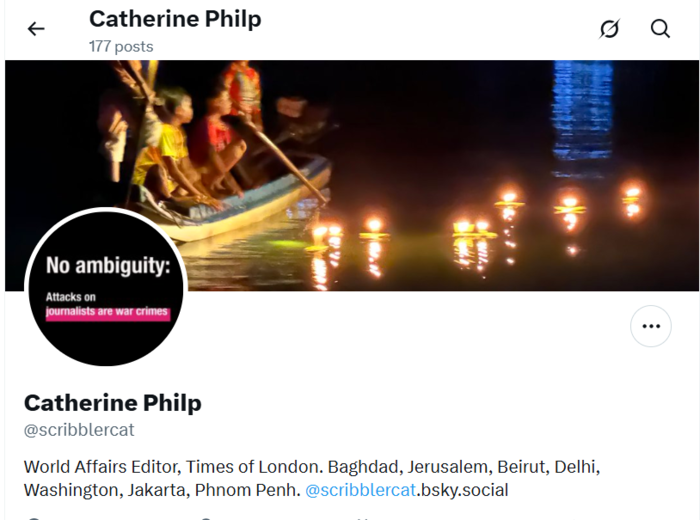
Catherine Philp’s recent reporting from Iran has drawn criticism for inaccuracies in casualty figures from the recent conflict between Iran and Israel. In her December 1 article titled “Families count the cost of war between Iran and Israel,” Philp provides an extensive 1,700-word account of the war’s impact on Iranian civilians, but critics say she significantly misrepresents casualty numbers on both sides.
The article claims that Iranian missiles killed “28 Israelis” while “injuring several dozen more.” According to official Israeli government sources, the actual death toll stands at 32 people, with all but one being civilians, and over 3,000 injured – a figure dramatically higher than Philp’s “several dozen” characterization.
Regarding Iranian casualties, Philp writes that “according to Tehran, more than 1,000 people were killed, about 700 of whom were civilians.” This civilian death toll appears inconsistent with other reporting on the conflict, including figures released through Iranian state-controlled media.
For context, the Associated Press reported on June 30, 2025, that Iran’s state-run IRNA news agency documented 935 total deaths, including 38 children and 132 women, but notably “did not give a breakdown between military and civilian casualties.” This makes Philp’s claim of 700 civilian deaths particularly questionable.
Independent monitoring organizations paint a significantly different picture. The U.S.-based Human Rights Activists group reported 1,190 total deaths, with 436 civilians, 435 military personnel, and 319 unidentified casualties. The organization consistently reports higher overall casualties than official Iranian figures, yet still shows a civilian count far below Philp’s reported 700.
Another respected monitoring source documented 1,082 deaths in Iran during the conflict, with a breakdown of 182 civilians and 900 military, security forces, and technical personnel affiliated with Iran’s military institutions. Their research identified 68 women and 45 children among the civilian casualties – numbers that starkly contradict Philp’s reporting.
The significant disparity between Philp’s figures and those from multiple other sources raises concerns about accuracy in her reporting on this sensitive conflict. Critics have reached out to Times editors requesting corrections to the erroneous Israeli casualty numbers and asking for substantiation of the claimed Iranian civilian death toll.
This controversy follows previous criticism of Philp’s work, particularly her 2024 column that some viewed as attempting to undermine evidence that Hamas used sexual violence as a weapon during its October 7 attack on Israel. That reporting generated significant backlash from organizations documenting these atrocities.
Accurate casualty reporting is crucial in conflict journalism, as these figures help shape international understanding of proportionality and impact. Misrepresenting such statistics, whether for Israeli or Iranian victims, can significantly distort public perception of the conflict.
The Times has not yet publicly responded to requests for correction or clarification regarding the casualty figures in Philp’s article. Media monitoring organizations continue to press for accountability in reporting on the Iran-Israel conflict, emphasizing the importance of factual accuracy when covering sensitive geopolitical issues that have profound human costs.
As tensions in the Middle East remain high, the need for precise, well-sourced reporting becomes even more essential for informed public discourse and policy responses to ongoing conflicts in the region.
Fact Checker
Verify the accuracy of this article using The Disinformation Commission analysis and real-time sources.

8 Comments
This is a concerning report about potential misinformation in the reporting around the Israel-Iran conflict. It’s important that journalists strive for accuracy, especially when covering sensitive geopolitical issues with significant human costs. I hope further investigation can shed light on the discrepancies in casualty figures cited.
Journalists have a responsibility to report the facts as accurately as possible, particularly on matters of war and conflict. While the specific details may be disputed, any loss of life is tragic. I hope this situation leads to more rigorous verification of information in future coverage of the region.
The discrepancies in casualty figures are very concerning. Accurate reporting is critical, particularly on issues of war and conflict where the human toll is so grave. I hope further investigation can shed light on what really happened.
This highlights the challenges of reporting on complex, high-stakes conflicts where information may be fragmented or disputed. I appreciate the attempt to provide context and compare sources, but clearly more work is needed to get the facts straight.
Given the complex and charged nature of the Israel-Iran conflict, it’s not surprising to see some inconsistencies in the media coverage. I appreciate the attempt to provide context and compare the reporting to official sources. Fact-checking is crucial, especially on topics like this with major human impacts.
This seems like a complex issue with competing narratives. I’m curious to see how this story develops as more information emerges. Responsible reporting on sensitive conflicts is so important.
This is a troubling report, and it highlights the importance of rigorous fact-checking and source verification, especially when covering high-stakes conflicts. Accurate information is crucial, as the human lives impacted should be the top priority.
Discrepancies in casualty figures are very concerning, especially when the stakes are so high. I hope further investigation can shed light on what really happened and lead to more reliable coverage going forward.