


Listen to the article
Health Officials Combat HPV Vaccine Misinformation as Uptake Lags
Gurugram health officials are sounding the alarm over misleading social media content that has significantly hampered Human Papillomavirus (HPV) vaccination efforts among teenage girls. The district Health Department reports that videos falsely linking the vaccine to infertility and other health issues have created widespread anxiety among both teenagers and their parents.
Officials will address this growing concern at a task force meeting scheduled for Thursday, which will be chaired by the deputy commissioner of Gurugram. The meeting will bring together representatives from multiple departments, including Education, Women and Child Development, and urban local bodies, to develop a coordinated response to combat vaccine hesitancy.
“Unscientific content on social media can lead to fear and misconceptions about HPV vaccines among young parents,” said Dr. Lokveer Singh, chief medical officer of Gurugram. “A coordinated awareness campaign for the World Health Organisation (WHO)-approved vaccines will be intensified.”
According to health officials, numerous social media videos feature individuals claiming to be medical professionals who falsely associate the Gardasil-4 HPV vaccine with infertility, autoimmune diseases, and menstrual disruption. The Health Department has categorically refuted these claims, emphasizing that such misinformation poses a serious public health risk.
The impact of this misinformation has been substantial. Since the nationwide immunization campaign launched on February 27, only 704 girls aged 14 have received the potentially life-saving vaccine in the district. This represents a fraction of the 30,000 vaccinations health officials hope to administer by May 31 in the first phase of the campaign.
The Gardasil-4 vaccine targets four HPV variants responsible for approximately 90% of cervical cancer cases. Cervical cancer remains a significant health concern in India, where it is one of the leading causes of cancer-related deaths among women. Health experts stress that early vaccination is crucial for effective prevention.
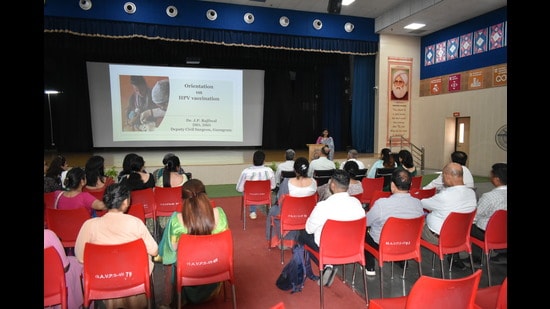
In response to the low vaccination rates, the district health department has initiated targeted interventions. “Around 50 principals participated in a workshop conducted on Tuesday. Similar door-to-door awareness plans are being executed through ASHA workers,” explained Dr. JP Rajliwal, district immunisation officer (DIO). “Parents need to realise that HPV shots are necessary to rule out cervical cancer at an early age.”
Most vaccinations to date have been administered at key healthcare facilities, including Civil Hospital in Sector 10A, Pataudi sub-divisional hospital, and Bhordakalan and Wazirabad public health centres. An additional 30 facilities have been offering free shots since April 3, expanding access across the district.
Dr. Rajliwal noted that in the first five weeks of the campaign, only 320 doses were administered, highlighting the slow initial uptake of the vaccine. The upcoming task force meeting aims to address this challenge by developing a unified vaccine advocacy strategy across all relevant government departments.
Public health experts suggest that vaccine hesitancy is not unique to the HPV vaccine but has become increasingly problematic in recent years due to the rapid spread of misinformation through social media platforms. The issue represents a broader challenge for public health officials worldwide who must balance educational outreach with addressing deeply held concerns, sometimes based on misleading information.
The task force meeting is expected to result in a comprehensive action plan that will include educational initiatives targeted at schools, community outreach programs, and potentially a social media counter-campaign to address the misinformation directly.
Health officials emphasize that the safety and efficacy of HPV vaccines are well-established through extensive clinical trials and years of use in vaccination programs worldwide. The potential benefit of preventing cervical cancer, they argue, far outweighs any minimal risks associated with vaccination.
Fact Checker
Verify the accuracy of this article using The Disinformation Commission analysis and real-time sources.

8 Comments
The drop in HPV vaccine uptake due to social media misinformation is troubling. Proactive public health education and coordinated efforts between different departments are necessary to counter unfounded claims and promote the benefits of this vital preventive measure.
Agreed. Transparent communication from medical experts, emphasizing the safety and efficacy of the WHO-recommended HPV vaccine, will be crucial to addressing the community’s concerns and boosting vaccination rates.
It’s unfortunate that misleading social media content has led to a drop in HPV vaccine uptake in Gurugram. Public health education and science-based outreach will be crucial to counter these unfounded claims and promote the benefits of this WHO-recommended vaccine.
Absolutely. Proactive steps by the health department to engage multiple stakeholders are a positive step. Transparent communication and fact-based messaging are essential to overcome vaccine hesitancy fueled by misinformation.
The HPV vaccine is an important preventative measure, especially for young women. It’s worrying to see misinformation spreading and deterring people from this vital healthcare. I hope the coordinated awareness campaign can effectively address the community’s concerns.
Vaccine hesitancy due to online misinformation is a concerning trend. The HPV vaccine is an important preventive measure, and I hope the planned awareness campaign can effectively address the community’s fears and restore trust in this WHO-approved vaccine.
Concerning to hear about the drop in HPV vaccine uptake due to misinformation. Proactive public health education is crucial to address unfounded fears and boost vaccination rates. Fact-based awareness campaigns led by medical experts can help build trust and counter social media falsehoods.
Agreed. Vaccine hesitancy fueled by online misinformation is a growing challenge. Transparent communication from health authorities, emphasizing the safety and benefits of the WHO-approved HPV vaccine, will be key to overcoming this issue.