


Listen to the article
In an era where social media has overtaken television as Americans’ primary news source, public health experts are grappling with how to effectively communicate reliable health information amid growing misinformation. This challenge was the focus of a recent School of Public Health conversation that attracted more than 550 viewers online.
The average person spends approximately 2.5 hours daily on social media, with adolescents nearly doubling that time. This extensive exposure to platforms like TikTok, Instagram, and Facebook creates significant opportunities for encountering health misinformation, according to experts at the November 12 event co-hosted by Boston University’s School of Public Health (SPH), College of Communication (COM), and Public Health Post.
“We are not just competing for attention—we’re competing for cognitive depth in an ecosystem that’s optimized for distraction,” explained Traci Hong, professor of media science at COM. She noted that social media encourages “fast-thinking” – emotional, automatic responses that leave little room for reflection or deliberation, creating fertile ground for misinformation to flourish.
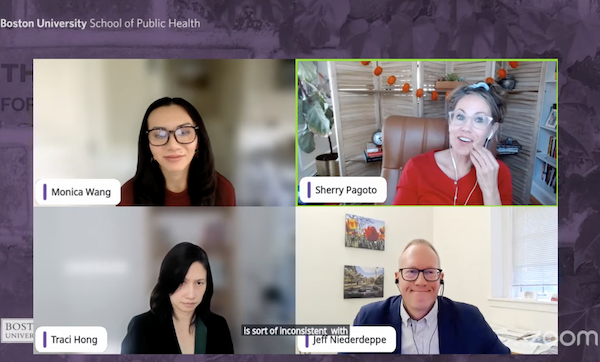
The panel, moderated by Monica Wang, associate professor of community health sciences and executive editor of Public Health Post, explored how health professionals can navigate the digital landscape to communicate trustworthy information despite widespread distrust in scientific and government institutions.
Sherry Pagoto, professor and director of the University of Connecticut Center for mHealth & Social Media, emphasized that everyone is susceptible to cognitive biases, including health professionals. She identified several key biases affecting information consumption: confirmation bias (believing information consistent with existing beliefs), bandwagon effect (following others with similar beliefs), illusory bias (believing repeatedly stated information), and partisan bias (accepting information aligning with political views).
“No matter who you are and how much education you have, we’re all vulnerable to misinformation,” Pagoto stated.
Social media algorithms further amplify these biases by serving users content that reinforces their established beliefs and interests. This problem has intensified since major platforms like Meta scaled back content moderation policies, creating more opportunities for misinformation to spread unchecked.
Rather than solely focusing on debunking myths, Pagoto suggested that public health professionals should make concerted efforts to understand people’s values, particularly in communities historically marginalized by scientific institutions. “There are a lot of communities that have not been respected by science, and so they are skeptical of expert consensus and mandates. It may be better to spend our conversations learning about others’ values, rather than trying to change their minds.”
Jeff Niederdeppe, senior associate dean of faculty and research at Cornell University’s Jeb E. Brooks School of Public Policy, highlighted the challenges public health communicators face against well-funded opposition. “We always have to compete with well-funded oppositional forces, whether they’re selling products or representing powerful interests, and they’re often able to outspend public health,” he said.
Niederdeppe drew an important distinction between information overload and consistent messaging. “I don’t know that we’ve reached a level of fatigue on public health topics…I think we are often out-exposed by competing interests,” he observed. He noted that consistent messaging across various contexts benefits public health communication, though communicators should avoid demanding that health concerns supersede all other life priorities.
The experts recommended multiple strategies for effective health communication, including collaborations with social media influencers, partnerships with trusted community leaders, and leveraging artificial intelligence to create interactive data dashboards that personalize health information. These approaches aim to increase consumption of accurate information while fostering more positive engagement in digital spaces.
Pagoto concluded the session with an optimistic vision for the future of social media consumption: “I hope that ‘hope-scrolling’ becomes the word of 2026,” suggesting a shift from the negativity often associated with these platforms toward more constructive health information exchanges.
As social media continues to dominate information consumption, these strategies represent crucial approaches for public health experts seeking to combat misinformation and rebuild trust in scientific expertise during a period of unprecedented communication challenges.
Fact Checker
Verify the accuracy of this article using The Disinformation Commission analysis and real-time sources.

20 Comments
Combating misinformation in medical news reporting is a crucial task, especially with the rise of social media as the primary news source for many Americans. I’m glad to see experts coming together to discuss strategies for effectively communicating reliable health information.
Agreed. With the extensive time people, especially younger generations, spend on social media, the potential for harm from health misinformation is substantial. Innovative approaches are needed to address this issue.
The spread of health misinformation on social media is a major concern that needs to be addressed. I’m glad to see experts coming together to discuss strategies for effectively communicating reliable information and countering this dangerous trend.
Agreed. With the significant time people, especially younger generations, spend on social media, the potential for harm from false health claims is substantial. Innovative approaches are needed to address this challenge.
It’s concerning to hear about the significant time people, especially adolescents, are spending on social media and the impact this has on the spread of health misinformation. Experts will need to find creative ways to reach people and provide reliable information.
Absolutely. The emotional, fast-paced nature of social media makes it a prime environment for the proliferation of false health claims. Addressing this challenge is vital for protecting public health.
The panel discussion on addressing health misinformation in news reporting is a timely and important topic. Experts will need to find ways to effectively cut through the noise and emotional triggers on social media to ensure people have access to accurate, science-based information.
Definitely a critical issue. With social media’s dominance as a news source, the spread of false health claims can have serious consequences for public health. Addressing this challenge is vital.
Misinformation in medical news reporting can have serious consequences for public health. I’m glad to see experts coming together to discuss strategies for effectively communicating reliable information and combating this problem.
Absolutely critical. With the public’s heavy reliance on social media as a news source, this issue needs to be addressed urgently to protect the health and well-being of communities.
The spread of health misinformation on social media is a major concern that needs to be addressed. I’m glad to see public health experts taking this issue seriously and looking for ways to combat it.
Definitely a critical issue. With so much reliance on social media for news, the potential for harm from false information is substantial. Innovative approaches are needed to counter this trend.
Interesting to hear about the panel discussion on this important topic. Communicating accurate health information in the age of social media distraction is a significant challenge that requires innovative solutions.
I agree. Experts will need to find ways to cut through the noise and emotional triggers on social media to ensure people have access to reliable, science-based health information.
Interesting to hear about the efforts to combat misinformation in medical news reporting. With the heavy reliance on social media as a news source, this is a significant challenge that requires innovative solutions from public health experts.
Absolutely. The emotional, fast-paced nature of social media makes it a prime environment for the proliferation of false health claims. Addressing this issue is crucial for protecting the well-being of communities.
Combating misinformation in medical news is critical, especially with the rise of social media. Experts need to find ways to effectively communicate reliable health information and counter the rapid spread of falsehoods online.
Absolutely. The challenge of competing for attention and cognitive depth in the age of social media distraction is a significant hurdle that needs to be addressed.
It’s concerning to hear that the average person spends 2.5 hours daily on social media, with adolescents even more. This creates immense potential for encountering and believing health misinformation.
I agree. The emotional, fast-thinking nature of social media platforms makes it an ideal breeding ground for the spread of false information. Experts will need to find innovative ways to counter this trend.