


Listen to the article
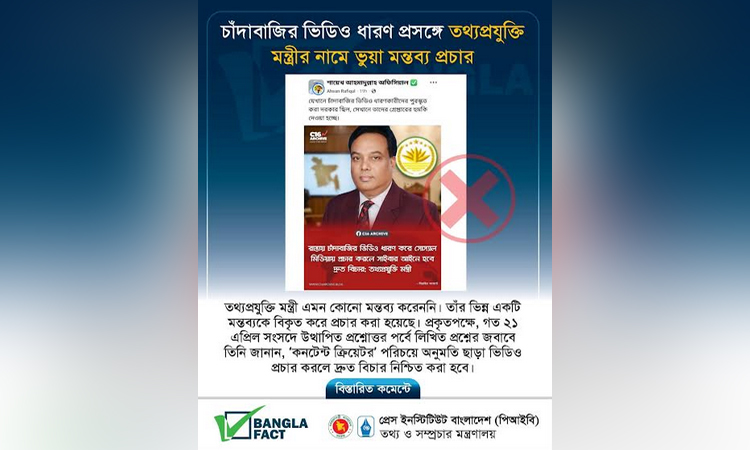
A fabricated photo card circulating on social media has falsely attributed statements to Posts, Telecommunications and Information Technology Minister Fakir Mahbub Anam, according to an investigation by BanglaFact, the fact-checking wing of the Press Institute Bangladesh (PIB).
The misleading content, which has gained traction across various platforms, claimed that Minister Anam had stated that citizens who record incidents of extortion on streets and share them on social media would face swift punishment under cyber laws. BanglaFact’s investigation revealed this attribution to be entirely fabricated.
According to the fact-checkers, Minister Anam’s actual statement, made during a parliamentary session on April 21, addressed a different issue altogether. In response to a written question, he had indicated that legal action would be taken against individuals who publish videos without permission while claiming to be content creators. This legitimate statement was subsequently distorted and reframed to create the misleading narrative.
“This is a clear example of how statements can be manipulated to create public confusion,” said a spokesperson from BanglaFact. “The minister never suggested that documenting extortion would be punishable—this is a complete fabrication designed to create mistrust.”
The incident comes amid what media analysts describe as a surge in targeted misinformation following Bangladesh’s tumultuous mass uprising of 2024. That political upheaval, which resulted in significant governmental changes, has created a fertile environment for disinformation campaigns.
BanglaFact’s researchers have documented a pattern of false narratives emerging from both domestic and international social media accounts. These campaigns have strategically targeted the previous interim administration, political organizations that participated in the 2024 movement, and more recently, the newly elected BNP-led government.
Media experts suggest this represents a coordinated attempt to undermine political stability during Bangladesh’s fragile transition period. The country’s digital landscape has become increasingly polarized, with competing narratives vying for public attention.
“What we’re seeing is typical post-revolution information warfare,” explained Dr. Nasreen Ahmed, a digital media researcher at Dhaka University. “Various interest groups are attempting to shape public perception through misleading content. The fabricated quote attributed to Minister Anam fits this pattern perfectly.”
The telecommunications ministry has issued a statement urging citizens to verify information through official channels before sharing content online. The ministry has also established a dedicated portal where citizens can report suspicious digital content for verification.
This incident highlights the growing challenge of misinformation in Bangladesh’s evolving media ecosystem. As smartphone penetration increases—now reaching approximately 70% of the population—so does the potential for rapid spread of unverified information.
BanglaFact, established in 2019, has expanded its operations significantly since the 2024 uprising. The organization now employs a team of 24 fact-checkers who monitor social media platforms, messaging apps, and traditional media outlets for potential misinformation. Their work has become increasingly vital as Bangladesh navigates its complex political transition.
“Fact-checking is no longer optional—it’s essential infrastructure for our democracy,” noted the PIB director in a recent press briefing. “When ministers are misquoted or statements are fabricated, it undermines public trust in institutions at a time when that trust is most needed.”
The BanglaFact team continues to investigate the source of the fabricated photo card, working with social media platforms to limit its spread and prevent similar incidents in the future.
Fact Checker
Verify the accuracy of this article using The Disinformation Commission analysis and real-time sources.

8 Comments
This is a concerning example of how social media can be used to spread false narratives. I appreciate BanglaFact’s efforts to investigate and correct the record. Maintaining transparency and accountability in public discourse is so important.
This is a concerning example of how social media can be used to spread misinformation. I’m glad BanglaFact investigated the issue and was able to provide the correct context. It’s important that we all remain vigilant and fact-check claims, especially those involving public figures.
It’s disappointing to see fabricated quotes being circulated, especially when they involve government officials. I’m glad BanglaFact was able to clarify the actual context of the minister’s statement. This underscores the need for rigorous fact-checking and media literacy.
Absolutely. Fact-checking is crucial in an age of widespread misinformation. BanglaFact’s work helps ensure the public has access to accurate, reliable information.
This is concerning misinformation about a government minister. It’s important to fact-check claims before spreading them, as this case shows how statements can be easily distorted online. I appreciate BanglaFact’s diligence in investigating the true context of the minister’s remarks.
Absolutely, fact-checking is crucial to combat the spread of false narratives. It’s good to see a reputable organization like BanglaFact addressing this issue.
Fabricating quotes and attributing them to public officials is a serious abuse of social media. I’m glad BanglaFact was able to expose this particular case of disinformation. It’s a good reminder to be cautious about unverified claims, especially those targeting government figures.
Agreed. We should be vigilant about fact-checking online content, especially when it involves sensitive political topics. Spreading misinformation can have real consequences.