


Listen to the article
Al-Fanar Media CEO to Explore Higher Education’s Battle Against Misinformation in Upcoming Webinar
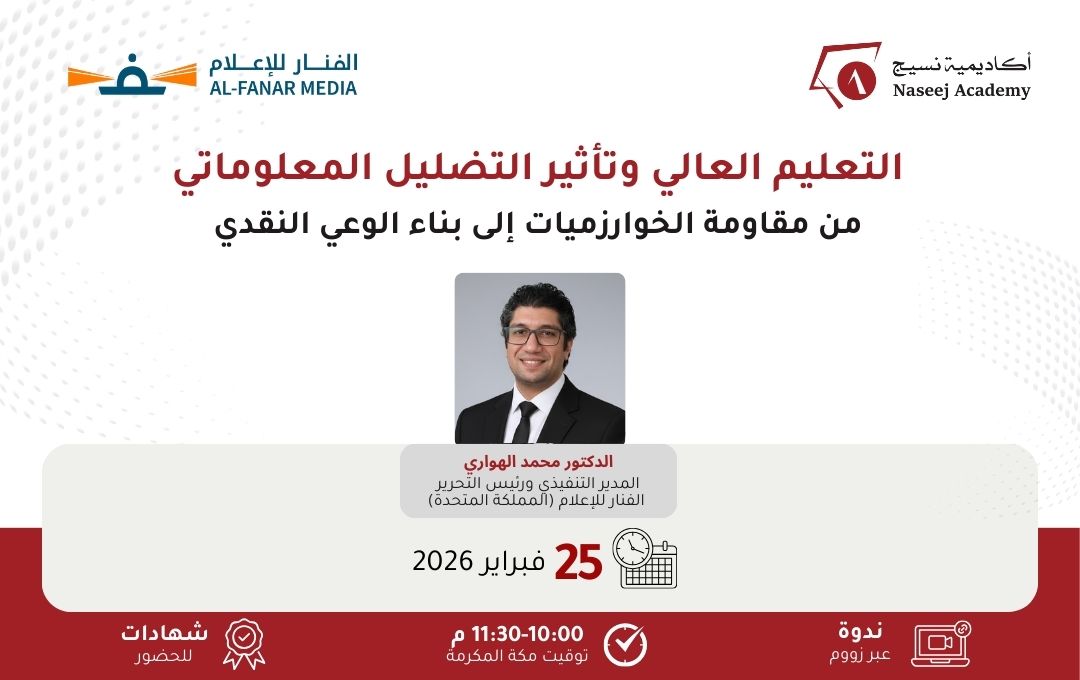
Mohammad El-Hawary, CEO and Editor-in-Chief of Al-Fanar Media, will lead a timely webinar examining the complex relationship between higher education and misinformation. The virtual event, scheduled for February 25, will focus on the theme “From Resisting Algorithms to Building Critical Awareness” and is being organized in collaboration with Naseej Academy.
The webinar comes at a crucial moment when academic institutions worldwide are struggling to adapt to an increasingly complex information landscape dominated by digital platforms, algorithmic content distribution, and the proliferation of sophisticated misinformation.
El-Hawary’s discussion will tackle five key areas that represent significant challenges for modern universities. The first explores whether higher education institutions are operating within or outside the logic of digital platforms in today’s attention economy – a fundamental question as universities compete for student engagement in an environment dominated by social media algorithms.
The webinar will also address why students continue to struggle with distinguishing between innocent errors and deliberately structured misinformation, a skill gap that educators have found increasingly concerning as digital literacy becomes essential for informed citizenship.
Perhaps most urgently, El-Hawary will examine the emergence of artificial intelligence and deepfake technologies, which he characterizes as “a structural challenge universities remain largely unprepared to confront.” This technological frontier has rapidly evolved beyond many institutions’ ability to develop appropriate pedagogical responses.
The fourth theme positions critical thinking not merely as an academic skill but as a “survival skill” that extends beyond classrooms into civic engagement and professional decision-making. This perspective aligns with growing calls from employers and civic leaders for graduates equipped to navigate complex information environments.
Finally, the discussion will examine the university’s broader societal role, transitioning from traditional knowledge production to actively shaping public awareness about information integrity in democratic societies.
The webinar reflects Al-Fanar Media’s ongoing commitment to media literacy in the Arab region. The organization recently gained increased international recognition when El-Hawary was elected to represent Arab states on the Global Governing Council of the UNESCO Media and Information Literacy Alliance (MIL) for 2026, alongside Hania Bitar.
This prestigious position places El-Hawary at the forefront of global efforts to advance media literacy. The Alliance’s Global Council serves as its highest decision-making authority, setting strategic priorities for media literacy initiatives worldwide and coordinating international collaboration on policy, research, and educational practices.
UNESCO’s Media and Information Literacy Alliance, launched in 2013 in Abuja, Nigeria, has evolved from its original incarnation as the Global Alliance for Media and Information Literacy Partnerships (GAPMIL). The organization was established to strengthen international cooperation, harmonize foundational concepts in media literacy, and provide a unified voice for global media literacy advocates.
The upcoming webinar represents a significant opportunity for educators, administrators, and policymakers in the Arab region to engage with pressing questions about information integrity in higher education. As universities face unprecedented challenges from misinformation, El-Hawary’s expertise offers valuable insights for institutions seeking to prepare students for a media landscape of increasing complexity.
Those interested in attending the February 25 webinar can register through the link provided by Al-Fanar Media and Naseej Academy.
Fact Checker
Verify the accuracy of this article using The Disinformation Commission analysis and real-time sources.

14 Comments
Interesting to hear how higher ed is tackling misinformation. Algorithms and digital platforms definitely present new challenges for universities trying to reach and educate students. Looking forward to hearing more about the specific strategies discussed in the webinar.
Yes, critical thinking and media literacy are crucial skills for students to develop in today’s information landscape. Glad to see institutions taking this issue seriously.
Interesting to see a focus on the role of digital platforms and algorithms in the spread of misinformation. Universities have to operate within this complex ecosystem, so understanding these dynamics is key.
Curious to learn more about the specific strategies and frameworks the webinar will cover for combating misinformation in higher ed. Developing students’ media literacy is so important these days.
Addressing misinformation is a vital task for academic institutions. It’s encouraging to see leaders in higher ed taking proactive steps to help students navigate the complex digital world.
Agreed. With the rise of fake news and disinformation, building students’ capacity for critical analysis is more important than ever.
This webinar seems timely and relevant. Misinformation is a growing challenge for universities, as they compete for student attention in an algorithmically-driven digital landscape. Looking forward to hearing the insights shared.
Absolutely. Tackling misinformation requires a multi-pronged approach, from teaching critical thinking to re-evaluating institutional practices. Glad to see this issue being addressed.
The relationship between higher ed and misinformation is a complex one. I’m curious to learn more about the specific strategies and frameworks universities can use to build student awareness and resilience.
The challenges of misinformation in the digital age are particularly acute for universities. I’m curious to learn more about the specific approaches and frameworks discussed in this webinar for addressing this complex problem.
Kudos to Al-Fanar Media and Naseej Academy for organizing this important webinar. Misinformation is a growing challenge that universities must confront head-on. Looking forward to the insights shared.
Agreed. Developing students’ critical thinking and media literacy skills is crucial, especially as they navigate the digital landscape. This webinar could offer valuable lessons for the higher ed sector.
This webinar touches on a vital issue for higher education. Misinformation poses a serious threat to the credibility and mission of academic institutions. Looking forward to hearing the strategies discussed.
Absolutely. Equipping students with the tools to critically evaluate information sources and resist the pull of digital algorithms is essential. Glad to see this topic getting the attention it deserves.