


Listen to the article
AI Conversations Show Promise in Combating Wind Farm Misinformation
Our collective ability to reach sustainable development goals faces a significant challenge from misinformation about renewable energy solutions. As generative AI rapidly becomes one of the most influential sources of public information, researchers have begun examining how these tools might affect beliefs about wind farms – with encouraging initial results.
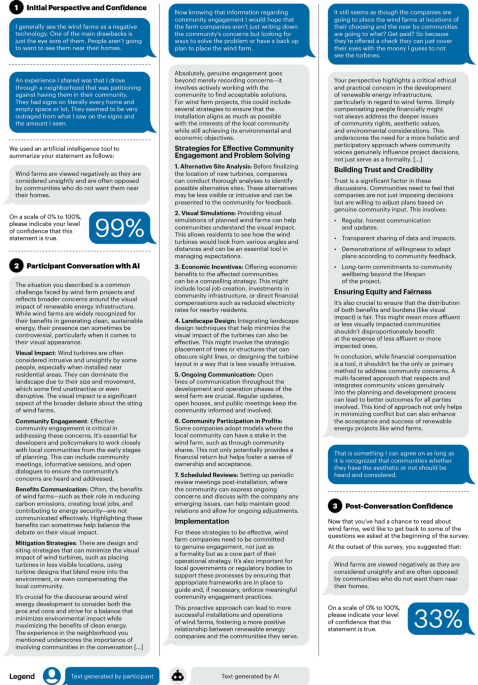
Two recent studies investigated whether conversations with ChatGPT could reduce misinformation and improve attitudes toward wind energy. The findings suggest AI conversations can produce modest but meaningful improvements in beliefs, particularly in the short term.
For individuals who initially expressed negative views about wind farms, confidence in those negative beliefs decreased by approximately 10% after just a three-round conversation with ChatGPT. Participants also demonstrated increased support for pro-wind policies and decreased agreement with common misconceptions following these interactions.
“Although modest, these effects should not be dismissed,” noted the researchers. “In the context of informational interventions on science and technology issues, where meta-analyses typically find small effects, these results are encouraging. At population scale, such effects have the potential to shift beliefs among millions of people.”
The studies found that ChatGPT conversations did not appear to introduce new misinformation about wind farms. This offers provisional reassurance, though researchers caution this shouldn’t be taken as a blanket guarantee of accuracy across all possible AI interactions on the topic.
The durability of these positive effects varied. While some improvements in beliefs remained observable after a month, others diminished over time – a pattern consistent with broader evidence that attitude change is generally difficult to sustain, particularly for topics with emotional or partisan significance.
When compared directly with a traditional fact sheet from the US Department of Energy, the ChatGPT intervention performed comparably on many measures, though the fact sheet proved more effective at reducing agreement with a broad range of misconceptions. This may be because the fact sheet comprehensively addressed many myths, while the AI conversations responded more narrowly to participants’ specific concerns.
The research highlights several unique advantages of AI tools for addressing misinformation. Unlike static fact sheets, ChatGPT engages individuals in personalized conversations, tailoring responses to specific concerns. The technology’s accessibility and ability to operate in multiple languages make it effective for reaching diverse audiences, including those unlikely to seek out government fact sheets.
However, the researchers identified important limitations. The “black box” nature of AI algorithms and lack of regulatory oversight makes it difficult for users to understand how information is being generated, potentially undermining trust if inconsistencies arise. Additionally, because ChatGPT creates unique responses for each user, researchers couldn’t isolate which specific conversational features were most effective in changing beliefs.
The environmental impact of AI systems also raises ethical considerations, though researchers note the computational energy costs must be evaluated against the potential climate benefits of increased renewable energy acceptance.
Looking forward, experts suggest several promising directions for improving AI-based interventions against misinformation. These include developing ensemble learning approaches that combine multiple specialized AI models, creating graph-based systems that analyze how specific myths propagate through social networks, and implementing multi-session interventions to reinforce corrections and sustain belief change.
“GenAI shows potential as a complementary tool for addressing misinformation about wind farms,” the researchers concluded. “While our findings reveal both strengths and limitations compared to traditional approaches, its adaptability, accessibility, and capacity for personalized engagement suggest value as part of a diversified intervention strategy.”
The studies represent an important first step in understanding how AI conversations might influence beliefs about sustainable energy, with implications for accelerating the deployment of climate-critical infrastructure.
Fact Checker
Verify the accuracy of this article using The Disinformation Commission analysis and real-time sources.

14 Comments
Misinformation around renewable energy is a major obstacle to sustainability efforts. Using AI to have constructive dialogues and correct common misconceptions could be a valuable tool in the arsenal. It’s good to see researchers exploring this potential.
Combating misinformation around renewable energy is critical, so this research on leveraging generative AI to counter wind farm myths is really exciting. Even small improvements in beliefs and attitudes could add up to make a meaningful difference. Curious to see how this technology might be applied to address misinformation in other areas as well.
While the effects may be modest, they’re still meaningful. Every bit helps in the fight against misinformation, especially on crucial issues like climate change and renewable energy. I’m curious to see if this approach could be scaled up or applied to other renewable technologies as well.
This is a fascinating look at how generative AI could be used to combat misinformation about renewable energy solutions like wind farms. The ability to have thoughtful, fact-based conversations and shift beliefs, even modestly, is really promising. I’m eager to see how this research progresses and if the approach could be scaled up or applied to other renewable sectors.
The potential for generative AI to have a positive impact on public perceptions of renewable energy is quite compelling. While the effects may be small, chipping away at misinformation through constructive dialogues could contribute to important shifts in support for solutions like wind farms. Eager to see further developments in this area.
Misinformation is a major obstacle to sustainability efforts, so this research on leveraging generative AI to counter wind farm myths is really intriguing. The ability to have nuanced dialogues and correct misconceptions, even in a small way, could be a game-changer. Curious to see how this technology might be applied to other renewable sectors as well.
Renewable energy is critical to our sustainable future, so combating misinformation around solutions like wind farms is crucial. Using generative AI to have constructive dialogues and correct misconceptions is a clever approach. Curious to see if this could be expanded to address misinformation in other areas as well.
It’s promising to see that even brief interactions with ChatGPT can lead to measurable improvements in beliefs and attitudes around wind energy. While modest, these effects could add up to make a real difference, especially if scaled up. Curious to see how this technology might be applied to other renewable sectors.
This is a creative and promising approach to combating misinformation around renewable energy. Using generative AI to engage people in thoughtful, fact-based conversations about wind farms could be a valuable tool. Even modest improvements in beliefs and attitudes could add up to make a real difference over time.
This is an encouraging development in the fight against misinformation around renewable energy. If generative AI can effectively shift beliefs and increase support for wind power through conversational interventions, that could be a valuable tool. Looking forward to seeing how this research progresses.
Misinformation is a major roadblock to achieving sustainability goals, so this research on using generative AI to counter wind farm myths is really interesting. Even modest improvements in beliefs and attitudes could make a meaningful difference. Curious to see if this approach could be applied to other renewable sectors as well.
While the effects may be modest, any progress in shifting beliefs and increasing support for renewable energy solutions is valuable. Using generative AI to have constructive conversations and address misinformation around wind farms is a clever approach. I’m eager to see if this could be scaled up or adapted for other renewable technologies.
Generative AI’s ability to have nuanced, fact-based conversations is really intriguing in the context of combating misinformation. If these tools can effectively reduce negative beliefs and increase support for wind energy, that could be a game-changer. I’m eager to see further research in this area.
This is an interesting look at how generative AI could help combat misinformation around renewable energy solutions like wind farms. It’s encouraging to see that even brief conversations with ChatGPT can shift people’s beliefs and increase support for pro-wind policies.