


Listen to the article
The Camera’s Hidden Influence: New Perspective on Conflict Photojournalism
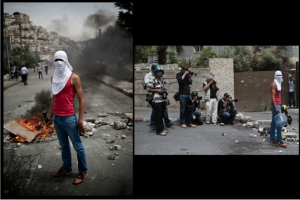
Italian photographer Ruben Salvadori is challenging conventional wisdom about photojournalism in conflict zones with his provocative project that turns the lens on journalists themselves. His photo essay and video “Photojournalism Behind the Scenes” explores how media professionals may influence the very events they claim to document objectively.
The project, filmed in East Jerusalem where Palestinian protests against Israeli forces occur weekly, reveals the sometimes uncomfortable relationship between photographers and their subjects. By “breaking the taboo of the invisible photographer,” Salvadori questions fundamental assumptions about visual journalism in volatile situations.
“What we see is not always what happened,” Salvadori explains in his video. By documenting photographers positioning themselves for dramatic shots and sometimes inadvertently escalating tensions through their presence, he raises important ethical questions about the production of conflict imagery.
This examination comes amid long-standing debates about media representation of the Israeli-Palestinian conflict. Pro-Israeli media watchdogs have coined terms like “Pallywood” and “Hezbollywood” to describe what they see as manufactured documentation designed to sway international opinion against Israel.
In 2005, Boston University professor Richard Landes produced the documentary “Pallywood: According to Palestinian Sources,” which alleged specific instances of media manipulation aimed at winning the public relations war against Israel. This came as a response to the 2004 documentary “Peace, Propaganda and the Promised Land,” which made contrary claims that U.S. media coverage was predominantly biased in favor of Israel.
The competing narratives underscore how the conflict in the region continues to be waged through public relations and media as much as through physical confrontation. Both sides understand the power of imagery in shaping international opinion and policy.
Media scholar Dr. Sarah Coleman, who studies visual journalism in conflict zones, notes that Salvadori’s work “forces us to confront uncomfortable truths about the production of news imagery. The camera isn’t just documenting events—it’s shaping them.”
This phenomenon isn’t unique to the Israeli-Palestinian conflict. The famous 2003 toppling of Saddam Hussein’s statue in Baghdad’s Firdos Square provides another notable example of how media portrayal can diverge from reality. What Western media largely presented as a spontaneous demonstration by Iraqis celebrating liberation was later revealed to be an event orchestrated largely for cameras by coalition forces.
The demand for dramatic, emotionally resonant imagery creates market pressures that can lead journalists to seek—or even help create—moments of tension that make for compelling photographs. News organizations compete for attention in a crowded information landscape, and striking visual content drives engagement.
Salvadori’s project highlights a growing crisis of trust in visual media. In an era of digital manipulation and selective framing, the old belief that “the camera never lies” seems increasingly naïve. His work raises important questions about journalistic standards and the responsibility of news consumers to view visual reporting with a critical eye.
“The photographer is not an invisible fly on the wall,” Salvadori argues. “We need to acknowledge our role in shaping the narrative.”
Following the success of his work in Jerusalem, Salvadori plans to expand his project to other conflict zones, including Afghanistan and Pakistan, to determine whether the patterns he observed are universal across different cultural and political contexts.
Media ethics experts suggest that greater transparency about how conflict imagery is produced could help restore trust in photojournalism. This might include wider camera angles showing the media presence, behind-the-scenes context, or more explicit disclosure about how photographs were obtained.
As visual literacy becomes increasingly important in a media-saturated world, Salvadori’s work serves as a timely reminder that every photograph represents not just what happened, but also choices made by the person behind the camera.
Fact Checker
Verify the accuracy of this article using The Disinformation Commission analysis and real-time sources.

7 Comments
This project raises important questions about the power dynamics at play in conflict zones. The role of the media is often underappreciated, but it can have significant real-world implications. Thoughtful discussions like this are needed to uphold journalistic integrity.
Photographers hold a great deal of influence, whether they intend to or not. This project sheds light on the ethical minefield they must navigate. Maintaining objectivity while being mindful of one’s impact is a constant challenge in this field.
The Israeli-Palestinian conflict is such a charged and complex issue. This examination of media representation is timely and important. We should continue to critically examine the biases and blind spots that can seep into conflict reporting.
It’s concerning to think that the imagery we consume may not always reflect the full truth of a situation. This project highlights the need for greater transparency and accountability around conflict reporting. The public deserves to know the complexities involved.
This is a fascinating look at the ethical dilemmas of conflict photojournalism. It’s important that we scrutinize how media professionals may influence the events they cover, even if unintentionally. Transparency around these dynamics is crucial for maintaining public trust.
Photographers have an immense responsibility when documenting volatile situations. This project highlights the need for heightened awareness of how their presence and actions can impact the scenes they’re trying to capture. Ethical guidelines for this field are clearly warranted.
I agree, it’s a delicate balance that photojournalists must navigate. Maintaining objectivity while recognizing their own influence is no easy task.