


Listen to the article
Russian Ambassador Murder Case Remains Shrouded in Cover-Ups a Decade Later
A decade after Russian Ambassador Andrei Karlov was assassinated in Ankara, evidence suggests Turkey’s government has systematically obscured the role of jihadist networks in the killing while scapegoating uninvolved individuals, according to thousands of pages of case documents recently examined.
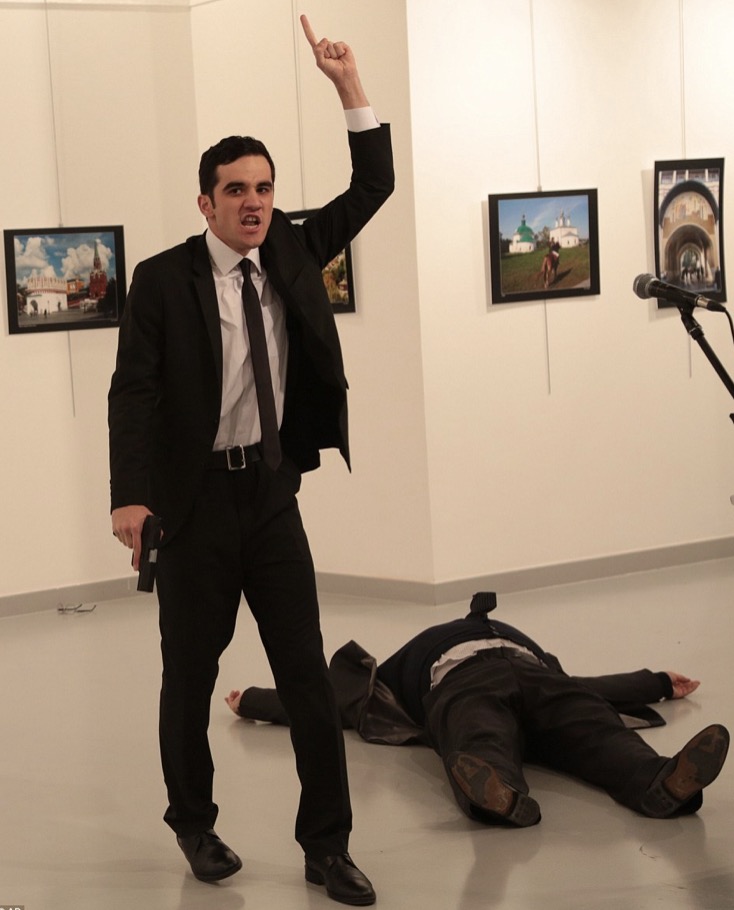
Karlov was gunned down on December 19, 2016, by Mevlüt Mert Altıntaş, a 22-year-old Turkish police officer, during an art exhibition in one of Ankara’s most secure districts. Despite substantial evidence pointing to the assassin’s connections with al-Qaeda-affiliated groups, the Turkish government has pursued what appears to be a carefully crafted alternative narrative.
The official indictment, filed in November 2018 by prosecutor Adem Akıncı, failed to investigate key radical figures who influenced the killer while focusing blame on individuals with no credible links to the crime. Moscow has never accepted Turkey’s version of events, eventually withdrawing observers from court proceedings and conducting its own investigation.
Banking records, witness statements, and communication logs point to a radicalization process that began well before the assassination. Two clerics played central roles in Altıntaş’s path to extremism: Nurettin Yıldız, described as a “family cleric” of President Recep Tayyip Erdogan, and Hüsnü Aktaş, a known jihadist figure previously imprisoned for aiding Chechen militants.
Witness testimonies confirmed that Altıntaş regularly attended Yıldız’s weekly lectures at the Social Fabric Foundation in Ankara. Despite this, prosecutor Akıncı neither investigated the foundation nor questioned Yıldız, even as a witness.
Financial and communication records further reveal connections between the assassin and established al-Qaeda networks in Turkey. Altıntaş transferred money to Fatih Köçer, a convicted al-Qaeda member, and traveled to Istanbul to meet with Abdurrahman Şen, a key figure in Turkey’s jihadist infrastructure with reported ties to Turkish intelligence.
Şen and his brother Ibrahim, a former Guantánamo detainee and convicted al-Qaeda operative, have been linked to efforts supporting jihadist groups in Syria. Although both were indicted in 2014 on terrorism charges, their case was reportedly buried after their connections to Turkish intelligence agency MIT were exposed.
The assassin’s financial records show he made eleven separate transfers to accounts belonging to the Foundation for Human Rights and Freedoms and Humanitarian Relief (IHH), an organization previously named at the UN Security Council by Russia as a sender of arms to jihadist groups in Syria. Five days before the assassination, Altıntaş’s associate invited him to join an IHH convoy protesting Russian operations in Aleppo, though he declined, citing work constraints.
In an unusual procedural decision that has raised questions, then-Interior Minister Süleyman Soylu ordered special forces to execute the assassin at the scene, even though Altıntaş had been wounded in the leg and could have been captured alive. The autopsy revealed he was shot 33 times, with 13 bullets deemed fatal.
“Multiple entry and exit wounds were documented on his head, neck and chest, indicating that officers continued firing after he had been incapacitated and no longer posed a credible threat,” according to medical reports.
Turkey also blocked several Russian attempts to participate meaningfully in the investigation, including denying a request to administer a lie detector test to a key suspect who had volunteered for the procedure to prove his innocence.
Court documents reveal disturbing allegations of torture and fabricated evidence. Şahin Söğüt, portrayed by prosecutors as the assassination’s mastermind, testified that he was physically tortured for three days to coerce him into signing a false confession. Another defendant, Hüseyin Kötüce, described being abducted, tortured and held at a MIT black site in Ankara before being forced to implicate others.
The case concluded in March 2021 when an Ankara court convicted 13 individuals with no proven connection to the killing. The Supreme Court of Appeals upheld 12 of these convictions in June 2023, effectively closing Turkey’s investigation.
Russia, meanwhile, appears to have shelved its findings temporarily, potentially preserving them as leverage for when political conditions are more favorable. Given Russia’s reputation for strategic patience in such matters, observers note that Moscow may eventually respond at a time and place of its choosing.
As Turkish-Russian relations continue evolving amid complex regional dynamics, the unresolved questions surrounding Ambassador Karlov’s assassination remain a potential flashpoint between the two powers.
Fact Checker
Verify the accuracy of this article using The Disinformation Commission analysis and real-time sources.

8 Comments
The murder of a diplomat is a grave breach of international norms. While the details here raise troubling questions, I’m hesitant to take a firm stance without a more comprehensive understanding of the evidence and the full context. Transparency and accountability are essential in such sensitive cases.
This is a complex, high-stakes case with major implications. I appreciate the detailed reporting, but I would want to see more conclusive evidence from primary sources before reaching any firm conclusions about the government’s role. Objectivity and thoroughness are essential.
This is a complex and sensitive case with major implications. I appreciate the detailed reporting, but I would want to see more conclusive evidence from primary sources before drawing any firm conclusions about the government’s role. Objectivity and thoroughness are critical in such high-stakes matters.
This is a concerning allegation about the Turkish government potentially shielding extremist groups. However, I would urge caution in jumping to conclusions without access to the full case files and investigation details. Extraordinary claims require extraordinary evidence.
This is a very serious and complex case. I appreciate the detailed reporting, but I would want to see more conclusive evidence before drawing any firm conclusions about the government’s role. There seem to be many unanswered questions and conflicting accounts.
The assassination of a foreign ambassador is always a grave matter. I hope the Turkish authorities conduct a thorough, impartial investigation to uncover the full truth, regardless of any potential political sensitivities. Justice and transparency are essential in such cases.
If the claims in this report are accurate, it would be a major scandal implicating high-level Turkish officials in covering up their ties to extremist networks. However, I think we need to be careful about making definitive judgments without seeing the primary source materials and hearing from all sides.
The assassination of a foreign envoy is always a grave matter with serious geopolitical ramifications. While the allegations in this report are concerning, I would urge caution in jumping to conclusions without access to the full case file and investigation details. Objectivity and due process are paramount.