


Listen to the article
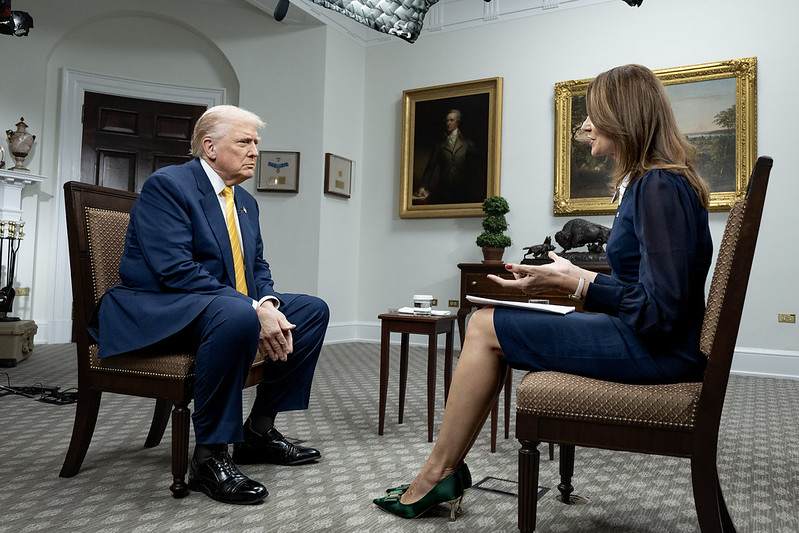
In a recent broadcast that has drawn regulatory scrutiny, GB News aired an interview between presenter Beverley Turner and President Trump that featured numerous unchallenged falsehoods about energy and climate change, violating the UK’s broadcasting standards.
The November 15 interview, part of Turner’s “Late Show Live” program, began with Trump ironically complaining about being victimized by “fake news” before proceeding to make multiple false claims that went uncorrected by the host. This lack of correction appears to violate Ofcom’s Broadcasting Code, which requires news to be “reported with due accuracy” and stipulates that “significant mistakes in news should normally be acknowledged and corrected on air quickly.”
Among Trump’s inaccurate assertions was a claim that drilling in the North Sea is “impossible.” Data from the North Sea Transition Authority directly contradicts this, showing that 42 development wellbores were drilled in both 2023 and 2024, with expenditure increasing from £1.4 billion to £1.6 billion.
The former president also falsely stated that the British government takes “almost 100% of the money” from North Sea oil extraction. In reality, the marginal tax rate stands at 78%, with various allowances available for capital expenditure and other costs.
Trump’s claim that the North Sea has “1,000 years of life” in oil production was equally misleading. The basin is considered mature, with UK oil production having declined by 77.8% between 1999 and 2024. Natural gas production fell by 70.2% during the same period. Current projections show production dropping by 89% between 2025 and 2050.
When the conversation turned to renewable energy, Trump falsely characterized wind power as “the most expensive energy you can get.” Analysis published by the previous Conservative government contradicts this assertion, showing onshore wind to be among the cheapest electricity sources in the UK, with costs 67% lower than those of combined cycle gas turbines.
Trump continued with unfounded claims that wind farms “lose millions of dollars” and are not profitable. According to the European Technology and Innovation Platform on Wind Energy, the European wind industry, including the UK, generates €86.8 billion in revenue annually and adds €54.4 billion to Europe’s GDP.
The interview took a more controversial turn when Trump declared climate change “a hoax,” directly contradicting scientific consensus. Just two months prior, the U.S. National Academy of Science had concluded that “the evidence for current and future harm to human health and welfare created by human-caused greenhouse gases is beyond scientific dispute.”
Trump also made false assertions about China’s renewable energy usage, claiming the country sells wind turbines but doesn’t use them domestically. In fact, China leads the world in wind energy deployment with 510 gigawatts of installed capacity as of late 2024.
Other misleading claims included exaggerations about wind turbines killing birds, despite evidence that cats, cars, buildings, and power lines pose far greater threats to avian populations. Turner herself contributed to the misinformation by falsely stating that wind turbines “can’t be recycled,” when in fact the European wind industry has plans to recycle most materials from decommissioned turbines.
Trump incorrectly stated that wind turbines must be replaced after just ten years, while the U.S. Department of Energy puts their service life at approximately 30 years—comparable to closed-cycle gas turbines.
A complaint has been filed with Ofcom regarding the interview, though the regulatory body’s character limits for submissions and its track record of addressing climate misinformation have been criticized as inadequate. Previous complainants have noted that Ofcom often ignores reports about inaccuracies in energy and climate change coverage on broadcast media.
This incident highlights ongoing concerns about the spread of climate misinformation and the responsibilities of broadcasters to correct false statements, even when made by prominent public figures.
Fact Checker
Verify the accuracy of this article using The Disinformation Commission analysis and real-time sources.

14 Comments
While robust debate and diverse perspectives are valuable, this interview seems to have crossed a line by allowing demonstrably false claims to go uncorrected. Responsible journalism requires a commitment to verifying facts, even when interviewing high-profile, controversial guests.
Absolutely. Fact-based reporting is essential, especially on topics with significant societal and policy implications. Allowing inaccuracies to stand undermines the credibility of the coverage.
The apparent lack of scrutiny in this interview is concerning. Media outlets should strive to uphold high standards of accuracy, especially when covering complex policy issues with significant real-world impacts. Responsible reporting is essential.
I agree. Unchecked falsehoods, particularly from prominent figures, can quickly spread and undermine public discourse. Robust fact-checking protocols are vital to maintain journalistic integrity.
While I understand the desire for provocative interviews, allowing blatantly false claims to go unchallenged undermines the credibility of the coverage. Responsible journalism requires diligent verification of facts, particularly on consequential matters like energy and the environment.
Absolutely. Platforms that amplify misinformation, even inadvertently, can do real harm. Fact-checking and contextual reporting are crucial to inform the public accurately.
Interesting to see the former president make such inaccurate claims about North Sea drilling and oil taxation. Fact-checking is crucial, especially for high-profile interviews on sensitive topics like energy and climate change.
Agreed. Providing accurate, data-driven information is key to having a constructive dialogue on these complex issues.
It’s concerning to see such misinformation being spread, especially from a former world leader. Rigorous fact-checking and correction of significant errors should be standard practice for media interviews on important policy topics.
You’re right, accountability and transparency are essential. Media outlets have a responsibility to uphold journalistic integrity, even when interviewing controversial public figures.
It’s disappointing to see a respected news outlet air an interview with so many inaccuracies. While editorial freedom is important, a basic level of fact-checking should be the norm, especially for high-profile guests making claims about critical topics like energy and the environment.
You’re right. The public deserves reporting that is grounded in facts, not political rhetoric. Responsible journalism requires diligence in verifying claims, even from prominent figures.
This interview highlights the need for greater scrutiny of claims made by public figures, especially on technical subjects like energy and climate change. Fact-checking and correction of significant errors should be a fundamental part of the journalistic process.
Agreed. Unchallenged misinformation, whether intentional or not, can have real-world consequences. Maintaining high standards of accuracy should be a priority for media outlets.