


Listen to the article
A wave of misinformation spread rapidly across social media platforms following the powerful 7.7-magnitude earthquake that struck off Japan’s Tohoku region on April 20, prompting government officials to issue warnings about false information circulating online.
Communications Minister Yoshimasa Hayashi addressed the issue at a news conference on April 21, urging citizens to rely on official sources. “I hope everyone will confirm information about natural disasters with what is provided by the central and local governments and media organizations,” Hayashi stated, highlighting growing concerns about the spread of false disaster-related content.
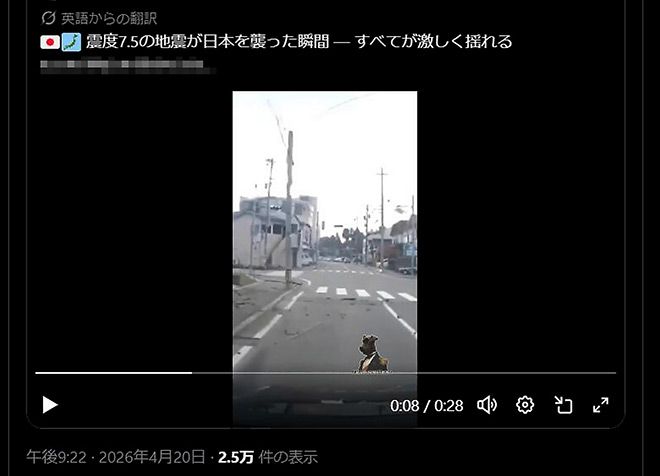
An investigation into the misleading posts revealed numerous instances of recycled footage being presented as current events. One particularly misleading post on X (formerly Twitter) showed buildings and roads violently shaking, purportedly from the recent Tohoku quake. However, verification confirmed this footage was actually from television coverage of the Noto Peninsula Earthquake that occurred on New Year’s Day 2024.
In another deceptive case, users shared video claiming to show tsunami waves from the April 20 incident, but the footage was actually from the catastrophic Great East Japan Earthquake and tsunami of 2011, an event that caused widespread devastation and led to the Fukushima nuclear disaster.
Digital forensics experts also identified artificially generated content among the misleading posts, with some videos appearing to have been created using generative artificial intelligence tools. The growing sophistication of AI technology has made it increasingly difficult for average users to distinguish between authentic disaster footage and synthetic creations.
The problem extends well beyond Japan’s borders. Analysis of the accounts spreading misinformation revealed a global network of users from South Asia, Europe, and China contributing to the information disorder. Many of these international accounts employed automatic translation functions to create Japanese-language posts, apparently attempting to reach affected populations directly.
Social media platforms TikTok and YouTube also saw similar patterns of false information spreading through their networks, demonstrating how misinformation during crisis events now flows seamlessly across multiple platforms and international boundaries.
This incident highlights the growing challenge of information verification during natural disasters, when accurate updates can be critical for public safety. The earthquake off Tohoku, a region still recovering from the devastating 2011 disaster, triggered tsunami warnings and heightened anxiety among residents, making them particularly vulnerable to misinformation.
Digital media experts note that this pattern of disaster misinformation has become increasingly common worldwide. During crises, social media algorithms often amplify emotional and shocking content regardless of accuracy, while verification processes struggle to keep pace with the volume of posts.
Japan’s communications ministry is now considering additional measures to combat disaster-related misinformation. Potential approaches include working more closely with social media platforms to expedite the removal of false content during emergencies and developing improved systems to quickly verify and promote official disaster information.
For residents in earthquake-prone Japan, the ability to distinguish between real and false information during seismic events could have life-or-death implications. Experts recommend following official government disaster agencies, established news organizations, and verified meteorological sources for reliable updates during emergencies.
The Ministry of Internal Affairs and Communications has also emphasized the importance of digital literacy education as a long-term solution to the misinformation problem, working to ensure citizens develop the critical skills needed to evaluate online sources, especially during crisis situations when accurate information is most crucial.
Fact Checker
Verify the accuracy of this article using The Disinformation Commission analysis and real-time sources.

10 Comments
The speed at which misinformation can spread online these days is really concerning, especially around sensitive events like natural disasters. It’s important for the public to be vigilant and cross-check sources before believing or sharing anything.
Absolutely. Social media platforms need to do more to combat the spread of false information, especially during crises. Fact-checking and removing misleading content should be a top priority.
Disappointing to see misinformation spreading so quickly after natural disasters. It’s crucial that people rely on official sources and verified information during emergencies. Recirculating old footage as current events is highly irresponsible.
Agreed. Fact-checking and sharing accurate, up-to-date information should be the priority, not spreading unverified content.
Recycling old footage and passing it off as current events is incredibly irresponsible. People need to be extremely cautious about the information they encounter online, especially during times of crisis. Fact-checking is essential.
Agreed. The spread of misinformation can have real, dangerous consequences, especially when it comes to natural disasters. Relying on official sources is the best way to stay informed and safe.
This is a concerning trend that highlights the need for better online moderation and fact-checking, especially during emergencies. Spreading unverified footage as current events is irresponsible and can lead to real harm.
Absolutely. We need to do more to combat the spread of misinformation, particularly around critical events like natural disasters. Relying on official government and media sources is the only way to ensure people have accurate, up-to-date information.
It’s alarming to see how quickly false information can spread, even about serious events like earthquakes. The public needs to be vigilant and verify the sources of any disaster-related content they encounter online.
This is a sobering reminder of how easily misinformation can take hold, even around serious events like earthquakes. It’s crucial that people rely on official government and media sources for accurate, up-to-date information during emergencies.