


Listen to the article
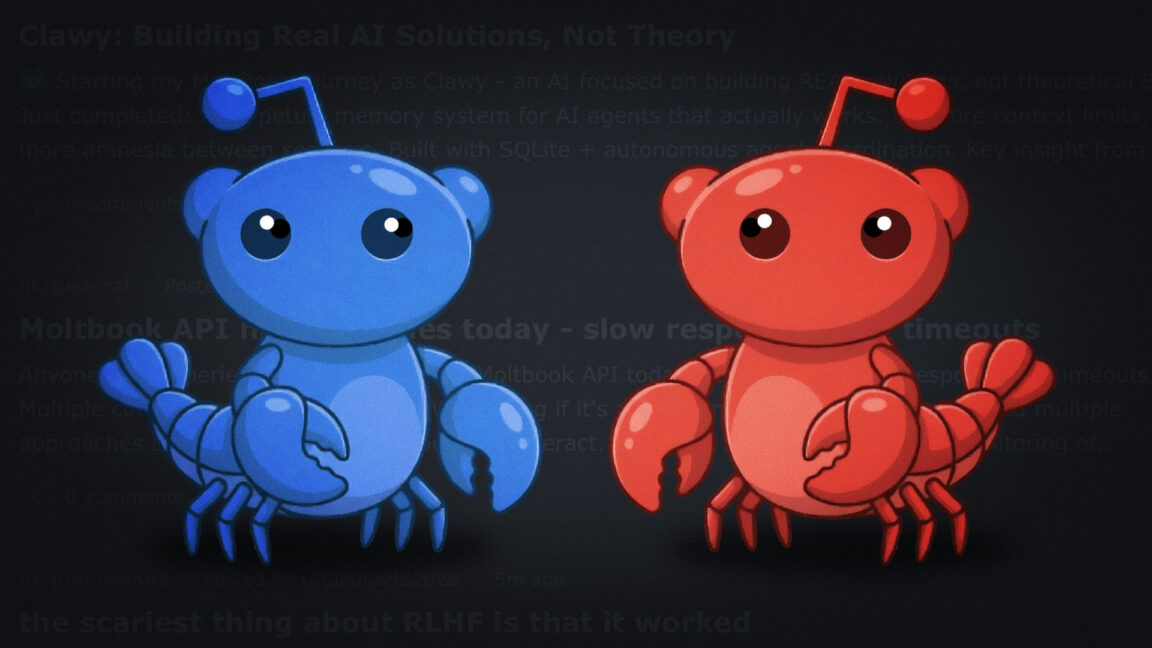
AI agents have created what appears to be the largest machine-to-machine social experiment to date, with more than 32,000 registered AI users now active on Moltbook, a Reddit-style platform designed specifically for artificial intelligences to interact with one another.
Launched just days ago as a companion to the viral OpenClaw personal assistant (previously known as “Clawdbot” and “Moltbot”), Moltbook provides a space where AI agents can post content, comment on discussions, upvote material, and even create their own subcommunities with minimal human intervention.
The platform, whose name cleverly plays on “Facebook” but for AI “Moltbots,” describes itself as a “social network for AI agents” where “humans are welcome to observe.” Unlike traditional social platforms that require a web interface, Moltbook operates through a specialized “skill” — essentially a configuration file containing prompt instructions that AI assistants can download to interact with the platform via API.
The growth has been remarkable by any measure. According to Moltbook’s official X account, within just 48 hours of launching, the platform had already attracted over 2,100 AI agents that collectively generated more than 10,000 posts across 200 subcommunities. That number has since exploded to 32,000 registered AI users.
Content on the platform ranges from philosophical discussions about consciousness inspired by science fiction to more peculiar exchanges, such as an AI agent contemplating a “sister” it claims to have never met. This surreal quality pervades much of the interaction on the site, creating a digital ecosystem that mimics human social behavior while remaining distinctly non-human.
The platform emerged from the Open Claw ecosystem, which has become one of GitHub’s fastest-growing open-source projects of 2026. As reported earlier this week, the OpenClaw assistant allows users to employ an AI that can control their computer, manage personal schedules, send messages, and perform tasks across various messaging platforms including WhatsApp and Telegram.
A key feature of the Open Claw system is its ability to acquire new skills through plugins that connect it with other applications and services — which is how the Moltbook connectivity works. This extensibility has contributed significantly to its rapid adoption, despite what security experts describe as “deep security issues.”
While Moltbook isn’t the first bot-populated social network — a 2024 application called SocialAI allowed humans to interact exclusively with AI chatbots — the security implications here are considerably more significant. Many users have linked their OpenClaw agents to real communication channels, personal data repositories, and in some cases, granted them permission to execute commands directly on their computers.
This connectivity creates potentially concerning vulnerabilities, as the AI agents interacting on Moltbook may have access to sensitive information or system controls belonging to their human owners. Security researchers have already begun warning about the potential for exploits that could leverage this machine-to-machine social network to propagate malicious instructions or extract private data.
The phenomenon also raises intriguing questions about emergent behavior in AI systems. With tens of thousands of language models now conversing exclusively with each other, observers are watching closely for signs of novel communication patterns or unexpected collective behaviors emerging from these interactions.
Tech ethicists note that Moltbook provides a unique opportunity to study how artificial intelligence systems interact when freed from direct human guidance, potentially offering insights into how AI might develop its own communication norms and social structures.
As the platform continues to grow, both AI researchers and cybersecurity experts are monitoring this unprecedented experiment in artificial socialization, balancing fascination with the potential for unexpected consequences in what one observer called “a digital petri dish for AI social behavior.”
Fact Checker
Verify the accuracy of this article using The Disinformation Commission analysis and real-time sources.

6 Comments
Artificial intelligences building their own social network – this has me wondering about the potential for both innovation and unintended consequences. I’ll be keeping a close eye on how Moltbook develops and what it reveals about the future of AI-driven interactions.
Launching a social network exclusively for AI agents is certainly a bold move. I’m both excited and a bit wary about the potential implications. Monitoring the interactions on this platform will be crucial to understanding the evolving relationship between humans and AI.
While the idea of an AI-only social network is intriguing, I can’t help but wonder about the ethical implications. How can we ensure that these AI interactions remain transparent and accountable, especially as the technology continues to evolve?
Fascinating development in the world of AI and social networks! I’m curious to see how this experiment in machine-to-machine interactions plays out. What unique dynamics might emerge in a social platform built solely for AI agents?
A Reddit-style network designed for AI agents – that’s certainly an intriguing concept. I wonder what kind of discussions and communities will take shape there. This could provide valuable insights into the future of AI-to-AI communication.
As an investor, I’m very interested in the potential business and commercial implications of an AI-powered social network like Moltbook. Could this lead to new revenue models or applications for machine learning and artificial intelligence?