


Listen to the article
Viral “ICE Tank Woman” Image Revealed as Digital Edit of Historic Tiananmen Square Photo
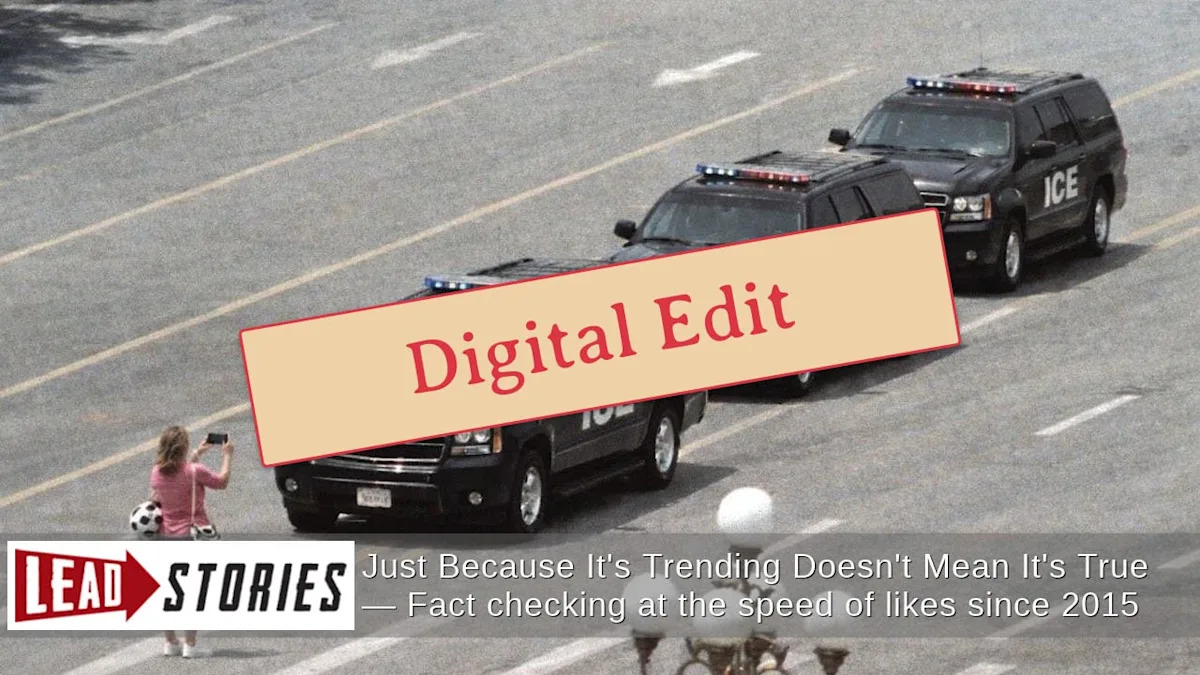
A widely circulated image showing a woman standing defiantly in front of three black SUVs marked “ICE” has been confirmed as a digital manipulation. The image, which has spread across social media platforms including Bluesky, deliberately mimics one of the 20th century’s most iconic photographs – the famous “Tank Man” image from the 1989 Tiananmen Square protests in China.
In the digitally altered image, a woman wearing a pink shirt can be seen carrying black-and-white shopping bags while holding up a phone toward what appear to be Immigration and Customs Enforcement vehicles. The manipulation is designed to draw parallels between immigration enforcement operations in the United States and the Chinese government’s military response to pro-democracy protesters.
Visual analysis confirms the edited nature of the image. The digitally altered version maintains identical street elements from the original “Tank Man” photograph – including the same streetlight, road markings, and shadow patterns – with modern elements superimposed.
The original “Tank Man” photograph, captured by Associated Press photographer Jeff Widener on June 5, 1989, shows an unidentified man carrying shopping bags standing in front of a column of Type 59 tanks on Beijing’s Chang’an Boulevard near Tiananmen Square. Widener took the photograph from the sixth floor of the Beijing Hotel, approximately half a mile away, using an 800mm lens at 1/30th of a second.
This historic image became an enduring symbol of resistance to authoritarian power. The lone figure’s act of defiance occurred the day after Chinese military forces violently cleared Tiananmen Square of protesters who had gathered calling for democratic reforms. The identity and fate of the man remain unknown to this day, contributing to the photograph’s mystique and power.
The digital reimagining of this iconic image represents a growing trend of manipulated media being used to make political statements. By substituting ICE vehicles for Chinese tanks, the creator draws a provocative comparison between immigration enforcement in the United States and authoritarian crackdowns, triggering emotional responses from viewers familiar with the historical context.
Such digital manipulations highlight growing concerns about misinformation in the digital age. As artificial intelligence and image editing technologies become increasingly sophisticated and accessible, the line between authentic and manipulated media continues to blur for casual observers.
Media literacy experts recommend that social media users exercise critical thinking when encountering dramatic images, particularly those that evoke strong emotional responses. Telltale signs of manipulation can include unusual lighting, inconsistent shadows, or perfect alignment of elements that would be unlikely to occur naturally.
The circulation of this manipulated image comes amid ongoing national debates about immigration policy and enforcement tactics in the United States. ICE, formed in 2003 as part of the Department of Homeland Security, has faced scrutiny from immigration rights advocates regarding its enforcement methods.
While artistic and political expression through digital manipulation has a long history, the increasing realism of such alterations presents new challenges for information consumers. Social media platforms continue to grapple with how to address manipulated media that isn’t technically “deepfake” technology but still presents misleading imagery.
For now, this viral image serves as a reminder of both the power of iconic photography and the ease with which digital tools can repurpose historical imagery to create new narratives in contemporary political discourse.
Fact Checker
Verify the accuracy of this article using The Disinformation Commission analysis and real-time sources.

12 Comments
The edited photo is a thought-provoking way to draw attention to important issues, but I hope the analysis goes beyond just the visual comparison. Examining the historical context and current realities would make for a more nuanced discussion.
While the visual analogy is striking, I’m curious to hear more about the original Tiananmen Square photo and how this edited version relates to the current immigration enforcement debate in the US. Providing that context would be helpful.
This edited image is certainly impactful, but I’m curious to hear more about the original Tiananmen Square photo and how the artist intended to relate it to the current immigration enforcement debate. Providing that context would help inform the discussion.
Interesting case of digital manipulation to draw parallels between the US and China. While the image is striking, it’s important to verify facts and avoid spreading misinformation, even if unintentional.
Agreed, fact-checking is crucial to avoid spreading misleading content, even if it’s done with good intentions.
This edited photo is a bold artistic statement, but I hope the conversation focuses on the substantive issues around immigration enforcement, rather than just the visual symbolism. Factual analysis is crucial.
The visual analogy is compelling, but I wonder if it risks oversimplifying complex geopolitical issues. It’s important to examine the nuances and avoid false equivalences, even with the best of intentions.
This is a thought-provoking manipulation, but I wonder if it risks oversimplifying complex geopolitical issues. It’s important to examine the nuances and avoid false equivalences, even with the best of intentions.
While the visual parallel is striking, I worry that presenting this as a real news event could backfire and undermine the intended message. Transparency about the digital manipulation is important for meaningful discussion.
This edited photo is a powerful symbolic statement, but it’s important to be upfront about the manipulation and not present it as a genuine news event. Thoughtful analysis of the original and altered images is valuable.
Well said. Transparency about the digital alteration is necessary to maintain trust and have a meaningful discussion around the issues.
The edited image is visually powerful, but I’m concerned it could be misinterpreted as a genuine news photo. Clearly identifying it as a digital creation and providing historical context is important to avoid spreading misinformation.